PART ONE OF TWO
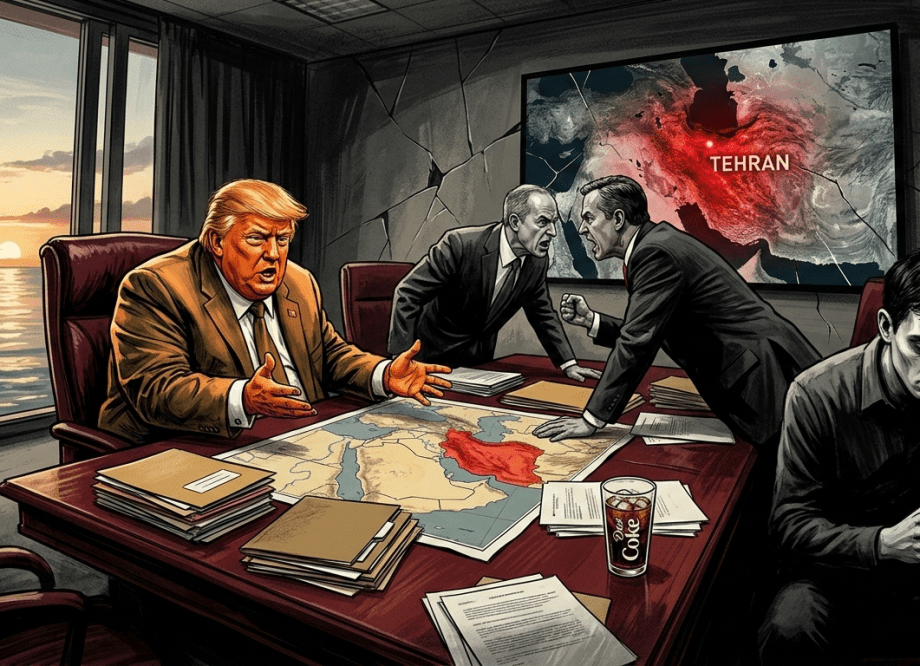
Operation Epic Fury is not just a war on Iran. It is a war inside the administration that launched it — fought across three continents before the first bomb fell on Tehran.
There is a peculiar kind of drama playing out inside the Trump Bunker of the Bizarre this week. Its theme? The accidental Armageddon. Cue bombs obliterating civilian apartments in Tehran. A US submarine sinking an Iranian frigate in the Indian Ocean. All the while, 151 fishermen are killed in the Caribbean, in 45 strikes, some in “tinnies”; some in their tiny, light, wooden boats- blown to matchsticks as a computerised guidance system worth a king’s ransom and a 450-kilogram Tomahawk missile warhead lobs out of the clouds at 800 kilometres an hour and, in an eardrum-splitting explosion, vaporises the hapless man at the tiller and his crew. Welcome to the global theatre of operations of the United States of America, 2026. No interval. No exits.
You need subtitles just to read about it. The narrative arc is impossible to follow, but picture this: a government so clueless it could not run a bath has launched the most ambitious, hugest US military operation in living memory. Napoleonic nincompoopery. Nobody can say how big, how long, or at what cost. And nobody in Team Trump can agree on why it did so, how long it will take, or what winning looks like. The Secretary of War and the Secretary of State are fit to kill each other. The Vice President, JD Vance (not his real name), a study in self-invention, self-delusion and evasion, disappears for three days. A queue of Pentagon top brass forms to quietly contradict the White House to anyone with a security clearance, a pulse, and a note-taking hand.
And that is only the military. The intelligence community’s own assessment of the threat Iran posed before the first missile fell is utterly at odds with every public justification the President of Pepsi-Cola and his sponsors have offered. This is not the fog of war. This is the fog of a government that started a war without the foggiest idea why, and is now improvising in real time, making it up as it goes along, while soldiers die and the costs tick over on the Uber Warmongers R Us meter, $891 million per day.
As Operation Epic Fury enters its second week — still sounding like one of the young prodigy Barron’s computer games — the fog is thickening into something far more toxic. An epic death wish, perhaps. Trump is drifting, publicly and unmistakably, toward a ground invasion of Iran. Boots on the ground. Iraq 2.0, complete with phantom WMDs. The populist grifter who built his political brand on ending America’s forever wars is edging toward the most catastrophic military misadventure since 2003.
But before Tehran, there was Caracas. And before Caracas, there were the fishing boats.
The Bodies in the Caribbean
The madness did not begin on 28 February 2026. It began on a September morning in 2025 when a US Navy warship put a two million dollar Tomahawk missile the size of a small aircraft into a small boat in the Caribbean Sea and killed all eleven people on board. The Trump administration called them narco-terrorists. Venezuelan authorities called some of them fishermen. The distinction has never been established in any court, because the Trump administration has not offered evidence, sought extradition, or requested a verdict. It has continued to simply kill people from the sky and post the videos on social media.
By 23 February 2026, five days before the bombs fell on Tehran, the death toll from Operation Southern Spear stood at 151 people killed in 44 strikes on 45 vessels across the Caribbean Sea and Eastern Pacific. The UN Secretary-General and the UN High Commissioner for Human Rights both declared the strikes violations of international human rights law. Legal experts said that killing the survivors of a shipwreck, which US forces did in at least two incidents, could constitute murder and a war crime.
Hegseth could be charged under the Uniform Code of Military Justice or the US War Crimes Act of 1996. Civil rights attorneys filed suit in federal court on behalf of families from Trinidad and Tobago, calling the attacks ‘premeditated and intentional killings’ that ‘simply’ constitute ‘murder, ordered at the highest levels of government.’ The Senate twice rejected resolutions to limit Trump’s authority to continue. The pattern was set.
Then came Venezuela. On 3 January 2026, in a predawn raid on Caracas, Operation Absolute Resolve, US forces bombed targets across the Venezuelan capital, captured President Nicolas Maduro, and flew him out of the country. Useful idiot, and Murdoch muppet, Trump announced the US would ‘run’ Venezuela pending a transition of power.
The raid on Caracas came as a surprise to Congress. When Pentagon policy chief Elbridge Colby was asked, under oath before the House Armed Services Committee, whether oil and gas executives had been briefed on the Iran strikes before Congress was, he did not rule it out. Two days after the Venezuela raid, Trump had confirmed he had spoken with US oil executives ‘before and after’ that operation. The Centre for International Policy has since documented this as a single arc: from the Caribbean to Caracas to Tehran, a deliberate, escalating pattern of US military force with no congressional authorisation sought at any point, accountable to no external legal authority.
Iran, in other words, was not a bolt from the blue. It is the logical destination of a doctrine established in the Caribbean fishing lanes and road-tested in the streets of Caracas. Not the Monroe Doctrine 2.0 but something far more barbaric.
The Vanishing Vice President
When Operation Epic Hubris (do they have tickets on themselves or not?) was launched in the early hours of 28 February, two happy snaps were put out by the White House. They tell the story more clearly than any press release. In the first, Donald John Trump sits in a pretend-he’s-in-charge-of-the-situation room at Mar-a-Lago, flanked by the saturnine, Secretary of State Marco Rubio and CIA Director John Ratcliffe, the men of the hour, watching history in the unmaking.
In the second, JD Vance (a name he just made up) watches the war from the White House, alongside, complete with those impossibly white teeth so essential to US public office, the almost pure vinyl, Tulsi Gabbard, “Ayatollah Tariff”, Treasury Secretary Scott Bessent, and (Negative) Energy Secretary Chris Wright. The man one heartbeat from the presidency, famously sceptical of foreign military adventurism, had been parked at the other end of Pennsylvania Avenue while his boss started a war.
He-who-claims-to-be “JD Vance” says nothing for 48 hours. It is a record. When the Incredible Sulk finally surfaces on Fox News on Monday night, his convictions are all squared away. He raves about Operation Idiocy. It is a remarkable conversion.
In 2023, as a senator, Vance endorsed Trump in a Wall Street Journal op-ed headlined ‘Trump’s best foreign policy? Not starting any wars.’ He wrote that he supported Trump specifically because ‘I know he won’t recklessly send Americans to fight wars overseas.’ That was then. Trump, in the first year of his second term, has now ordered more airstrikes than Joe Biden did in four years.
Vance’s bellicose public position and his private reservations are at war with each other. He assures Fox viewers that ‘there’s just no way Donald Trump is going to allow this country to get into a multi-year conflict with no clear end in sight.’
Trump, meanwhile, tells a CNN anchor that ‘wars can be fought forever’ until Iran offers unconditional surrender. Or hell freezes over. These are not two men singing from the same hymn sheet. They are two blokes who have not compared notes. Spoiler alert: Trump is no note-maker. There are no notes. But give him a public audience and he’ll make something up. Commander-in-Chief-as-improv.
The political stakes for Vance are impossible to miss. As frontrunner for the 2028 Republican nomination, he faces a wedge that would give any politician sleepless nights: back Trump’s war and alienate his America First, antiwar base; or hold the line and lose the president’s favour. Swami Tucker Carlson, Vance’s personal guru, calls the war ‘absolutely disgusting and evil.’ A Reuters/Ipsos poll shows 45 per cent of Republicans either oppose the war or won’t comment. A man who built his brand on being the anti-neocon, Vance now spruiks a mad, bad and dangerous war that neocons would have happily launched themselves.
Hegseth versus Rubio: The Limits of Bullshit and Bravado
The fault lines inside the Cabinet are not confined to the man-who-would-be-Vance question. Middle East Eye reports that Pete Hegseth and Marco Rubio were ‘at each other’s throats’ this week over sending ground forces into Iran, with former Fox News talking head Hegseth reportedly pushing for a ground invasion — Iraq 2.0 — while Rubio raises the trifling matter of what that adventure would cost.
The Pentagon calls the report ‘100% FAKE NEWS,’ which in the post-truth Trump era is not necessarily a denial so much as an endorsement. The State Department declines to comment. Meanwhile, you can hear the boots on the ground.
The contrast between the two men is not merely tactical. Hegseth, the Crusader-tattooed former Guantanamo Bay guard turned Secretary of War, and former Fox jockey, declared at the Pentagon podium: ‘No stupid rules of engagement, no nation-building quagmire, no democracy building exercise, no politically correct wars. We fight to win.’ Rubio, the more conventional figure, works the phones and press galleries with the language of calibrated threat management. Neither man has a clear theory of victory.
At a Pentagon press briefing, Hegseth declares that ‘this is not a so-called regime-change war, but the regime sure did change, and the world is better off for it.’ Trump, later that day, tells a CNN anchor the US is ‘knocking the crap out of them’ before segueing, effortlessly, as only Trump and perhaps Scott Morrison could, to the possible use of ground troops.
Cue boots on the ground. Pentagon Under Secretary for Policy Elbridge Colby, grilled before the House Armed Services Committee, was confronted with the unanswerable: ‘When President Trump was running for office, he said over and over and over again, I’m not going to do wars. He failed. We’re at war with Iran.’ Colby’s response, that Trump ‘sincerely meant’ his campaign promises, was so spectacularly self-undermining that a lawmaker called it ‘solid enough’ before adding there was ‘no question that he failed.’
The Intelligence Bombshell Nobody Can Explain
The most serious fracture is between the White House’s many and varied stated rationales for the war and the intelligence community’s own assessment. On 28 February, the White House told reporters Trump had authorised strikes after receiving intelligence showing Iran was preparing missile attacks on US bases that would create ‘a mass casualty situation.’ On Sunday 1 March, in a 90-minute closed-door briefing with bipartisan congressional staff, Pentagon officials acknowledged there was no intelligence suggesting Iran planned to attack US forces first. Full stop.
Senate Intelligence Committee Vice Chair Mark Warner tells CNN: ‘I saw no intelligence that Iran was on the verge of launching any kind of preemptive strike against the United States of America.’ Senator Tim Kaine is equally flat: ‘There was no imminent threat from Iran to the United States.’ But Senator Andy Kim has got Trump’s number: ‘This is an example of the president deciding what he wanted to do, and then making his administration go and find whatever argument they could make to justify it.’
Rubio’s attempt to reconstruct the imminent threat argument descended into farce. The ‘imminent threat,’ he explained, was that the US believed Israel was going to attack Iran, and if Israel attacked Iran, Iran would retaliate against US forces, so the US struck first. In other words: the administration launched a war to pre-empt an Iranian retaliation against a hypothetical Israeli attack that had not yet occurred. The Defence Intelligence Agency, meanwhile, had concluded in 2025 it would be a decade before Iran could develop ballistic missiles capable of striking the US homeland.
CNN noted that over a single week, the administration’s justifications migrated from ‘Iran has nuclear bomb-making material imminently ready,’ to ‘Iran has missiles that can reach the US homeland,’ to ‘Iran is using conventional weapons to create conditions to restart nuclear ambitions’, a sequence CNN characterised, with considerable restraint, as ‘a huge walkback.’
The Pentagon as a Black Box
What makes all of this unfathomable idiocy harder to assess is that the Pentagon, under Hegseth, has become largely opaque to the press. Six veteran military correspondents, speaking anonymously to CNN, described an information environment unlike any they had experienced. In ordinary wartime they would receive daily detailed briefings on how the conflict was evolving. Instead they are getting ‘a random tweet or video out with details’ with no capacity for follow-up questions. Virtually all operational queries are referred to the White House. ‘Most of what we gather is through leaks and Signal messaging, off the books,’ one said.
At the second Pentagon briefing, Hegseth and Chairman of the Joint Chiefs General Dan Caine delivered what CNN described as ‘almost two briefings going on simultaneously’, Hegseth’s register of dominance and triumphalism running alongside Caine’s expressions of ‘profound sadness and gratitude’ for the dead. Caine had started by saying the deaths deserved every word of coverage they received. Hegseth had charged that the press was covering casualties to ‘make the president look bad.’ There, in one podium and two microphones, is the administration’s war with itself made visible.
Success has many fathers. Yet Operation Epic Fury has many authors. Benjamin Mileikowsky, the man who calls himself “Netanyahu” and “bone-saw” Mohammed bin Salman lobbied for it, repeatedly and persistently, with the Saudi crown prince reportedly making multiple phone calls urging Trump to strike.
The Centre for International Policy notes what connects Venezuela, the Caribbean, and Iran: the deliberate, escalating construction of a new operational norm in which the most militarily powerful state on earth reserves to itself the right to use lethal force anywhere, against anyone, for purposes it defines unilaterally, accountable to no external legal authority.
The war-the-Trump-administration-cannot-agree-on-why-it-started-it is proceeding, at $891 million a day, toward an end that none of its architects dare name, save for the one who gets a fair mention in The Epstein Files, the Pandora’s Box of all time.
”We’ll see what happens,” Trump says, ever the elder statesman, a modern Demosthenes, the man with a plan that turns out to be “whatever it takes’ provides it serves his self-interest, a Leader of the Free World, for a post truth and ever-rapidly post-reason age, where barbarism rules.
An inept grifter, imposter and inveterate liar, the epitome of the actor in bad faith, Trumpt the man-child is, fittingly, perhaps, keeper of the nuclear codes, the increasingly senescent, narcopletpic, narcissicist who has what it takes to lead us all into oblivion.
In Part Two: why that end may require something nobody in Washington (except the man who proves you can take the man out of Fox but you can never take the Fox out of the man-Pete Hegseth) appears to want. Desperately.
 Urban Wronski Writes
urbanwronski liked your comment on Trump’s Team at War With Itself.
Any reason why the comment of mine which you endorsed has now been disappeared down the Memory Hole, along with others?
Are you being pressured by the usual suspects.
LikeLike