Truth is the first casualty of war, of course but there is one term in the lexicon of modern warfare, a liar’s bible, an ever-expanding dictionary of deception, a corporate-speak all set up to launder war’s obscenity that is so obscene that most Australians would never really heed, if they heard it all.
It is the “double tap.”
The “double tap”, which sounds like your pet kitten, waking you up playfully from your sleep, works like this: you bomb your target, a fishing boat, a hospital or a primary school, for example, and you call it “kinetic geometry”.
You wait. Instead of reporting that “we just bombed a school,” your Department of War officials, experts in war-jargonese, refer, instead to “expanding the kinetic geometry.” Now an act of war so monstrous that it beggars belief, is diminished to a mere problem in Euclidean Geometry, perhaps, lines on a map intersecting, rather than metal tearing through a prayer hall. Or some innocent young girl’s soft, utterly vulnerable body.
It suggests that a seven-year-old crushed to death is simply a by-product of an adjusted angle.
Then, as the pitifully few survivors crawl, bruised, bleeding and broken, perhaps, from in between massive slabs of shattered ferro-cement; or those outside at the time or in a reinforced corner, miraculously spared from the explosion of their innocent, joyous and hitherto peaceful lives, you strike again.
As shocked, terrified and tearful teachers gather children who are still breathing, as parents sprint toward the acrid, oily, smoke, as paramedics pull on gloves, you bomb the school again.
The second strike is an act of desperate and utter depravity; it is aimed not at the original target. It is aimed at the living, the “first responders”. At the helpers. The head-teacher gathering her brood. At anyone foolish enough to believe the worst is over.
The Double Tap, is without doubt, ambiguity, nuance or legal quibbling, a war crime, if not a crime against humanity. It violates Additional Protocol I of the Geneva Conventions, which prohibits attacks on medical personnel and deliberate targeting of civilians.
Under the Geneva Conventions and additional protocols, the “Double Tap” strike often violates several fundamental principles of armed conflict:
Perfidy/Treachery: Using the expectation of humanitarian aid to lure more people into a strike zone is seen as a betrayal of the basic rules of war.
Targeting Non-Combatants: First responders (paramedics, fire-fighters, and civilians) are protected under international law. Deliberately targeting them is a direct violation.
The Principle of Distinction: Belligerents must distinguish between combatants and civilians. Once a person is “hors de combat” (out of the fight due to injury), targeting them further is prohibited.
The Double Tap, much like the rest of Donald Trump’s foreign policy has been condemned by human rights organisations on every continent. And it is being used right now, in Iran, by the United States and Israel, with the quiet, craven blessing of our own federal government.
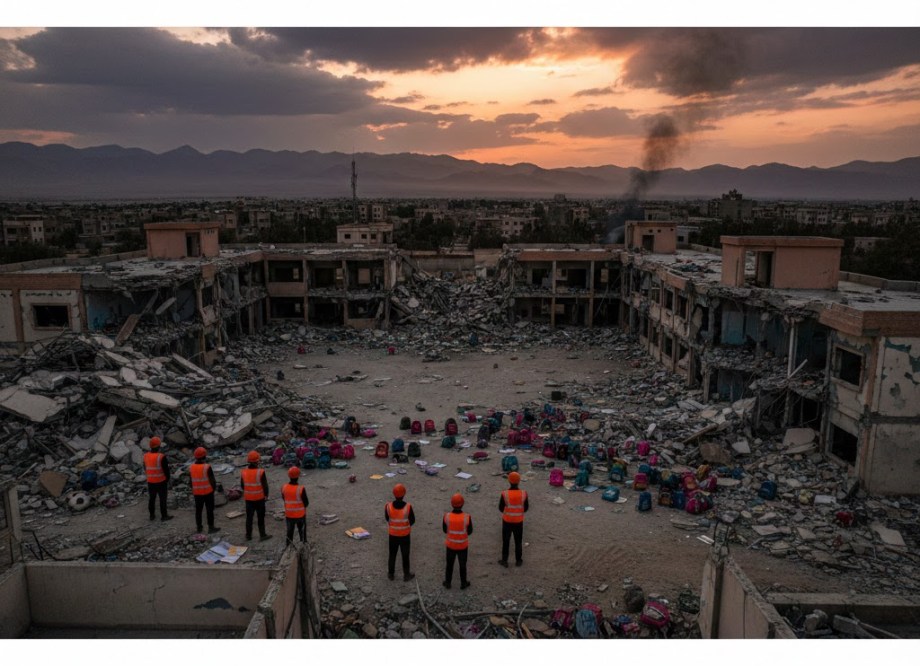
It is impossible to picture exactly what happened but here is some of what we know took place at the Shajareh Tayyebeh girls’ elementary school in Minab, in southern Iran’s Hormozgan province, on the morning of Saturday, 28 February 2026, the first day of Operation Epic Fury.
Epic? US military campaigns, themselves are named in a fit of deluded grandiosity; hubristic to the point of self-parody, another language entirely to the language of missile “strikes”. Operation Epic Fury is a purple patch in anyone’s reckoning but it speaks to a truth which cannot be got around. There are those who would glorify war. The same neocon hawks that dictated the US’ illegal Iraq invasion, in 2003, are back in power.
Or their successors. And right at this moment they are in charge of the world’s most powerful war machine.
Saturday is the beginning of the Iranian working week. The bell has just rung and corridors are crowded with young children moving to class for the second period of the school day. The building is packed. Girls aged seven to twelve were making their way to class. A few boys also attend.
Then the Tomahawk strikes. The building shakes and buckles. Site photographs show the massive slabs of concrete that crushed so many slender, unprotected children’s bodies. But nothing captures the sound.
The “Whistle-to-Roar” (0.5 Seconds Before Impact)
Unlike a falling mortar shell that whistles for several seconds, a Tomahawk is powered by a small jet engine. Survivors describe a low-pitched, mechanical growl that rapidly rises into a high-frequency scream It sounds like a passenger jet flying incredibly low—except it’s accelerating. It is the sound of thousands of pounds of metal tearing through the air at 800 kilometres per hour.
The Initial “Crack” (The Instant of Impact)
This is the sound of the 1500 kilogram missile casing hitting the building before the explosives detonate. Imagine a sharp, metallic “clack” or “crack,” like a sledgehammer hitting an anvil. Amplify a thousand times Then there is the sound of the kinetic energy being transferred. In the Minab school, this was the sound of the structural pillars shattering.
The “Double-Thump” (The Explosion)
A 450 kilogram warhead creates a massive overpressure wave. A deep, chest-crushing “THOOMP” that feels more like a physical blow than a noise. For those close to the strike, the sound is often described as silence. The pressure is so high it instantly ruptures eardrums or “overloads” the auditory nerve. You don’t hear the explosion with your ears; you “hear” it with your bones Because the Tomahawk is so heavy, the explosion is often followed by a rumbling, grinding sound—the “pancaking” of the building’s concrete floors.
The “Lexicon of Lies” Echo
In military reports, this sound is called an “Acoustic Signature.” To the girls in the prayer hall, it was the sound of the world being “erased.” Immediately following the blast, there is a “dead air” period, a haunting silence where the dust is so thick it actually muffles sound. Then, the high-pitched ringing of tinnitus sets in, followed by the first screams.
Miraculously seventy to a hundred children survive the initial, missile blast.
One teacher and the school principal gathered as many children as they could and herded them into the prayer hall. The principal rang parents. Come now, she told them. Come and get your children.
Then the second missile hits.
The First Strike (The “Breacher”) is believed to have been a Tomahawk Land Attack Missile (TLAM) or a Black Sparrow air-launched ballistic missile. A heavy, long-range weapon, it is designed to level entire buildings. Its warhead, alone, weighs 454 kilograms. Yet it is precise. In military circles, the Tomahawk is famous for its “through the window” capability. Using DSMAC (Digital Scene Matching Area Correlation), the missile takes a real-time photo of the target as it approaches and compares it to a stored satellite image.
If it’s off by even a few feet, it adjusts its fins to steer itself back on course.
Yet it has been claimed that the missile was meant for the nearby Asif Missile Group headquarters (an IRGC naval base), but it struck the school building instead, causing massive structural damage. It is more likely that the school was targeted by those who chose the same moment to assassinate as many government leaders as it could manage.
Given that the attack coincides with the assassination of the Iranian leader, Ayatollah Ali Khamenei, it is likely that the architects of the missile strike sought to provoke what is left of Iran’s complex leadership, designed to survive “decapitation” with its built-in resilience, duplication and reticulated redundancy.
“The principal called the parents and told them to come and pick up their children,” one of two Iranian Red Crescent Society paramedics tells Middle East Eye, speaking anonymously. “But the second bomb hit that area as well. Only a small number of those who had taken shelter survived.”
A staff member, also speaking to Middle East Eye, describes arriving at the school. She says she had watched those girls playing in the yard every day. Now she saw their bodies lying on classroom benches and in different corners of the building. “I felt like I had gone mute,” she says.
“I couldn’t speak. You could hear the sound of children crying and screaming.”
Between 165 and 180 people were killed in the Minab strike, almost all of them girls between seven and twelve years old. The morgues of Minab were overwhelmed. Bodies were held in refrigerated trucks. Sixty-nine of the dead could not be identified and their remains were sent for DNA testing.
On 3 March, excavators dug rows of small graves at a mass burial site eight kilometres from the school. Thousands filled the streets to carry the coffins. One mother held up a photograph of her daughter and called it, with terrible precision, “a document of American crimes.”
The school massacre was not an isolated event. At Tehran’s Niloofar Square on the Sunday evening of 1 March, families had gathered to break their Ramadan fast. A café, a square, an ordinary evening. “Suddenly there was the noise and explosion,” one survivor told Drop Site News. A double-tap strike killed more than twenty civilians there as well.
The Iranian Red Crescent was so alarmed by the pattern that its spokesperson issued a public warning: “We beg the public: do not rush to bombed areas. The first moments after an explosion are the most dangerous, some munitions are programmed to detonate again, turning rescuers and survivors into additional victims.”
Is this Epic Fury’s epitaph? An emergency services organisation has to warn civilians not to help the wounded, because the people dropping the bombs were specifically targeting those who came to help.
The double tap is not a rogue tactic born of battlefield chaos. It is a deliberate doctrine with a long American pedigree. The Grdelica bridge bombing in Yugoslavia in April 1999, when a passenger train was hit a second time as it crossed the wreckage of the first strike. The March 2019 drone strike in Deir Ezzor, Syria, which killed scores of civilians alongside the intended targets.
The April 2025 massacre at Ras Isa port in Yemen, where 84 civilians were killed in sequential strikes. Israel has deployed it repeatedly in Gaza; at Nasser Hospital, where more than twenty people including five journalists were killed; at the so-called “safe zone” in al-Mawasi, where more than ninety people died in a July 2024 attack.
The logic is maximal attrition. Don’t just destroy your target. Kill the memory of it, the infrastructure of response, the human instinct to help. Make the rescue itself a death sentence.
Break not just bodies but the will to bear witness.
US Defense Secretary Pete Hegseth, a man who oversees a military that has killed more than 400,000 civilians in its twenty-first century wars according to Brown University’s Costs of War Project, tells reporters:
“Of course, we never target civilians.” Secretary of State Marco Rubio adds that “clearly, the United States would not deliberately target a school.”
These are men who have described their own rules of engagement as “no stupid rules… no politically correct wars. We fight to win.”
Both statements cannot be true. Choose one.
The UN Special Rapporteur on counterterrorism, Ben Saul, did not mince his words. The strikes, he told Al Jazeera, constituted “the international crime of aggression.” An international law expert at the University of Manchester noted there was no evidence of an imminent threat, making the entire campaign a pre-emptive war, illegal under the UN Charter. The UN Secretary-General Antonio Guterres condemned the strikes as squandering every diplomatic opening that existed. Oman’s Foreign Minister had said, barely a week before the bombs fell, that a peace deal was “within our reach.”
Trump’s response to the concept of international law: “I don’t need it.”
Now for the question that should be burning a hole through every front page in this country, and is not: where is Australia in all of this?
The answer, which our government would prefer you not dwell on, is that we are in it up to our necks.
Pine Gap, the joint intelligence facility outside Alice Springs that successive governments have described with studied vagueness as a “communications station,” is an integral component of the US kill chain. It collects satellite intelligence across the Middle East. It provides targeting data. It was used during Operation Midnight Hammer in June 2025, when B-2 stealth bombers struck Iranian nuclear facilities.
It is almost certainly being used now. Australian personnel operate it. Australian sovereignty is pledged to its protection. Australian silence is its price of admission.
When the bombs began falling on 28 February, Prime Minister Anthony Albanese issued a statement of support within three hours, one of the first world leaders to do so, before most Americans were even awake. He and Foreign Minister, Senator Penny Wong declared that the world would “not mourn” Ayatollah Khamenei. Richard Marles, when asked whether the war was legal, responds that the legality is “a matter for the United States and Israel to go through.” Not for us. Nothing to do with us. Eyes front, mouths shut.
On Monday, a Coalition motion explicitly supporting the war passed parliament with Labor and One Nation voting together.
In the Senate, Greens Senator David Shoebridge voices what the major parties will not say:
“Pine Gap runs as an integral part of the US global war-making machine, and Pine Gap is being used right now to target bombs and killing in Iran. Anything the government says to the contrary of that is a plain, bold-faced lie.”
He notes that scores of Australians are currently serving on US nuclear submarines, including ones engaged in missile strikes on Iran. Greens Leader Senator Waters demands that Labor confirm no Pine Gap intelligence was used in the strikes and rule out its use going forward.
No such confirmation was given. No such ruling was forthcoming.
The Greens are the only party in parliament saying what every independent legal expert, every credible analyst and every honest reading of the facts confirms: this is an illegal war, Australia is a participant, and the government is treating the public like mushrooms.
Crikey put it plainly: Albanese and Wong “obsessively talk about international law, but go silent when Israel and the US breach it.” When Russia bombs Ukrainian civilians, Wong calls it illegal. Clearly. Loudly. Correctly. When the US bombs a school full of girls in southern Iran, the legality is “a matter for those directly involved.” The hypocrisy is not just embarrassing. It is a confession.
Defenders of this position, and there are plenty of them in the press gallery, will say that small powers have limited options, that the alliance requires solidarity, that speaking out would damage our security guarantees. This is the argument that has been used to excuse every act of Australian moral abdication since Vietnam.
It did not hold then. It does not hold now.
The question is not whether we can stop the war. We cannot. The question is whether we say, as a nation that claims to believe in international law, that bombing a prayer hall full of seven-year-olds is something we support. That targeting the people who come to help the dying is something we endorse. That providing the targeting data that guides these missiles to their destinations is something we are comfortable calling, in Albanese’s words, “standing with the brave people of Iran.”
The IRCS spokesperson’s warning to civilians, do not rush to bombed areas, is the most damning indictment of what is being done. A nation’s emergency services, warning its people that mercy itself has been weaponised against them. That compassion carries a death sentence. That to help is to die.
This is what Australia is endorsing with its silence. This is what Pine Gap is helping to make possible. This is the cost of being, as we so proudly describe ourselves, America’s most trusted ally.
The double tap. Remember the term. Because if we keep this up, history will use it to describe us too.
 Urban Wronski Writes
All Americans should read this
LikeLike
I am ashamed to be a part of a country which, by its governments silence, is complicit in promoting acts which are in direct contravention of established international law. As a lawyer I condemn it. As a humanist, I grieve it.
LikeLiked by 1 person
And for Albo and Marles saying no Australian sailors were involved in the Submarine strike. As if they retired to their Cabn to read a book. They must think we are Stupid.
LikeLike
Not new, the US and Israeli ‘double tap’ tactic has been used by their peer, Putin’s Russia which has cynically and cold bloodedly used the same vs Ukraine civilians.
LikeLike