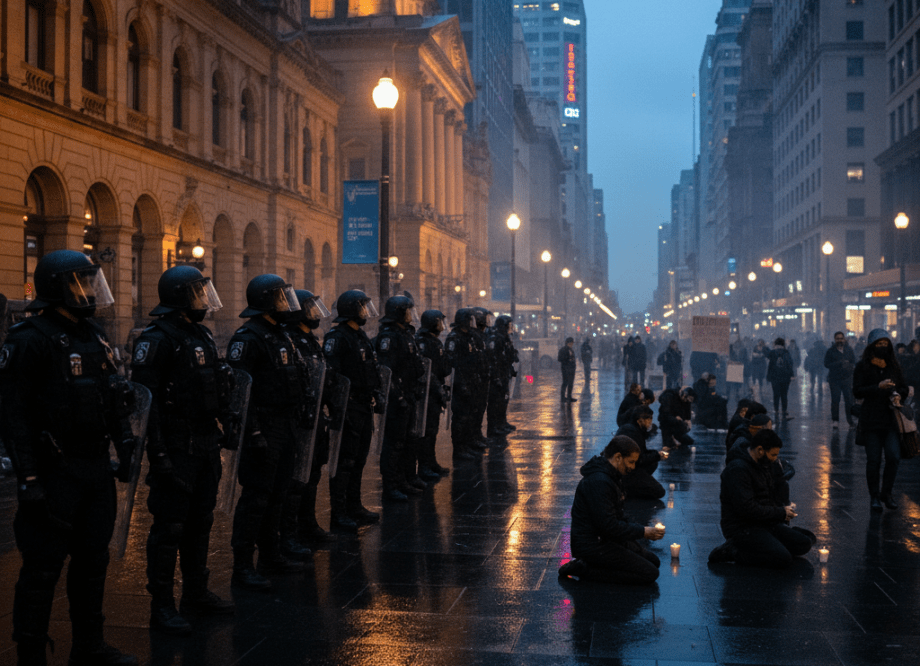
The summer evening of December 14, 2025, began in the soft, amber glow of Hanukkah candles at Archer Park. It ended in the staccato rattle of rifle fire and the scent of sea spray mixed with shotgun powder. Fifteen lives were extinguished by Sajid and Naveed Akram; a night that exposed not only the fragility of security, but the deeper frailty of Australia’s political imagination.
In the wake of that horror, the Albanese and Minns governments promised resolve. What they delivered instead was the familiar choreography of risk-aversion: the committees, the taskforces, the talking-points, and finally, a version of the old dingo fence. What began as an act of collective grief has metastasised into a tinpot tyranny, a prison guard or police patrol’s vision of order.
From Public Grief to Private Fear
By February, that perimeter has hardened into a siege. Sydney’s once open streets have become the staging ground of a security politics that no one voted for. The images from Town Hall; men dragged from prayer mats, Greens MP Abigail Boyd coughing through pepper spray—belong to a country that has quietly rewritten its own story of tolerance. A pluralist democracy does not kneel beneath its police lines for long without losing something essential.
The truth is simpler and harder: we have allowed fear, dressed in the high-vis vest of “public order,” to set the terms of our morality, proscribe our speech, define the living sinews of our commonwealth.
The Invisible, Myopic Pragmatists
Who, then, is running this show? Increasingly it seems to be the invisible, myopic pragmatists; those faceless avatars of modern Labor who mistake managerial caution for moral intelligence. This is the small-target governance of realpolitik, the gutless risk-avoidance that flatters itself as prudence. Yet it turns out to be a type of costly false economy; in the refusal to confront or even name the deeper moral crises beneath Australian politics; it proves a costly wrong, right turn.
Labor still governs as if haunted by ghosts: of Murdoch’s tabloids, of Trump’s shadow, of talkback nationalism. So fearful of offending the pro-Israel lobby or a resurgent Washington, they have allowed Australia’s political stage to be colonised by a foreign narrative. It is one thing to host Isaac Herzog on a “healing tour.” It is another to pretend that such theatre constitutes diplomacy while Gaza still smoulders and UN inquiries speak of mass dispossession.
Under the banner of “social cohesion,” the government has transformed mourning into a managed event and dissent into security risk.
The Ritual of Control
January’s Combatting Antisemitism, Hate and Extremism Act is the latest iteration of this logic; a law that inflates “incitement” until speech itself becomes suspect. Under the euphemism of protection, dissent becomes pathology. This is governance as theatre: motion without moral movement, legislative vigour masking ethical paralysis.
Paul Keating warned of the “instant band-aid”—politics mistaking activity for achievement. The current government has perfected the art. It calls Parliament to ban protest chants overnight, but remains paralysed before the “recreational hunting” loopholes that armed the Akrams. You can now go to prison for carrying a certain flag, but not for stockpiling a .308 rifle under the name of sport.
The Day of Kettling
And so came February 9, the day that Albanese and Minns kettled not only citizens, but independence of mind itself. In those 24 hours, freedom of expression was pinned beneath riot shields, freedom of association shoved into police vans, and the rights of conscience, democracy, and common decency were trampled into the wet asphalt of George Street.
Australia has always prided itself on a kind of decent moderation; the belief that even in our disputes, there existed a shared moral floor. What unfolded yesterday suggests that floor has given way. The government’s instinctive use of force against non-violence didn’t merely reveal insecurity—it revealed contempt. For protest, for plurality, and for the ordinary intelligence of the public.
History will not remember this as a day of security. It will remember it as a day of surrender; the moment when a Labor government, raised on the language of solidarity, chose the comfort of coercion over the courage of care.
The Moral Reckoning
We are witnessing the normalisation of the riot shield as a symbol of civic order, a transformation as swift as it is insidious. When a government greets a vigil with chemicals and batons, it is not protecting its people. It is protecting itself.
True cohesion is never policed; it is nurtured. It grows when governments address inequality rather than manage optics, when they embrace dissent as a sign of health, not heresy. It exists in the old Australian compact between decency and fairness; an agreement far older than Parliament and infinitely more fragile.
Labor, if it still remembers, must left heel; breaking from the intellectual, moral and spiritual shipwreck of the Shoppies bloc and return to its real heritage: the workers and communities who built a nation out of solidarity, common care, and the stubborn conviction that a free people stand tallest when they stand together.
Until then, we remain a country barricaded from itself.
 Urban Wronski Writes
According to footage transmitted to my TV, yesterday, 10/02, a new type of animal breed was spat up against a wall, somewhere in Sydney and hatched by the sun. Let’s call them Minn’s Goons, shall we? Among their skills appears to be kidney punching, as well as disabling victims with pepper spray.
Minns must be very proud of his band of fear mongering, low-life critters. I do hope his pride sticks with him as the next NSW election allows him to retire to their underground abode.
LikeLike
The pissant platitudes of dinkum blokes (no sheilas?) committed to a fair go was never true of this country – fables constructed out of whole cloth by .
From Dispossession by a brutalised convict colony under the martial “Law” of the Rum Corps (fewer than 500 until their coup was crushed by fresh British troops), the poltroonery of Eureka, Lambing Flat 5yrs later and a squatocracy yearning to bunyip aristocracy was halted by the Shearers’ Strike in 1891 and the 1906 Harvester case the social divisions, little different from the ‘Mother’ country’s class stratification. have been fixed in aspic,
The moral malaise, political pusillanimity and intellectual vacuum outlined above is not new – the Springbok tours 1971-81 anyone?
Have we so quickly forgotten the 2007 APEC conference and another freshly elected ‘Labor’ Premier Morris Iemma with the Ring of Steel (breezily breached by the Chaser lads) – which included all the usual toys that go bang, Black Hawks overhead and rooftop snipes?
The equally freshly minted NSW Police Commissioner Andrew ‘Mighty Mouth…sorry, Mouse’ Scipione (career desk jockey, Special Crimes and later Internal Affairs – always a bad CV) ordered a half milljon dollar water cannon.
Afterwards, resplendent in his bemedalled XXXS uniform, and visibly upset at not being able to create a reason to use – the usual thuggish robocop provocations notwithstanding, quote “…that’s how we ‘do business’ in NSW Police…”- he had to make do with warning that the Chaser team were “lucky not to have been taken out by the deployed snipers”.
This was when Mad Monk blustered about ‘shirt fronting Putin’ and grovelled instead with a shit eating grin.
IOW, politicians who fund & urge on uniformed thugs with badges, guns & all the military paraphernalia that is now the norm is NOT a bug but a feature of a diseased body politic.
PS Anyone notice the very distinct personnel involved on that shameful Monday night at Sydney Town Hall?
Apart from the particularly fat officer who specialised in barrages of kidney punches on unresisting and/or prone citizens already under half a dozen officers who then moved back to find new victims then were about a dozen who looked as if they’d been cloned in Petri dishes and grown in pods – same build & complexions, identical pencil ‘tashes and arrayed as one normally sees in the black stubbies, tight bulging tees and shades, (most recently outside NSW Parliament – auditioning?) whenever there is a need for agent provocateurs.
LikeLike
Amphibious, you are spot on. You’re spot on; the “fair go” myth was never more than a story Australia told itself to paper over dispossession and deep class divides. The folklore of “dinkum blokes” masks a lineage of state-sanctioned violence; from the Rum Corps and Eureka’s self-mythologising to the shearers’ strikes, the Springbok tours and APEC’s “Ring of Steel.”
The continuity you point out is the real indictment: authority here has always preferred coercion over conscience, spectacle over accountability. Those uniforms and weapons aren’t accidents of modern policing; they’re heirlooms of a nation founded by force and sustained by denial.
What we call a “crisis” of politics or morals is, as you imply, really the system working as designed — hierarchical, punitive, and allergic to dissent.
LikeLike
So many true believers have turned their back on Labor after this. One can see a huge swing to the Greens and Teals next NSW Election and Federal. I myself a Labor supporter almost forever. I have gone Green and a delicate shade of Teal. The two major parties have shit in their own bed, and the stink is vile. No Notion party will pick up some votes but not enough to be of any consequence. Could be a interesting few years coming up. Hopefully not political paralysis from the Greens or the cross bench if they gain a majority.
The only way Labor can save the furniture now is to bring in all the taxation reforms that are needed. And the Social Security updates to Unemployment, Pensions,Housing,Health. Otherwise the 94 seat majority blown in just 1 term.
What were they, and Albo thinking.
LikeLiked by 1 person
I have suggested that Sydney has become Minnsiapolis.
LikeLiked by 1 person