The Corporate Insiders on the RBA Board and How to Break Their Grip
Philip Lowe may have tip-toed into a cushy retirement among the well-clipped hedges and manicured lawns of leafy Randwick, but his RBA lives on, as tone-deaf and class-aligned as ever. The immortal former governor, who once blithely suggested Australians should “share dwellings” or “live with their parents” as housing costs spiralled out of control, walked away with a salary of a cool million dollars a year, plus superannuation. Now he’s a king-pin in Australia’s interlocking wealth-extracting factories.
Bourse Whisperer Lowe didn’t retire. He ascended, into a plutocratic afterlife where his RBA legacy lives on, not as a cautionary tale, but as a blueprint. From Future Generation’s wealth-laundering ‘philanthropy’ to the Business Council’s corporate wish lists, Lowe’s post-RBA gigs reveal the truth: Australia’s economic elite doesn’t just influence policy. It is the policy.
Meanwhile, the average punter is left grappling with mortgage stress, soaring rents, and wages that have not budged in a decade. Lowe’s whopping golden parachute is more than just a personal embarrassment. It is a perfect metaphor for the RBA’s role in the Australian economy: a mechanism for transferring wealth upward, insulating the powerful, and punishing the vulnerable. And despite Labor’s much-touted “reforms,” the board remains what it has always been: a who’s who of corporate and banking elites, ensuring the game stays rigged in favour of those who already hold the cards.
The Board: A Revolving Door for the Powerful
From March 2025, the RBA underwent its most significant structural overhaul in decades. The old single-board system was replaced with three separate boards: the Monetary Policy Board, the Payments System Board, and the Governance Board. On paper, this looks like progress. The government sold it as a way to bring “greater expertise” and “reduced groupthink” to monetary policy. But scratch beneath the surface, and the reality is far less reassuring.
The Monetary Policy Board, now solely responsible for setting interest rates, still includes the Treasury Secretary and six so-called “external” members. We are assured these members are “independent,” drawn from outside the RBA’s ranks. Yet, as always, the devil is in the detail.
These “independent” appointees are often cut from the same cloth: former bankers, corporate directors, and economists whose careers have been built within the very business establishment they are supposed to oversee. The Governance Board, meant to oversee the RBA’s operations and drive “cultural change,” is similarly stacked with insiders.
As Richard Denniss from the Australia Institute has long argued, this is not a bug in the system. It is the design.
The result is a boardroom where the interests of the “Top End of Town” are baked into every decision. The RBA’s structure ensures that monetary policy serves those who already hold power: investors, bankers, and the CEO class. And when the bank’s policies crush households under the weight of mortgage repayments or suppress wage growth, it is not an accident. It is the system working exactly as intended.
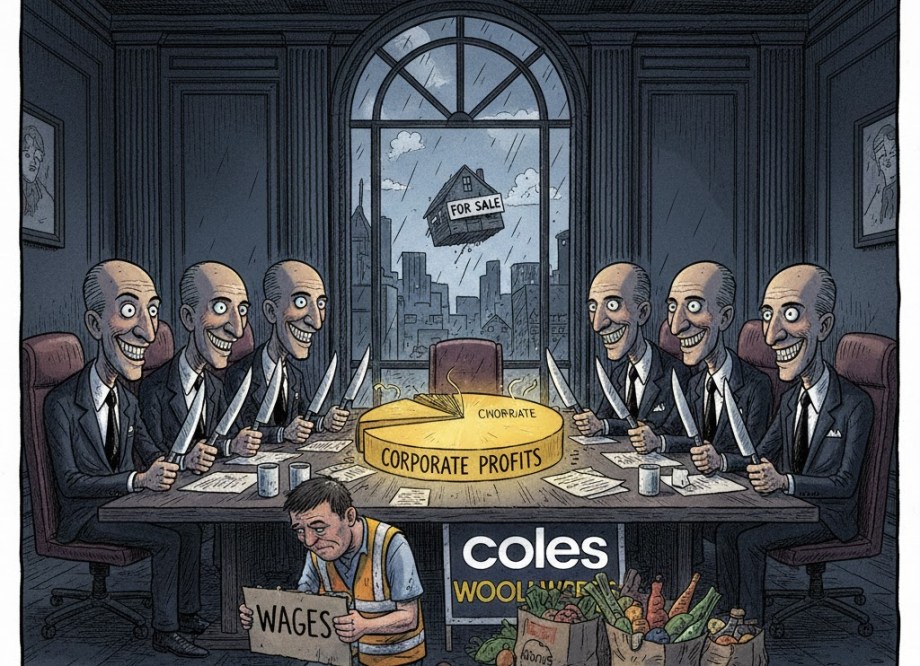
Consider the numbers. In 2023, corporate profits surged by 18 percent, while real wages grew by just 1.2 percent. The RBA’s response? Twelve interest rate hikes in eighteen months, crushing households while leaving price-gouging monopolies untouched. The bank’s “independence” is a myth. Its real role is to punish workers for corporate greed, all while maintaining the illusion of technocratic neutrality.
The Language of Power: How the RBA Speaks in Code and the Media Obliges
The RBA does not just wield power through policy; it wields it through language. Its public statements are a masterclass in mandarin obfuscation, a dialect of such studied blandness that it borders on gaslighting. Every utterance is an exercise in performative caution, where the subtext is always: We must not frighten the horses. Yet the effect is the opposite. By cloaking its intentions in layers of bureaucratic euphemism, the bank ensures that every syllable is parsed, dissected, and crucially amplified into panic by a media ecosystem that thrives on manufactured crisis.
Take the RBA’s May 2025 post-meeting statement, where Governor Michele Bullock described the board’s outlook as “highly uncertain” and noted that “further tightening of monetary policy may be required” to tame inflation. The actual policy shift? A pause in rate hikes. Yet within hours, the Australian Financial Review blared: RBA Warns of Pain Ahead: Mortgage Holders Face Brutal Rate Shock, while News Corp tabloids screamed about “looming financial Armageddon” for families. The RBA’s language, deliberately vague, hedged with caveats, had been weaponised into clickbait terror. The bank’s governors know exactly what they are doing. By speaking in code, they ensure the press gallery decodes it in the most extreme terms, lighting the touchpaper for a cycle of speculation that benefits no one but the financial class.
This is not incompetence. It is strategy. The RBA’s mandarin prose—its “balanced risks,” “cautious optimism,” and “data-dependent approach”, is not designed to inform. It is designed to obscure responsibility. When the bank warns of “challenges ahead,” it is not a forecast; it is a disclaimer, a way to shift blame onto “external factors” when its policies crush households. When it calls for “prudent fiscal management,” it is not economics; it is moralising, a dog-whistle to the LNP and the commentariat that any spending on social goods is “reckless.” And when it urges “patience” from wage-earners, it is not advice; it is a threat: Know your place.
The press gallery plays along because the RBA’s coded language gives them something to decode, and in the process, they grant the bank an aura of omniscience it has not earned. The Governor’s statements are treated like Delphic pronouncements, even as the bank’s forecasts miss the mark again and again. (Remember Lowe’s 2021 assurance that rates would not rise until 2024? Or his 2022 claim that inflation was “transitory”?)
The RBA’s real power is not in setting interest rates. It is in setting the terms of the debate, ensuring that every economic discussion starts from its premises: that wages are dangerous, that debt is sinful, and that the only “responsible” path is the one that keeps workers in their place.
And so the cycle continues. The RBA speaks in fifty shades of bland. The media translates it into shock and awe. And the rest of us? We are left paying the price.
The Household Budget Myth: A Weapon of Class War
The RBA’s most dangerous lie is not about inflation. It is about how money works. For four decades, the Liberal-National Party has sold Australians a fairy tale: managing the economy is like balancing a household budget. John Howard weaponised this analogy in the 1980s to justify austerity. Peter Costello turned it into a moral crusade in the 2000s. Scott Morrison wielded it like a cudgel to block pandemic support. The myth is simple, seductive, and utterly false.
A sovereign government is not a household. It issues its own currency. When it “borrows,” it is not maxing out a credit card. It is investing in the future; schools, hospitals, renewable energy, while private debt, like your mortgage, is the real millstone around the neck of the economy. Yet the RBA, the Treasury, and the Murdochs repeat the lie because it is the perfect smokescreen. It turns economics into morality, framing public spending as “reckless” and corporate tax cuts as “responsible.”
The numbers expose the con. Under Howard and Morrison, public debt as a share of GDP was higher than under Hawke, Keating, or Rudd. Yet the LNP’s “debt truck” only rolled out for Labor. The RBA’s complicity? Silence. While Coles and Woolworths posted record profits and energy companies price-gouged with impunity, the bank hiked rates twelve times in eighteen months. This is not incompetence. It is class warfare by spreadsheet.
The “household budget” myth ensures that when crises hit, the bill goes to workers, not the bosses. It is why public housing waitlists stretch for years, universities are starved of funding, and wages stagnate; all while the RBA clucks about “fiscal discipline.”
The bank does not just enable this. It enforces it.
The RBA as a Wealth Transfer Machine
The numbers are confronting. As of 2024, the top 20 percent of households control 62 percent of the nation’s net wealth. The bottom 20 percent? Just 1 percent. Since the 1990s, the share of national income going to workers has plummeted from 58 percent to 50 percent, while corporate profits’ share has surged from 22 percent to 30 percent. That is a direct transfer of 200 billion dollars annually from labour to capital. The Australia Institute’s research is damning: wealth inequality here is worse than in the US, with the top 1 percent owning more than the bottom 70 percent combined.
This is not an accident. It is the RBA’s core function. The bank’s theory, that inflation is driven by “excessive” wage growth, is a 40-year-old neoliberal relic, disproven by reality. Corporate price-gouging, not wages, drove 60 percent of post-2020 inflation. Yet the RBA’s response has been to crush wages and protect profits. It is economic gaslighting: blame workers for a crisis created by monopolies, then use interest rates to punish the victims.
The RBA does not just tolerate this wealth transfer. It accelerates it. By keeping wages suppressed and interest rates high, the bank ensures that the benefits of economic growth flow disproportionately to the wealthy. The result is a nation where the average worker’s slice of the economic pie shrinks every year, while the top 1 percent feast.
Do We Even Need an RBA
Here is the heretical question: why have a central bank at all? A handful of countries; Nauru, Monaco, Andorra, do without one, using foreign currencies or monetary unions. The RBA’s defenders claim it is necessary for “stability.” But stability for whom? For the banking sector, which profits from high rates? For the corporate elite, who benefit from suppressed wages?
The RBA’s track record is one of failure. From its disastrous “forward guidance” during the pandemic to its twelve rate hikes in eighteen months, the bank has repeatedly shown it is out of touch with ordinary Australians. Its “independence” is a myth. Its real role is to serve the powerful at the expense of everyone else.
The question is not whether we need an RBA. It is who it serves. Right now, the answer is clear: not you.
Breaking the Grip: A Path Forward
If we are serious about democratising monetary policy, we need more than tinkering at the edges. We need to dismantle the structures that allow the RBA to act as a wealth extraction machine for the corporate elite. That means abolishing the bank’s so-called “independence” and replacing it with democratic oversight, where monetary policy is shaped by workers, unions, and community representatives, not just bankers and executives.
We must tax wealth like we tax work, with a 2 percent annual wealth tax on fortunes over 5 million dollars and a windfall tax on corporate profits to begin reversing the upward wealth transfer that has defined the past four decades. Full employment must be mandated as the RBA’s primary objective, tying wage growth to productivity and ensuring that the benefits of economic growth are shared by all, not hoarded by a few. The corporate elite must be banned from the board, replaced by representatives from unions, small businesses, and civil society, people who understand the real-world impact of monetary policy on ordinary Australians.
And finally, we need to explore alternatives to the RBA entirely. From public banking to monetary unions, it is time to ask whether a central bank that serves the powerful at the expense of the people is really the best we can do. The RBA is not just broken. It is working exactly as intended, for exactly the people it was designed to serve. The question is no longer whether we can afford to change it. It is whether we can afford not to.


Anyone remember the last (allegedly) real person on the RBA board – Bill Kelty?
One of the Triumvirate of Class Traitors (nods to HawKeating) who abolished domestic industry and introduced Thatcherism before MrsT – “manufacturing is sooo 19thC – a service economy is the Future!” otherwise known as taking in each other’s laundry.
Basically they did what Li’l Johnny Eyebrows could only have wet dream about – gutting unions, reinstating tertiary education fees, surgically implanting the country as an anal polyp and ensuring that future generations would never have a secure home in which to raise happy children.
If AA gives the Lying Rodent – ™ © Bookshelves Brandis – a state funeral it should be the last, deliberate insult – a mailed guantlet across the face of any Rustadons still above ground.
But it won’t – as Eric Blair wrote after Wigan Pier, there is no turbulence remaining in the working class.
LikeLike
Amphibious, I hear your pain.
As I keep saying to anyone still willing to listen, ” I’ve lived through the best of times, now I’m facing my share of crap, also known as human engineering / brain washing.”
I’m patiently waiting for the breaking news that all dictionaries are to be recalled to remove the word humanity, a term deemed way past its used by date.
LikeLiked by 1 person
Boomers, esp the early ones who were educated in the 50/60s when the concept of ‘standards’ was not a punchline, may be the first known generation NOT to bemoan no longer being young.
I have no yen to live in the world which our grandchildren – if any – will inherit due to our fecklessness.
No matter for whom one votes, government wins- if voting could change anything it would be illegal.
LikeLiked by 1 person