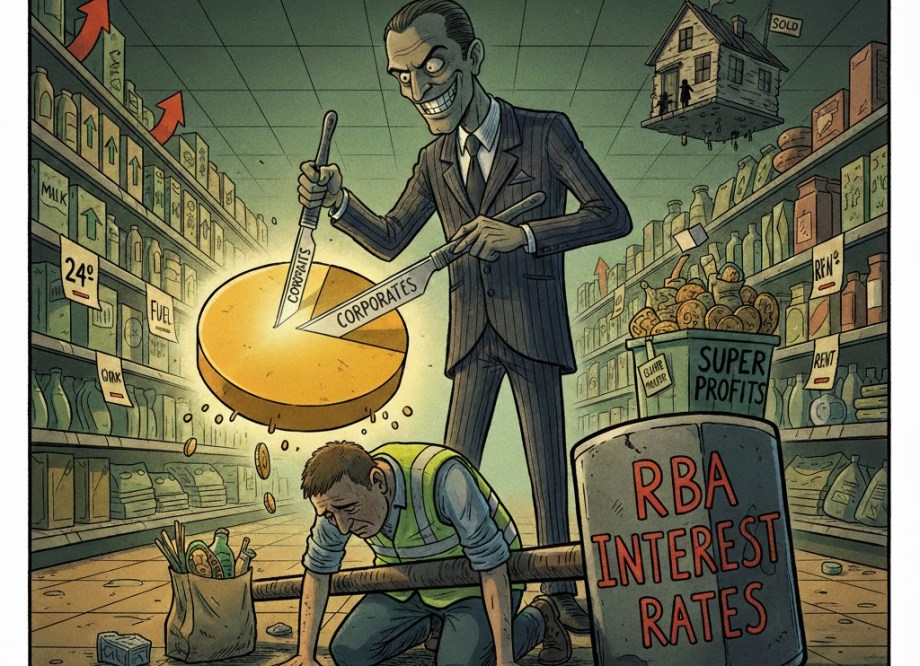
As we stumble through the economic wreckage of 2026, the Reserve Bank of Australia’s addiction to interest rate hikes lays bare a basic misdiagnosis of our national crisis. The RBA’s logic is a fossil of the twentieth century, treating inflation as a fever caused by an “overheated” working class with too much cash to splash.
Yet the data tells an uglier story. Research from the Australia Institute shows again and again, that the primary driver of our inflation crisis is not a surge in household demand but a calculated “profit-price spiral” orchestrated by multinational corporations. From energy to insurance, from the duopolistic grocery sector to the cartels of childcare, price-gouging has been practised with brazen impunity, ripping a multi-billion-dollar hole in household budgets while investors stay insulated from the fallout.
The Double Sucker-Punch: Mortgage Stress in a Profit-Price Spiral
The cruelty of this orthodox “cure” is that it’s a double-sucker-punch. While working families are already being bled dry by corporate markups at the checkout, they are then thumped by the RBA’s interest rate rises, forcing mortgage repayments to record highs. Get real. This policy assumes workers are all on easy street; free to top up the mortgage. Must keep the banks happy. Far from being “inflationary drivers,” wages have been going backwards for over a decade.
Since the pandemic, real wages have collapsed. Their buying power now sits well below 2021 levels. This erosion is no accident of the market; it is the own goal of a long and successful campaign by a slew of Coalition governments to cruel the bargaining power of the Australian worker.
Own goal? By weakening bargaining power, successive governments helped suppress wages for years. Now the resulting collapse in real wages fuels voter anger, economic fragility, and political blowback. Why try to discipline labour, if you destabilise the very economy and electorate you rely on? That’s the own goal: a strategy meant to strengthen their position has instead undermined it.
By criminalising industrial action and boosting the widespread casualisation of the workforce, the “Top End of Town” has engineered a silence at the bargaining table that ensures profits remain high while livelihoods shrink.
Consider this: in 2025, corporate profits surged by 18%, while real wages grew by just 1.2%. The RBA’s response? Raise interest rates again, ensuring that the pain of inflation is borne not by those who caused it, but by those who can least afford it.
The Myth of Rising Wages
Critics point to recent ABS data showing nominal wage growth of 3.7% in 2025 and declare the crisis over. But this is a sleight of hand. When adjusted for inflation, real wages remain stagnant or in decline, with buying power still below 2021 levels. The RBA’s own research confirms that wage growth has barely kept pace with inflation, let alone made up for the lost ground of the past decade. The claim that “wages are rising” ignores the simple truth: when your rent jumps 15%, your grocery bill soars 9%, and your mortgage repayments hit record highs, a 3.7% bump in nominal wages is not a recovery. It’s a cruel joke.
Contrast this with New Zealand, where the Ardern government’s 2022 Fair Pay Agreements (FPAs) framework delivered real wage growth in sectors like aged care and cleaning. By mandating sector-wide bargaining, FPAs lifted wages for low-paid workers by an average of 8–12% since 2023, while maintaining lower inflation than Australia. The difference? New Zealand targeted the root of the problem, bargaining power, rather than punishing workers with interest rate hikes.
It was too good to last. Under Luxon and the right-wing Nationals, FPAs no longer exist in New Zealand. All six sectors that had begun the process; including bus drivers, cleaners, supermarket workers, security, ECE, and hospitality, lost the chance to conclude agreements that Treasury estimated would have lifted wages by hundreds of millions of dollars.
Wage Theft and the Digital Panopticon
This engineered instability has given rise to a new “Precariat,” a class defined by its total lack of economic security. In 2026, wage theft is no longer a peripheral issue; it has matured into a sophisticated, normalised business model where “efficiencies” are found by shaving pennies off the hourly rates of the insecure. And overseeing it all is the corporate Palantír, not a mythic relic, but Palantir’s own software; a seeing stone repurposed for profit.
Like its namesake, Palantir promises perfect insight while delivering a curated, manipulative vision of the worker. Every movement is logged, interpreted, and fed back into a logic that mistakes extraction for efficiency. The shop floor becomes a digital panopticon, where the illusion of omniscience justifies ever‑rising quotas. By reducing a worker to a data point, surveillance technology strips bare the role, replacing fair expectations with the cold arithmetic of a machine convinced it sees all.
Take Carlos, a night-filler at a major supermarket chain. “UnSafeWay.”
Carlos no longer answers to a human manager; instead, he answers to a device that tracks his “items-per-hour” with cold precision. When he started in 2023, the quota was 120 items per hour. Today, it’s 180; and climbing. If he slows down to catch his breath, the system flags the “deviation” in real time. The company uses this data to constantly re-set its expectations: yesterday’s peak performance becomes today’s mandatory minimum. For Carlos, the result is a state of constant physical red-lining, proving that the modern corporation isn’t just taking the worker’s money; they are colonising their very autonomy.
Three of his colleagues have been sacked for “underperformance” after raising safety concerns. None have been replaced.
The Complicity of the Labor Party
This exploitation is facilitated by the quiet complicity of certain “right-wing” unions, most notably the Shoppies (SDA). While it boasts a massive membership, its legacy is one of “sweetheart deals” that have historically traded away penalty rates and base pay for minor concessions. By capturing the machinery of the parliamentary Labor Party, these unions act as a ballast for conservatism, ensuring that any Labor reforms to the RBA or workplace safety remain characteristically timid. When Labor had the chance to legislate price controls on groceries in 2024, the SDA, backed by Coles and Woolworths, pushed for “voluntary codes” instead.
The result? A 9% jump in grocery prices in 2025, while union density in retail fell to a historic low of 12%.
Rather than reclaiming its mantle as the historic partner of the Australian worker, Labor has instead offered reforms that do nothing to challenge the basic neoliberal bias of our institutions. By refusing to legislate for direct price controls or to help grow stronger unions, Labor has effectively abandoned the working family, choosing instead to keep in sweet with the investor class.
Juana’s Story: The Human Face of Insecurity
Juana, a 22-year-old casual worker in Melbourne’s western suburbs, embodies the daily reality of this systemic neglect and abuse. Despite the criminalisation of wage theft, her employer still expects “unpaid setup time”. It costs her over $3,000 annually. She is “system-charged” at every turn: her rent has jumped 15% as her landlord passes on interest rate hikes, and her grocery bill is a minefield of price-gouging.
For Juana, the RBA’s interest rate “cure” isn’t a strategy to lower her costs; it’s the final blow in a system designed to keep her in a state of permanent, profitable precarity. “I work two jobs, and I still can’t afford to see a dentist.”
The Enlightened Path: Choosing Social Cohesion Over Yield
There is, however, an enlightened alternative visible in the global landscape. Countries such as Spain and Austria have shown that inflation can be tamed through surgical fiscal policy rather than mass punishment. Spain’s windfall profit tax on energy companies and banks generated €3.5 billion in 2025, funding direct rebates to households and reducing energy prices by 12%. Meanwhile, Austria’s sectoral bargaining system has maintained union density at over 60%, ensuring that wage growth keeps pace with productivity.
Both nations treat union density not as a market distortion, but as a pillar of economic resilience.
Critics will argue that windfall taxes or price controls will stifle growth. Yet Spain’s economy grew by 2.4% in 2025 while its energy prices fell, proving that fairness and prosperity aren’t mutually exclusive. Australia, by contrast, has chosen to use a sledgehammer on the vulnerable while refusing to wield the scalpel on corporate super-profits.
A Path Forward: Courage, Conviction, Clarity
Australia’s path forward requires three things: courage to tax excess, conviction to empower workers, and clarity to reject the myths of trickle-down economics. In Part 2, we’ll show how the RBA’s board is stacked with corporate insiders. Their “independence” is a myth. We’ll also outline a five-point plan to break the profit-price spiral, from union reform to a public interest test for corporate mergers.
For now, the question remains: how much longer will we let the RBA and its corporate backers punish us for their greed?
 Urban Wronski Writes
The RBA, like the Treasury and ATO are all tools of government control, they are in fact facets of encroaching authoritarianism. The constant tinkering with taxation rates is all about division (robbing Peter to pay Paul) and raising/lowering interest rates keeps the public in a state of unrest.
The current attempts to reduce/remove cash from our society, the emphasis on electronic banking, the loss of home phones, replaced by mobile phones, are all ways of isolating and dividing society.
A divided society makes the masses easier to control, Orwell saw it coming.
LikeLike
And it seems a Labor Gov is scared to do anything. The great Neo Lib lie is working like a charm. With Ruperts backing. 2019 damaged Labor and it seems terminal paralyssis as set in. Dont scare the horses, even if we have a big majority. We are at a turning point here with the LNP in disaray, a One Nation party of clueless numptys. Who can sweep up alot of votes, not from being smart. But fooling the stupid. I feel we are not going to come out of this well. Unless the PM grows some and does something. What happened to his I fight Tories. FIGHT. Seems to have gone to water, so dissapointed. Or maybe Anthony is more of a back room wheeler and dealer, he showed that when Gillard was PM. But if nothing spurs him on, a leadership challenge is coming.
LikeLike
A leadership challenge needs a challenger – see gNat Colin Boyce.
Recall the February 2015 Lib spill aimed at being cleansed of the Mad Monk™ © – his self selected Nick(sic!)name – in which the empty chair won more votes.
The party room knew the electorate wanted him gone but none dared to stand.
Rather than bell the cat, Australia the cat was hanged on the swinging Sanctus bell for another 7 months before Talcum the Spineless Wonder was inserted – after promising all & sundry to abandon every skerrick of principle, ethics or common sense espoused during the ‘leather jacket’ phase.
The worst cop-out, being just the most shameful among many, was to promise a megaMinistry to the wannabe Untergrabbenkartofel Dutton so long as he promised not to challenge, an undertaking kept because Spud had too much fun approving SS-type black uniforms, boots etc for his troops and subverting normal standards of official decency – anyone remember PRODUCE YOUR PAPIEREN at Flinders St station?
The only once credible challenger to AA was/is/may be Tanya Plibersek – the backdoor specialist hasn’t dissed and denigrated her for the last almost 4yrs because she was a poor performer -quite the opposite.
In the long, dreary & well deserved years that “Labor” out of office she made her Shadow job, Education & Training, a crowning achievement which would have been so beneficial to the coming generation that AA’s first act in government was to strip it from and bury/burnbag all trace of it.
Having given her Environment as a Poison Chalice she went to excel in that role such that he took great delight in cutting her off at the knees when her proposal to…wot’s the phrase…’protect the environment’ plans seemed in danger of gaining wide acclaim everywhere with almost everyone interested in clean air, reduced emission and protecting endangered species & habitats.
Everywhere that is except where it mattered, the Big Ar$ed End of Town.
When, not if, she does another exceptional job in Social Services you’d be pushed to get odds on her not being pole-axed yet again.
IOW, to get rid of the incompetent incumbent requires someone who won’t be worse and, apart from the Member for Sydney, no such unicorn is discernible.
LikeLike