Albanese’s Iran Illusion: How Australia Sleepwalks into Someone Else’s War
While our federal government waffles on about rules based order, Iran is rewriting the rules of modern warfare. Trump is threatening regime-change. The Strait of Hormuz has become a kill box where $13 billion aircraft carriers play sitting duck to lethal, glorified speedboats, where cyberattacks double as deterrence, and where Australia, ever the loyal deputy, pretends it’s all someone else’s problem. Labor’s silence isn’t prudence. It’s complicity in a US strategy that’s already unravelling, and we’ve got the scars to prove it.
Trump already bombed Iran once. In June 2025, Operation Midnight Hammer saw seven B-2 stealth bombers drop bunker-busters on three nuclear facilities while Pine Gap provided the targeting data. Iran’s face-saving response, a telegraphed missile strike on Al Udeid Air Base in Qatar, fooled no one. But it burned through 25% of America’s total THAAD interceptor stockpiles, missiles the US produces at a rate of roughly one per month. Now Trump’s threatening round two, this time with explicit regime-change goals, and Albanese still won’t acknowledge that Australia’s uncritical alignment has painted a target on our own facilities.
The real damage? Washington’s isolation campaign isn’t weakening Tehran. It’s shoving Iran into Beijing and Moscow’s arms, locking in an anti-Western axis that thrives on American blunders, while teaching every threshold nuclear state that compliance buys nothing but bombs. Why won’t Labor admit the scale of the mess? Because doing so would mean confessing its own role in a policy already fraying at the seams.
Iran’s Budget Warfare: Turning American Strength into Liability
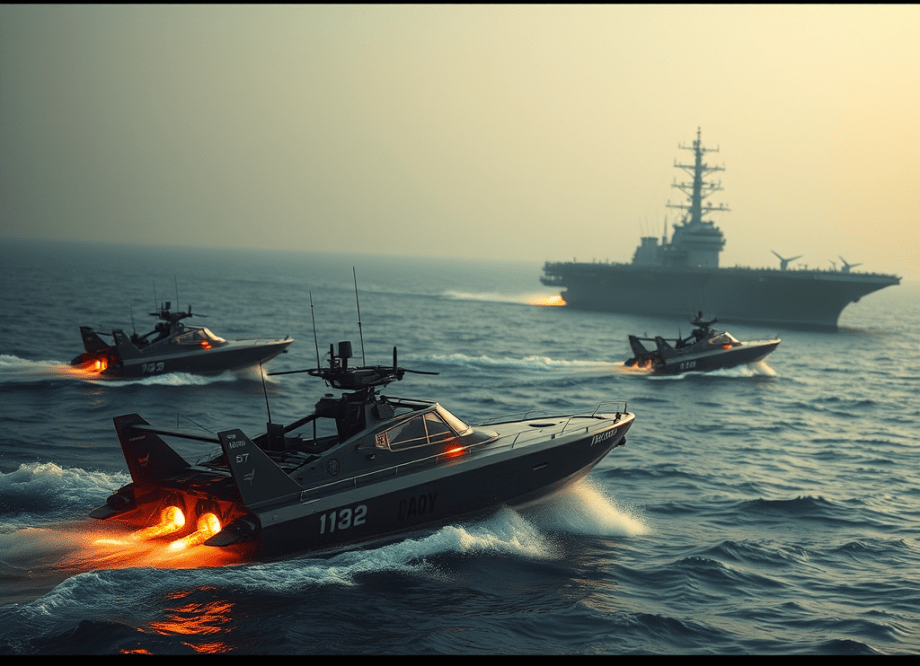
Iran isn’t trying to match the US ship for ship. The Islamic Revolutionary Guard Corps has crafted a playbook that turns American firepower into dead weight: coastal swarms, cyber harassment, proxy deterrence. The goal isn’t winning a war. It’s making escalation so unpredictable, expensive, and politically toxic that the US thinks twice before starting one.
In the cramped waters of the Strait, even Iran’s modest fleet of fast-attack craft becomes a force multiplier. The IRGC doesn’t need a knockout punch, just enough chaos to trap US commanders in a no-win scenario. Push ahead and risk humiliation. Retreat and signal weakness. Dither in the middle while morale drains away. So far, the Pentagon has mostly chosen door number three, proving you can outspend your opponent by billions and still lose the initiative to speedboats and audacity.
The Strait of Hormuz: Where Geography Beats Firepower
The USS Abraham Lincoln isn’t just another, elderly ship in the Strait. It’s a floating monument to American overreach, now redeployed for what Trump calls an “armada larger than Venezuela,” the latest regime-change operation on his scorecard. Iran’s swarm tactics don’t need to sink a nuclear-powered carrier to succeed. They just need to make every transit a gamble, every patrol a potential disaster.
The IRGC’s speedboats may look like dinghies, but in these confined waters where 20% of the world’s oil flows, they’re a constant reminder: geography, not firepower, decides who blinks first. Tehran isn’t trying to win a shootout. It’s turning the Strait into a quagmire where the US loses whether it escalates or backs down, and every crisis burns through irreplaceable defensive systems while China takes notes.
Cyber Jihad: How Iran Turned Hacking into Deterrence
Iran may not match Russia or China’s cyber prowess, but it doesn’t need to. Its campaigns against US, Israeli, and Gulf targets aren’t about knockout blows. They’re about raising costs, sowing doubt, ensuring any strike on Iranian soil comes with a digital counterpunch. From disrupting Saudi oil facilities to probing Israeli water systems, Tehran’s message is simple: hit us, and we hit back, not just with missiles, but with chaos in your backyard.
At home, the regime has weaponised the internet itself, using imported surveillance tech and homegrown censorship to crush dissent. Since January 8, Iran’s internet connectivity has been throttled to 1% of normal levels, a digital blackout designed to hide what appears to be one of the bloodiest crackdowns in modern Iranian history. It’s crude, effective, and one more layer of deterrence the Pentagon now factors into every war plan.
The Massacres Under the Blackout: What Trump’s “Humanitarian” Intervention Ignores
Here’s what Trump won’t mention when he frames the next strike as protecting Iranian protesters: his administration is planning regime change in a country already reeling from mass killings. Since late December, Iran has experienced its largest uprising since 1979, sparked by currency collapse and spreading nationwide. The regime’s response has been catastrophic.
Iranian state media admits to 3,117 dead. The US-based Human Rights Activists News Agency documents 6,479 deaths, mostly protesters, with another 17,091 cases under review. Some reports claim 30,000 to 36,500 killed during January 8-9 alone, when the regime imposed its internet shutdown. Thousands more arrested, business assets seized, “terrorism” charges filed against anyone accused of supporting the unrest.
Now Trump’s war planners, according to Drop Site News, hope strikes on the IRGC will “galvanise Iranians to return to the streets and deliver a knockout blow to their government.” Netanyahu is “assuring Trump that Israel can help put in place a new government that is friendly with the West.” It’s regime change dressed up as humanitarian intervention, using protesters as props while planning to bomb the very country they’re trying to transform.
The cynicism is staggering. As one former senior intelligence official acting as informal Trump advisor put it bluntly: “This isn’t about the nukes or the missile program. This is about regime change.”
Proxies on a Leash: Hezbollah’s Controlled Escalation
Hezbollah isn’t just an Iranian client. It’s a deterrent with tens of thousands of rockets, many now precision-guided. The group’s real power lies in what it doesn’t do. By holding fire unless provoked, it forces Israel and the US to calculate every move, knowing a misstep could trigger a regional war neither wants.
This isn’t deterrence through invincibility. It’s deterrence through unpredictability. During the June 2025 conflict, Iran fired an estimated 550 missiles and roughly 1,000 drones at Israel. While most were intercepted, the few that hit their targets killed 28 people, wounded over 3,000, and caused extensive property damage. The message was clear: Iran and its proxies have the initiative, turning every crisis into a game of chicken where the first to flinch loses.
Washington’s Exhaustion: Too Many Wars, Too Little Bandwidth
The US isn’t paralysed by Iranian deterrence. It’s paralysed by its own overstretch. Under Trump, and now under Defence Secretary Pete Hegseth, the Pentagon has been hollowed out by purges, infighting, and a civilian-military trust deficit that would make a seasoned bureaucrat weep. America is juggling crises in Europe, the Indo-Pacific, and the Middle East with a military stretched thin and a political class that can’t decide between regime change, containment, or grudging détente.
The June 2025 strikes exposed the problem in stark terms. To protect Israel and Al Udeid Air Base from Iranian retaliation, the US expended at least 100, potentially up to 150 THAAD interceptors, roughly 25% of total stockpiles. For perspective, the US produced only 11 such missiles in 2023 and expected another 12 in 2024. They’re burning through defensive systems faster than they can replace them, trading irreplaceable capabilities for temporary tactical wins.
Iran’s ability to raise costs isn’t brilliant strategy. It’s opportunism in the face of American exhaustion. The threatened “imminent” second strike isn’t strength. It’s a superpower running on fumes, out of good options and unwilling to admit it.
The Uneasy Axis: How US Sanctions Backfired
US sanctions didn’t bring Iran to heel. They pushed it deeper into Beijing and Moscow’s orbit. China’s military cooperation remains selective, but Russian-Iranian ties are anything but. From drones for Ukraine to shared cyber tactics, the two regimes are learning from each other, and every failed US gambit gives them another reason to tighten the bond.
Joint cyber drills, AI weapons development, sanctions-busting deals: this isn’t an all-powerful axis, but it doesn’t need to be. For Iran, the goal is survival. For China and Russia, it’s chipping away at US dominance, one collaboration at a time. Meanwhile, the lesson to every threshold nuclear state watching this unfold is unmistakable: Libya gave up its nukes and got NATO intervention. Ukraine relinquished its arsenal and got invaded. Iran stayed at the threshold and got bombed anyway.
As senior Iranian adviser Mehdi Mohammadi put it on state television: Washington’s demands “translate into disarming yourself so we could strike you when we want.” If compliance offers no protection, why comply? Trump’s strikes aren’t deterring proliferation. They’re accelerating it, while undermining the credibility of the IAEA and the entire architecture of international monitoring.
The Pine Gap Paradox: Australia’s Uncritical Complicity
Australia isn’t a neutral observer. Through Pine Gap, we provided the intelligence backbone enabling the June 2025 strikes on Iranian nuclear facilities, operations now drawing genocide allegations at the ICJ given the broader context of US-Israeli coordination. That makes us complicit, and Tehran has noticed.
Iranian Brigadier General Mohammad Akraminia was explicit in his warning: if the US strikes again, “the scope of war will certainly extend across the entire region… From the Zionist regime to countries that host American military bases, all will be within range of our missiles and drones.” That’s not bluster. That’s a direct threat to Australian facilities, delivered after we’d already enabled one round of strikes.
The Herzog visit crystallises Labor’s paralysis. Albanese frames it as “solidarity” with Jewish Australians, but the timing, amid ICJ hearings, domestic protests, and credible reports of an “imminent” second US strike aimed at regime change, screams political theatre. Hosting an Israeli president while Pine Gap’s data flows unrestricted into contested operations isn’t tone-deaf. It’s a neon sign for Iranian retaliation: cyberattacks, grey-zone harassment, or worse.
Yet Albanese won’t acknowledge the risks, because doing so would mean admitting our uncritical alignment with Washington has made us a target. So we get silence, deflection, empty platitudes about “shared values,” while senior US military officials tell Middle Eastern allies that Trump may strike Iran “as soon as this weekend.”
Greg Moriarty, our ambassador in Washington, saw this coming. His warnings about blowback from sanctions and military-first strategies should be shaping the debate. Instead, they’ve been sidelined, because realism doesn’t win elections, and admitting the Pine Gap Paradox would require honesty this government doesn’t possess.
The Nuclear Cascade: What Comes After Trump Bombs Iran Again
If Trump follows through, the consequences extend far beyond the Middle East. Every regional power watching this crisis is recalculating. Saudi Arabia has made no secret of its nuclear ambitions, with Crown Prince Mohammed bin Salman publicly declaring the kingdom would pursue weapons if Iran did. Riyadh’s deepening defence cooperation with nuclear-armed Pakistan isn’t coincidence. It’s a hedge against American unreliability and regional instability.
Turkey, meanwhile, has chafed under NATO’s nuclear arrangements. President Recep Tayyip Erdoğan questioned in 2019 why Turkey shouldn’t possess nuclear weapons when others in the region do. The June 2025 strikes sent a message to Ankara and Riyadh alike: US protection is selective, flowing to preferred partners, not necessarily to them.
If Iranian leadership survives another US attack, they will almost certainly accelerate their weapons program. The threshold status that once represented strategic restraint will be abandoned for the only security guarantee that apparently works: actual possession of nuclear weapons. Trump’s strikes won’t destroy Iran’s nuclear ambitions. They’ll guarantee them, while triggering a regional cascade that makes the world demonstrably less safe.
Crossroads: The Choice Albanese Won’t Make
Australia still has options, but the window is closing fast. We can deepen our operational integration with the US, provide targeting for regime-change strikes, and hope Iran decides we’re more trouble than we’re worth. Or we can use our position inside the American security ecosystem to argue for de-escalation, regional guarantees, diplomacy over another roll of the dice with irreplaceable defensive systems and global proliferation architecture.
The second path means telling a distracted superpower our support has limits, that we won’t sign a blank cheque for a strategy multiplying our exposure while delivering only drift. It means acknowledging publicly that Pine Gap’s role in the June strikes has already made Australia complicit, and that a second round aimed at regime change crosses a line we should never have approached.
But if Albanese won’t level with the public about the stakes, we risk sleepwalking into a conflict shaped by other people’s decisions, on other people’s timelines, with Australian facilities providing the targeting data that helps trigger a regional war and global nuclear cascade.
Drop Site News reports the strike could come “as soon as this weekend.” Common Dreams notes 56% of Americans already believe Trump has gone too far with military interventions. Even many Iranian protesters warn the US will exploit their struggle rather than support it. The pieces are in place for a catastrophic escalation, one that makes the June strikes look like a warning shot.
The question isn’t whether Australia can afford to speak plainly about these risks. It’s whether we can afford not to, and whether Albanese has the courage to admit that our “shared values” with Washington don’t extend to enabling regime-change operations that will make us targets while accelerating nuclear proliferation across the Middle East.
The silence from Canberra isn’t prudence. It’s complicity. And if Trump pulls the trigger this weekend, Albanese’s refusal to acknowledge our role will look less like diplomacy and more like dereliction.
 Urban Wronski Writes
For too long our government has ignore the genocide in Gaza, the annexation of West Bank lands, the bombing of Iran and the killing of Venezuelan civilians.
It’s time for our government to stand up for what Australia claims to stand for, or, are we to continue to be the butcher’s block?
LikeLike
Before adding my own thoughts, I want to state, re. the intro. paras. – wot U sed.
The pale, shrinking chimera that is today’s ‘Labor’ party learned the wrong lesson from 1975.
EG Whitlam was right.
Today’s toadies aren’t fit to shine his shoes which they come not within cooee of filling.
LikeLiked by 1 person
It is old news (see Des Ball’s 1980 opus A Suitable Piece of Real Estate) that Pine Gap exemplifies our complicity in EVERY belligerent action undertaken by the USA.
Then, now and in the future – Taiwan anyone?
Less well known is NW CAPE at Exmouth (aka Harold E. Holt – dark humour?) which provides essential, and geographically unique, VLF communications with the world-wide USN nuclear submarine fleet, see above, Taiwan!
Need one mention Darwin’s soi-disant R&R base? With months of announcing the establishment this was extended & repurposed for tired & emotional B52s, Stealth B2s & refuelling Stratotankers such as the Boeing KC-135 and the new KC-46 Pegasus. Perhaps Chairman Xi hasn’t noticed that either?
As for this week’s pre-emptive TACO (https://www.theguardian.com/world/2026/jan/31/trump-hints-at-deal-with-iran-to-avoid-military-strikes) never has feckless pusillanimity been so welcome.
Perhaps the Orange Oaf or War Secretary Kegsbreath has been advised of the 2002 MILLENNIUM CHALLENGE (MC02) $250M war games exercise & retired Marine Corps Lieutenant General Paul K. van Riper (the opposite of Kubrick’s Gen Jack D. Ripper)?>
Everything old is new again.
LikeLike