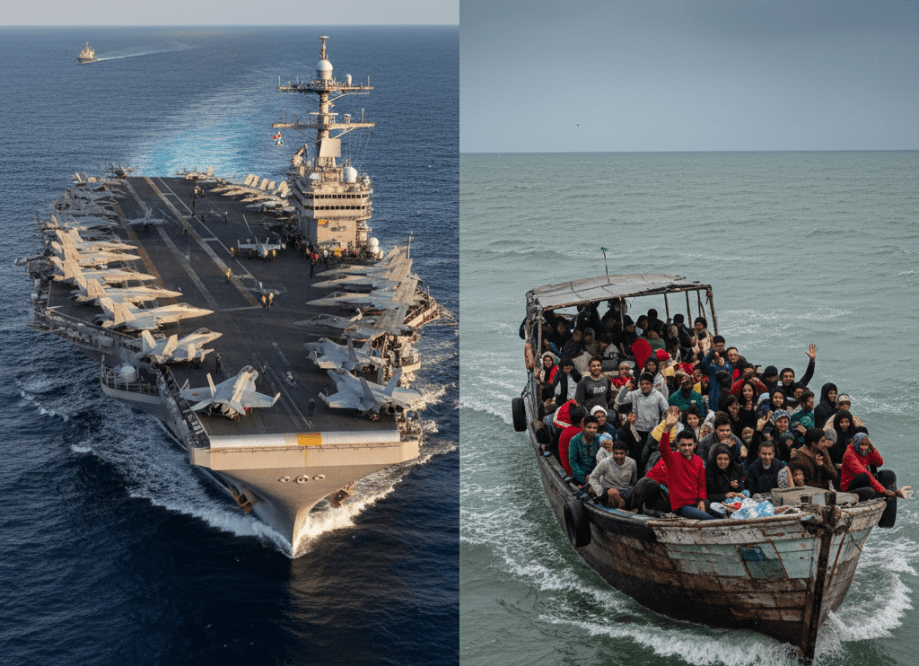
Right now, this minute, the USS Abraham Lincoln and nine escort warships; 5,700 sailors, 75 aircraft, 1,200-plus Tomahawk missiles, 7,500 tons of ordnance, are sitting in the Persian Gulf like a firing squad aimed at Iran’s heart.
Think of the beating hearts of all the innocent, ordinary, civilian men, women and children. Add 50,000 troops, a dozen THAAD and Patriot batteries, F-35 squadrons at Al Udeid, and you’ve got three times the naval tonnage that preceded last June’s strikes on Iranian nuclear sites. Those killed 247 people, flattened 18 facilities, and bought the world exactly six months before Tehran was back enriching uranium.
Or so the US military machine and its compliant army of global mass media would have us believe. For years, we have heard that Iran is only months away from making nuclear weaponry.
Imagine if you can this massive war machine. We have to imagine. Not one Australian media outlet; not Nine/Fairfax, not News Corp, not the ABC, not the indies, has a correspondent who can independently verify those numbers, track those ships, or model what they mean for Australians when the holocaust starts.
We’re about to sleepwalk into another war we’ll swear we never saw coming. Again. Are we up shit creek with Uncle Sam again? You bet. But let’s not forget our own role: we’ve spent the last decade so busy demonising boat people and building the national security theatre that we’ve forgotten who the real threat is.
How We Learned to Stop Worrying and Love the Armada
Something happened to Australia’s threat perception over the past twenty years, and it wasn’t subtle. We normalised the abnormal until we couldn’t tell danger from distraction any more.
Trump’s back, threatening to flatten Iran with his “beautiful armada,” and the response is… what? A collective shrug? Mild concern? He’s negotiating by demanding Iran give up a nuclear weapons program it doesn’t have. The man who has done everything he could to award himself the Nobel Peace Prize is negotiating whilst holding the world’s biggest gun to Tehran’s head. The bloke literally tried to overthrow his own government, faces multiple indictments, openly admires dictators, and promises “speed and violence” against Iran.
But we’ve normalised him. He’s just Trump being Trump. Funny make-up. Pass the remote.
Meanwhile, we’ve spent two decades working ourselves into a lather over refugees in leaky boats. Stop the Boats. Border Protection. Operation Sovereign Borders. Billions on offshore detention.
Billions more on surveillance and intelligence gathering; ASIS, ASIO, the Australian Signals Directorate, the whole alphabet soup of agencies supposedly keeping us safe.
And when the boats kept not coming in numbers that justified the spending? We pivoted to new threats. Hate speech laws rushed through Parliament with minimal scrutiny, supposedly to protect us from extremism, effectively give government new powers to shut down dissent. We handed over our civil liberties like we were clearing out the garage. Took years of softening up, but we did it. A conspiracy of silencing dressed up as community safety. You wouldn’t read about it. You can’t. You know what happens to whistle-blowers.
From what, exactly, are we being protected?
Not from the country that could spark an oil shock through Hormuz disruption; regardless of global supply levels, closing that strait means supply chain chaos and price spikes that’ll cost every Australian household thousands in fuel and groceries.
Not from the ‘alliance partner’ that’s dragged us into every disastrous Middle East adventure since 1991. Not from the US military-industrial complex that treats Australian lives and treasure as loose change in the poker game of American empire.
No. We’re being protected from words that might hurt feelings, from refugees fleeing the bombs, missiles and carefully engineered shrapnel fragments our great and powerful friend is about to rain down on them.
And from writers, observers, thinkers; from citizen-journalists who might connect the dots too publicly.
The biggest terrorist threat to Australian prosperity and security is parking carrier strike groups in the Persian Gulf. But we’ve built an entire national security apparatus; surveillance, detention, speech codes, designed to look everywhere except at our own alliance obligations.
Hormuz matters. Even with oil glut, 21 million barrels a day go through that 21-mile-wide strait. Disruption creates immediate logistics crisis and price panic, even if there’s technically enough oil elsewhere. Insurance costs spike, tankers reroute around Africa (adding weeks), markets panic-buy futures.
The Infrastructure That Isn’t There
This isn’t about ideology or editorial courage. It’s about capacity. Cold, practical, dollars-and-cents capacity that got gutted while we were building border security theatre and speech police.
To adequately warn Australians about military build-ups that could crater our economy and drag us into conflict, you’d need maybe three to four specialist correspondents plus database subscriptions. Call it $800,000 to $1 million annually for a major masthead. Less than we spend on one year of detaining asylum seekers on Nauru. A rounding error compared to the budget for covering Taylor Swift’s tour.
But here’s the obscene part: we have intelligence infrastructure. ASIS gets $600 million annually. ASIO gets $500 million. The Australian Signals Directorate gets $2 billion. Defence gets $55 billion. All that capacity, all those analysts tracking threats; and not one tasked with telling the Australian public what American military buildups mean for Australian households.
We’ve got billion-dollar spy agencies that can’t warn us, and million-dollar media outlets that won’t fund the journalists who could. Perfect.
The Pattern We Keep Missing
This is the fourth time. The plot never changes. Only our tabloid-sensation-hungry, click-baited, dopamine-addled brains, short-circuiting long-term memory circuits, make each screening feel like a surprise.
Gulf War I, 1990-91: Half a million US troops pre-positioned. We sent warships, cleared mines. Then oil hit $42 a barrel, recession gutted manufacturing.
“Nobody told us it would be this big.”
Iraq, 2003: 130,000 troops, four carrier groups. John Howard committed us before the UN route was exhausted. Then 4 million refugees, twenty-year quagmire, war crimes inquiries.
“The intelligence was wrong.”
Iran, June 2025: Abraham Lincoln and B-2 wings offshore. Then 140 JDAMs, 247 dead, Brent crude to $110.
“It was surgical. Nobody expected consequences.”
Iran, January 2026: Same carrier. Three times the tonnage. Same Gulf. Same target. Same playbook.
Australian media coverage: You’re reading it.
The Spreadsheet in Plain Sight
None of this is secret. Volunteer plane-spotters track C-17 Globemasters to Ramstein. Satellite watchers catch the Abraham Lincoln through Malacca Strait. The War Zone reports mine countermeasure ships near Hormuz. CENTCOM announces F-15E deployments, readiness exercises.
It’s all there. Numbers, locations, weapons systems, historical patterns. Updating in real time, publicly available. We’re just not looking.
We’d rather spend the money on another inquiry into TikTok, another airport security upgrade, another few hundred million on detention centres for the refugees we’ll create when the bombs start falling.
What It Costs to Stay Blind
When the strikes come—and it’s when, not if—here’s what happens:
Oil shock. Twenty percent of our crude comes through Hormuz. Closure could send Brent past $150. That’s $2.50-plus at the bowser, $3 in regional areas. Tradies can’t afford job sites. Farmers can’t run harvesters. The economy grinds toward paralysis.
Alliance drag. ANZUS has no off switch. We provide intelligence through Pine Gap. Logistics. Probably special forces. Which makes us targets. Last time Iran retaliated, they hit Al Udeid Air Base with ballistic missiles. Our people operate from there.
Refugee blowback. Iraq gave us 4 million displaced. Syria, 5 million. Iran’s got 89 million. Where do they go? Here, via Indonesia, in boats that drown families. Then Hanson calls it invasion. Joyce demands tougher borders. The cycle continues while we refuse to see any connection between our bombs and their boats.
Budget black hole. Fuel subsidies. Defence spending surges. Veteran support overwhelmed. Every dollar that could’ve gone to housing or education gets eaten by a war we’ll pretend we were forced into.
And when it’s over, we’ll have the same inquest: “How did this happen? Why didn’t anyone warn us?”
The intelligence was available. We just spent twenty years building a security apparatus designed to look everywhere except at the actual threat.
We were too busy stopping boats to notice the armada.
The Fist Is Clenched
Right now, the pieces are in position. Carriers deliver precision munitions. THAAD batteries absorb retaliation. Special ops mop up chaos.
Trump’s “hope I don’t have to use it” is June 2025 verbatim: bomb first, bluster later.
And Australia? DFAT will issue a statement about alliance partnerships. The Opposition will back the government. The Greens will object. The media will cover the politics instead of the consequences.
Then fuel prices spike. And we’ll pretend nobody could have predicted it.
But someone could have. Someone would have, if we’d valued warning Australians about real threats as much as scaring them about imaginary ones.
The information is there. The pattern is clear. The consequences are predictable.
We just spent two decades teaching ourselves to look the other way. We built a security theatre that protects us from refugees while leaving us naked to the country that keeps starting the wars that create them.
The board is set. The missiles are primed. The playbook is open to the same page as 1991, 2003, and June 2025.
And we’re about to claim, once again, that nobody saw it coming – because we were too busy stopping the boats to notice the world’s biggest armada. If you don’t count China.
 Urban Wronski Writes
One thought on “The War Nobody’s Paid to See Coming”
Comments are closed.