The nation halts. Or does it?
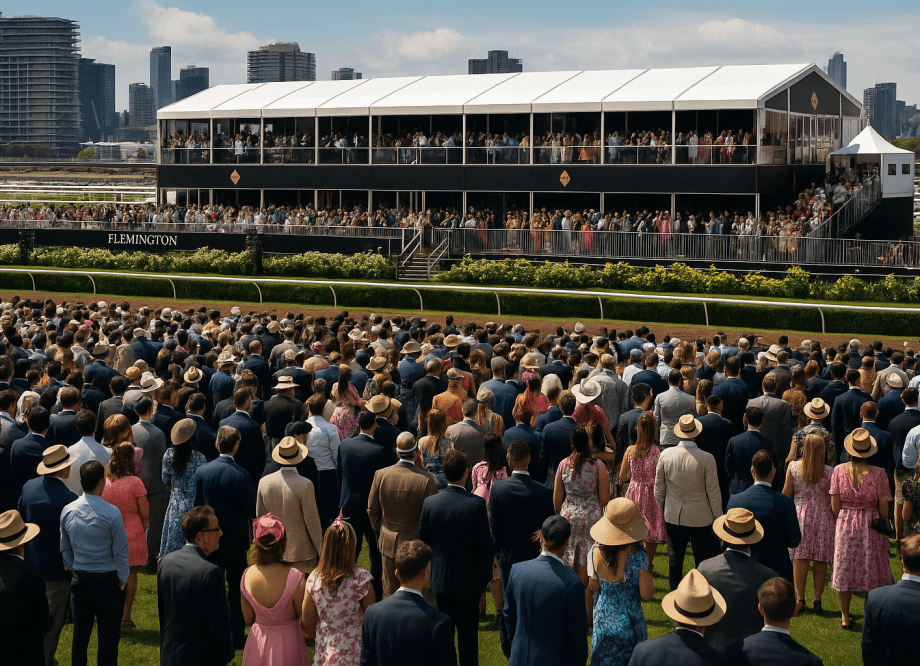
The first Tuesday in November, Melbourne pauses, the nation halts. Or does it? Something’s shifting. The crowd’s thinner than it used to be, the roar less deafening. But let’s start with what remains.
You can smell it before you see it: horse shit, sweat and YSL Opium, hot chips frying in oil that’s been working since dawn. Eighty thousand bodies crushed up against Flemington’s rails (down from 90,000 a decade ago), another hundred thousand peer out from beer gardens and boardrooms, all eyes fixed on twenty-four horses whose combined value exceeds the GDP of Tuvalu. The marquees shimmer in the heat like mirages. Inside them, silk and champagne. Outside, the punters clutch form guides like scripture, studying bloodlines and track conditions as though knowledge could overturn mathematics.
Listen. The bookies call the odds, voices hoarse by noon. The crowd roars and moans in waves. Glass shatters somewhere near the betting ring. A woman in a fascinator that cost more than a week’s rent wobbles past on heels sinking into turf that’s drunk 80,000 litres of water since yesterday. A bloke in a cheap suit tears his ticket into confetti, lets it fall like snow onto crushed beer cans.
We’re told it’s “the race that stops a nation.” What kind of nation stops for this? A three-minute gallop where most lose so a handful can win, and even the winners often limp away broke, nursing long-shot delusions and hangovers that last till Thursday.
The Money Trap
Three hundred and ten million dollars are bet on Cup Day alone. Watch where it goes. Into the offshore accounts of corporate bookmakers. Into the pockets of international syndicates whose air-conditioned stables (climate-controlled, Italian-tiled, staffed by veterinarians earning more than most Australian teachers) make working kitchens look medieval. The fantasy persists: anyone can win. But there are twenty-four horses, one winner, and odds that would embarrass a casino.
The average dividend doesn’t buy lunch. It buys longing.
Feel the texture of it. The form guides go limp in sweaty hands. The betting slips curl and fade in back pockets. The ATM queues lengthen as the day wears on, each withdrawal smaller than the last, hope measured in diminishing increments.
But we persevere. Because rich men want it? For them, status is a currency, not a cost. Owners pour more into costs, training, and excess than most punters see in a year, hoping for a moment in the sun and a photo in the form guide. The rest of us pay for the show: $1.5 billion splurged over the spring carnival. Eighty thousand litres of water a day irrigating the course (enough to keep a drought-stricken wheat farm alive for weeks) so horses can bolt for glory, or sometimes, straight into oblivion.
That $310 million could fund 620 new teachers for a year. Or 3,100 hospital beds. Or housing for 1,550 homeless Australians. Instead, it evaporates in three minutes of “sport.”
Crime as Spectacle
The Cup isn’t just a party. It’s a money laundromat running at full speed. AUSTRAC issues warnings about racing as a vehicle for money laundering, but on Cup Day, hundreds of millions swirl through bets nobody tracks, layered and laundered until clean.
The methods are documented in the industry’s own integrity reports. Jockeys taking envelopes in car parks. Horses “milkshaked” with bicarbonate to mask bleeding, given the mixture through tubes shoved down their throats hours before post time. Electric “jiggers” (little zappers hidden under saddles, applied at the crucial moment to make a horse bolt or pull up).
In 2018, Damien Oliver (champion jockey, Melbourne Cup winner) copped a ten-month ban for placing a $10,000 bet against himself. In 2022, Racing Victoria charged multiple participants in race-fixing conspiracies involving Victorian races. The whole machinery of corruption hums along beneath the champagne and the fascinators.
The wheels of justice turn slower than any thoroughbred.
Bodies Count
“Cup Day! A great equaliser!” The headlines shriek it every year.
Walk along Flemington’s rails. Really look. Mug punters who “wager” (never “gamble,” that’s too honest) and lose. Statisticians in cheap suits studying odds that never favoured them. Larrikins three sheets to the wind by the third race, shouting at horses that can’t hear them, at jockeys who wouldn’t listen if they could. The smell of beer and vomit mingles with expensive perfume. Someone’s crying in the women’s toilets. Someone’s throwing punches near the betting ring.
By evening, the ambulances start their regular runs. Alcohol poisoning. Assaults. The domestic violence statistics spike after racing weekends, reliable as a starting gun.
The jockeys (heroes, we’re told). Watch them in the mounting yard before the race. Stripped down to racing weight through diuretics and saunas, some so dehydrated their lips crack, bodies maintained at weights their frames were never meant to carry. What kind of hero earns a median income of $50,000 to $65,000 a year for chronic injuries, a five-year career in a whirlpool of broken bones and concussions, and a suicide rate triple the male national average?
About 870 have died in Australian racing history. For every one draped in Cup-winning glory, a dozen limp away for good, backs destroyed, heads scrambled, done by thirty. Jamie Kah, riding Half Yours today, was put into an induced coma for five days in 2023, after a serious fall left her with broken bones, while the bleeding on the brain meant that she had to Google her own name to check her age.
Danny Nikolic: forty-seven races won, career ended by depression and addiction. Caitlin Forrest: twenty-five years old when she took her own life after injuries ended her riding career. The Cup doesn’t mention them in its promotional materials. They don’t fit the fairy-tale of glamour, triumph and good fortune.
The Animals
Since 2014, at least seven horses have died in or after the Melbourne Cup. You don’t see this in the broadcast. The screens cut away. The commentators pivot to the winner’s circle.
Anthony Van Dyck, 2020. Broke down mid-race, leg shattered, euthanised on-track behind the screens they erect for exactly this purpose. The Cliffsofmoher, 2018. Same fate, same screens. Admire Rakti, 2014, collapsed and died after finishing last, heart giving out in the mounting yard while the crowd cheered the winner. At least 174 die each year across the nation.
Thousands more are quietly destroyed every year across Australian racing: too slow, too broken, too inconvenient for owners chasing the next fleeting brush with status. The industry calls it “wastage.” As though noble living creatures (animals that can hear your heartbeat, that startle at sudden movements, that form bonds with their handlers) fail to pay their way whose slaughter is a line item to be written off.
It is expensive. Each horse consumes more water than your family, more feed than several people would eat. Climate scientists wring their hands over agricultural waste and turf irrigation for “prestige.”
Misplaced Mythologies
Melbourne Cup as “a great equaliser”? Look at the enclosures. It’s one Cup for the Emirates-branded elite: lobster and French champagne, designer dresses that cost more than a car, conversations about property portfolios and European holidays. Another for the public: warm beer, crushed plastic cups, arguments over unpaid rent and whether the favourite’s got a chance.
The old bread-and-circuses routine. Turn everyone’s eyes away from wage theft and inequality to the glittering spectacle of silk-clad billionaires grinning over champagne flutes.
Notice the language everywhere. “Gaming” not “gambling.” “Wagering” not “blowing your dough.” “Fillies Day” for the women (sexism, euphemism, and marketing bundled together under the banner of “responsible betting”). Horses don’t die, they’re “humanely euthanised.” Jockeys don’t crash, they experience “race falls.” Punters don’t lose their rent, they “participate in the entertainment experience.”
The euphemisms mask the carnage. But responsibility never attends Cup Day. Hypocrisy does, in suits.
The Untouchable Industry
Here’s what power looks like in Australia: you can lose $2,000 on the Cup (blow your weekly wage, your rent money, your kid’s school fees) and pay not a cent in tax. But buy a loaf of bread on the way home and the government takes its cut.
Australia taxes food more reliably than it taxes gambling.
No GST on betting. No tax on punters’ losses, no matter how catastrophic. The gambling industry has convinced successive governments (Labor and Coalition alike) that taking a slice of Australia’s $25 billion annual gambling losses would be economic vandalism. Meanwhile, the same governments slap a 10% GST on tampons, bread, milk, vegetables. Necessities get taxed. Addiction gets a free pass.
The power runs deeper than tax exemptions. It runs through donations, through lobbying budgets that dwarf entire government departments, through the revolving door between racing administrators and political advisers. Tom Waterhouse (bookmaker, scion of a gambling dynasty) crops up everywhere: advertising during family viewing hours, embedded in sports broadcasts, his face as familiar to Australian kids as any cartoon character.
The industry spent $264 million on advertising in 2022. Not educating punters about odds or promoting “responsible gambling.” Selling the dream. Making every kid with a smartphone think betting is just part of watching sport, part of being Australian.
Politicians talk tough about problem gambling. They commission reports, hold inquiries, express concern. Then they take the donations and kill the reforms. When Tasmania tried to reduce poker machine numbers, the industry threatened to pull sponsorships, withdraw from racing venues, collapse the “entertainment sector.” The government folded. When the Productivity Commission recommended mandatory pre-commitment schemes for poker machines, both major parties binned it within months.
The Melbourne Cup is the industry’s annual reminder of its power. Look what we can do, it says. We can stop the nation for a horse race. We can make gambling seem glamorous, patriotic, essential to Australian culture. We can convince people that losing money is “having a flutter,” that systematic wealth extraction is “entertainment,” that economic predation is tradition. And you can’t touch us.
The racing industry alone is worth $4 billion annually, though mysteriously, it operates on tiny margins and cries poor whenever regulation looms. Yet somehow there’s always money for lobbying, for political donations, for advertising campaigns that frame any reform as an attack on Australian culture itself.
Every Cup Day, while champagne corks pop in the Emirates marquee and punters tear up their losing tickets, the gambling lobby’s message to politicians gets reinforced: we own this day, we own this tradition, and if you come for us, we’ll make you pay. Not in tax (never in tax) but in campaign contributions withdrawn, in marginal seats targeted, in talkback campaigns about “nanny state overreach.”
The result? A country where you can destroy yourself gambling tax-free, but the government makes sure to collect its revenue from your breakfast. Where food banks struggle while betting agencies multiply. Where problem gambling affects 1 in 100 adults (half a million Australians) but poker machines outnumber post offices.
The Cup isn’t just a race. It’s a yearly demonstration of who really runs this country. And it’s not the people holding the losing tickets.
The Dying Spectacle
But here’s the thing: the spectacle is dying. Slowly, inevitably, like a thoroughbred put out to pasture.
Attendance is down. Revenue is down. The Melbourne Cup still draws a crowd, but nothing like the glory days. The Nup to the Cup movement grows each year (animal rights activists blocking streets, celebrities refusing invitations, entire workplaces declining to stop for the race). International horses increasingly skip Melbourne for richer, more prestigious races in Dubai, Hong Kong, Saudi Arabia. The Cup is losing its lustre in the global racing calendar.
And the gambling? It’s fragmenting. The explosion of sports betting (every AFL game, every cricket match, every MMA fight now comes with a deluge of live odds) has carved up the gambling dollar. Why wait a year for one three-minute race when you can bet on a different event every night? The Cup faces competition from a gamblers’ paradise it helped create.
But there’s something deeper at work. Something more insidious than animal rights campaigns or competing races or even the proliferation of betting options.
The TikTok generation is here. And the Cup’s delayed gratification doesn’t compute.
Think about it. A full day of buildup for three minutes of action. Hours of waiting, studying form guides, watching preliminary races, standing in queues, making your way to the track or the pub. All that anticipation for a payoff that lasts less time than a YouTube video.
Compare that to scrolling TikTok or Instagram: dopamine hit after dopamine hit, delivered in fifteen-second bursts, algorithmically optimised to keep you hooked, each swipe promising something new, something better, something more stimulating than the last. Our brains are being rewired. Neuroscientists document it: reduced attention spans, increased need for novelty, addiction to instant gratification.
Dr. Anna Lembke at Stanford’s Addiction Medicine Dual Diagnosis Clinic describes it as dopamine dysregulation. Our brains evolved for a world of scarcity, where rewards came slowly and required patience. Now we live in a world of abundance, where every screen offers instant pleasure. The result? We’re training our brains to expect constant stimulation, immediate payoff, perpetual novelty.
The Melbourne Cup demands the opposite. It asks you to wait. To build anticipation. To invest emotional energy over hours for a single climactic moment. That’s an increasingly alien experience for anyone under thirty who’s grown up with infinite scroll and algorithmic feeds.
The three-minute race doesn’t deliver the dopamine cascade that ten minutes on TikTok provides. It’s one hit, delayed, brief, and often disappointing (because most people lose). Modern digital life has turned us all into dopamine junkies who need constant micro-doses, not the Cup’s single delayed rush.
The racing industry doesn’t understand this yet. They’re still marketing the Cup as if anticipation itself were pleasurable, as if delayed gratification were something people valued. But delayed gratification is precisely what’s being engineered out of us by every app, every platform, every algorithm designed to keep us engaged.
The Cup is an analogue experience in a digital age. A slow burn in a world of instant ignition. A three-minute climax in an era of endless stimulation.
Maybe that’s the real death knell. Not the animal rights protests or the competition from other races or even the fragmenting gambling market. Maybe the Cup is dying because we’re being re-programmed to find its core experience (waiting for a payoff) fundamentally unsatisfying.
Our consciousness is being reshaped by our screen time. Attention spans contract. The hunger for novelty grows. The capacity for patience atrophies. And a horse race that demands you wait all day for three minutes of action starts to feel like a relic from another era.
The question isn’t whether the Cup will survive. It’s whether we’ll still have the neural architecture to appreciate it if it does.
The Reckoning
Every year, thousands who can least afford it get drawn into this whirlpool. Lost bets, broken illusions, mounting debts they’ll never erase. You can see it in their faces by the last race: the hollow-eyed realization that the system was never designed for them to win. The house always wins. It’s not a secret. It’s not even hidden. We just choose not to look.
The Cup exposes the claws of our ruling elite (each year sharper, stronger, more intent on reminding us that they still have their hands on the reins). And those who lose most? The ones whose losses are the most invisible: the animals shot behind screens, the jockeys whose bodies give out at thirty, the families left picking up the pieces after dad blew the grocery money on a roughie in race seven.
Our richest fantasy or darkest folly?
The Melbourne Cup. Australia’s richest fantasy, its darkest folly. We haven’t abolished the monarchy. We’ve just traded one set of In-bred horse-faced symbols for another, and somehow convinced ourselves it deserves our reverence. But like the hapless dysfunctional royal soap opera, The House of Windsor, the gloss is coming off. The born to rule over us plot is wearing thin, the characters dull.
For one day, Australia stops. Or fewer of us do each year. Not to celebrate equality, fraternity or sport or national pride, but to watch the powerful flaunt their wealth while the rest of us forlornly clutch our losing tickets and call it tradition. The manure gets trucked away. The broken glass gets swept up. The horses that didn’t break down float back to their stables. And everyone pretends it was all worth it.
The TAB always wins. But the losses to man and beast – read sentient equine creature that can recognise its image, are incalculable So why do we keep playing? And for how much longer will anyone care?
 Urban Wronski Writes