Part 1 – Sunday Feature
A Maritime Folly for the Ages
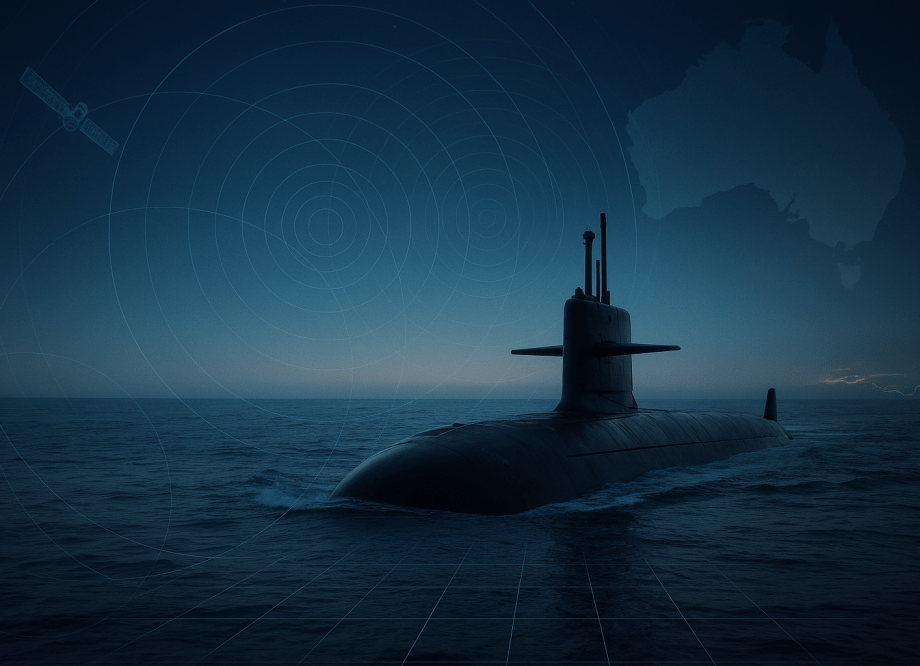
When future historians catalogue great strategic blunders, Australia’s AUKUS pact will earn pride of place; nestled between the Charge of the Light Brigade and the Maginot Line. Here we are, in 2025, committing hundreds of billions to nuclear submarines; mid-20th-century stealth technology rendered vulnerable by 21st-century detection systems, scheduled for delivery (perhaps) in the 2040s, to fight a war that Washington itself increasingly doubts will occur.
Each week brings fresh absurdity. Our prime minister sits beside Donald Trump, smiling through thirty-five minutes of improvisational chaos, nodding as the American president boasts of shipbuilding miracles and “rare earth abundance”; Crikey Albanese emerges to announce another billion-dollar “gift” to boost US industrial capacity; not a purchase, not a co-investment, but a tithe. We are not customers buying capability; we are a tributary state funding an empire that cannot build enough submarines for itself, let alone for us.
The Technology Time-Warp
Let’s start with the obvious: nuclear submarines are an exquisite relic of another age. Yes, nuclear propulsion extends endurance, but the strategic premise; a vessel hiding beneath the waves to evade detection; belongs to a pre-satellite, pre-AI world.
Modern detection makes invisibility a myth. Research institutes in China, the US and Europe have demonstrated prototype systems that can detect submarines from orbit using wake signatures, synthetic aperture radar, magnetic-anomaly sensing. The Nuclear Threat Initiative+2Interesting Engineering+2 Underwater sensor arrays, now spreading across the South China Sea, create acoustic maps of entire basins. idstch.com AI pattern-recognition can identify vessels by their acoustic “fingerprints”: the precise harmonics of propeller blades and hull resonance.
Even if half-these systems work only intermittently, the principle of undetectability; the very logic of stealth, evaporates. By the time our AUKUS submarines glide out of port in the 2040s (if they ever exist), they will be as hard to spot as Sydney’s NYE fireworks on a Chinese defence monitor.
The United States Navy knows this. That is why it is pivoting toward unmanned underwater vehicles; cheap, numerous, expendable. Drone swarms can overwhelm defences and be replaced in months, not decades. A single nuclear submarine costs around US $10-12 billion and takes twelve years to build. For the same money, you could field thousands of autonomous underwater craft.
The irony: the global leader in drone technology is China. So instead of innovating, we cling to geriatric platforms from a supplier already facing ship-yard bottlenecks. The US Navy admits a shortfall of at least 17 attack submarines, with its production yards operating beyond capacity. Pearls and Irritations+2Congress+2 And buried in the AUKUS fine print are clauses allowing the US to prioritise its own fleet; keeping our money even if deliveries slip. The Strategist
This is not defence procurement; it’s cargo-cult modernity.
The Tyranny of Distance Revisited
Historian Geoffrey Blainey coined the phrase “tyranny of distance” to capture Australia’s isolation. Under AUKUS it becomes the tyranny of bloody-mindedness. A Scott John Morrison heritage item.
Even if the boats arrive, even if they are not obsolete, even if Chinese detection falters, geography itself makes the concept absurd. The South China Sea’ our presumed theatre; is 6,000-7,000 kilometres from Darwin or Sydney. A submarine cruising at 20 knots would need two weeks just to get there, navigating Indonesia’s heavily-monitored archipelagos and contested straits.
Meanwhile, Chinese submarines operate from bases minutes from the action. Ours would arrive after the credits roll. The strategic logic; Australia shaping events in someone else’s backyard with a handful of boats; rests on the same cartographic delusion that sent the Light Brigade into the valley of death.
What Australia actually needs are rapid-response, regionally-based systems: air power, missiles, cyber, and drone fleets deployable from our shores. The future of deterrence lies in speed, numbers, and automation; not stealth leviathans prowling oceans halfway around the world.
The American Endgame: Bases, Not Boats
Watch actions, not words. Washington’s real objective is not to give Australia submarines but to gain basing rights.
We are building the docks, the maintenance yards, the nuclear-training infrastructure; at our expense. We are extending our sovereign territory into American strategic architecture without the vote. In strategic terms we are constructing a forward operating base for the United States, granting it Southern Hemisphere reach without congressional oversight.
The Americans who oppose AUKUS, such as strategist Elbridge Colby, do so precisely because they want every available submarine for their fleet. The ones who support AUKUS; Trump, Rubio, Vance, are isolationists who see Asia as someone else’s problem.
Thus the paradox: Australians backing AUKUS imagine it binds America to defend us. The Americans backing AUKUS are the ones least interested in doing so. We are building our security on a deal endorsed by those who reject its premise. It’s like buying fire insurance from a company that doesn’t believe in fire.
Epilogue / Part 2
AUKUS isn’t strategy; it’s theatre; a performance of loyalty masking dependence. Tomorrow we’ll follow the political thread: how a bipartisan procession from Morrison to Albanese turned this folly into doctrine, and how Australia’s reflexive deference keeps replaying the same imperial script.
 Urban Wronski Writes
Trust Lunatic America now?
Absolute stupidity !
LikeLiked by 1 person