Fifteen people were killed at Bondi. Grief must come before politics. This op‑ed argues for facts over fury, rejects opportunistic narratives, and centres solidarity.
Welcome to Post-Truth Australia, where the lies have become so brazen they’ve stopped pretending to be anything else. The Coalition’s “Net Zero Heroes” want to dig up every tonne of coal in the country. Tasmania’s preparing a modern potlatch ceremony – ceremonially bankrupting itself with a stadium that’ll cost billions while the AFL chips in $15 million. And our Communications Minister stands firm on a social media ban that wouldn’t work in an iron lung. It’s mythomania at industrial scale, and as Hemingway knew: we go broke gradually, then suddenly.
Guardian reporting shows Advance has pumped out at least 44 anti-immigration ads on Meta since the 2025 election campaign began, with more than 1.5 million impressions, drenched in talk of “mass immigration” and “threats” to Australian values. Some Liberal MPs have called the campaign “disturbing” and warned it will poison relations with migrant communities.
By 2021, a bare 50.5% of Australian jobs qualified as permanent full-time positions with leave entitlements, meaning half of all employed Australians now face one or more dimensions of insecurity in their work says The Australian Council of Trade Unions. This isn’t some unfortunate accident of market forces. It’s the deliberate result of a business model, embraced across both private and public sectors, that systematically shifts the risks of employment from employer to employee while minimising labour costs at the expense of job quality
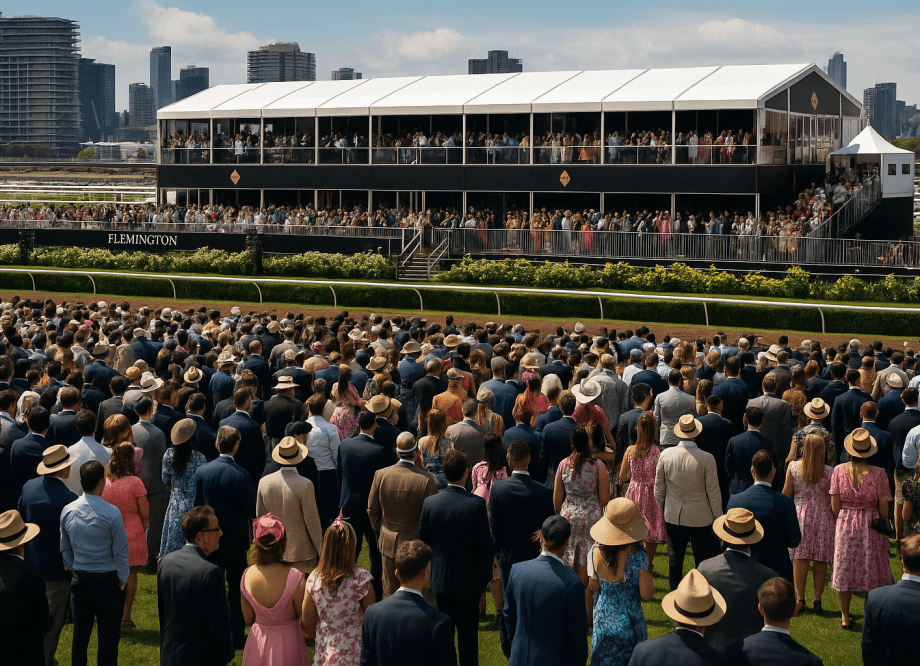
The Melbourne Cup bills itself as “the race that stops a nation.” But what stops: a celebration of sport and equality, or a yearly demonstration of who holds real power in Australia? This forensic examination reveals a dying spectacle built on inequality, corruption, and animal cruelty, now facing its greatest threat: a generation rewired for instant dopamine hits.
(Growth, Growth, Growth)
There’s nothing you can do that can’t be done
Nothing you can sing that can’t be sung
Nothing you can say but you can learn how to play the game
It’s easy
There’s nothing you can make that can’t be made
No one you can save that can’t be saved
Nothing you can do but you can learn to be you in time
It’s easy
All you need is Growth
Growth is all you Need
(Growth, Growth, Growth)
Adapted from All you need is love, with apologies to LENNON, JOHN / MCCARTNEY, PAUL
Preaching growth yet not explaining how to achieve it; in denial over pressing global issues and events, yet all too keenly aware of its image, the latest G20 was strong on talk, self-promotion and attention-seeking yet feeble in any useful or real capacity. Lacking any genuine economic theory or strategy, weary world leaders attempted to weather the storm under a threadbare neo-con security blanket, chanting the growth mantra for reassurance while blindly leaving the world’s future to a mythical free market to determine.
With dark storms brewing in world finance, peace, climate and health, the G20 fixedly looked the other way, its impotence symbolised by its hapless, outmanoeuvred bantam chairman, Australian Prime Minister, Tony Abbott, who fussed and scratched around his own parochial nest clucking about needing co-payments for doctor’s visits, privatising universities, not taxing carbon and in ‘growing’ GDP, leaving President Obama to set the real agenda. Having promised no talk-fest, Abbott did little but talk, leaving real problems to fester; leaving plans to others; postponed for later.
Part of its latest failure arises from the G20’s own flawed nature. It is stretched paper-thin to accommodate a diverse membership. It has no clear identity or Raison d’être, and it meanders in ever decreasing circles, from meeting to meeting, overshadowed by its own ineffectuality – its history of grand intentions undercut by un-met and broken promises.
The G20 lacks teeth; it meets to make consensus declarations which are not binding and in Russia’s case in the past, quickly broken. It dances to the tune of the IMF, an institution with a track record of toxic assistance in the form of loans predicated on domestic ‘liberalisation reforms’ – loans which can cripple the beneficiary, as in Argentina’s case in 2001, a country which only began to recover from collapse when it had repudiated its IMF loans and their conditions. The patient can be squeezed to death by the doctor.
Accordingly, the G20’s record is one of overpromised, overpriced underachievement. Last weekend’s meeting alone cost Australian taxpayers close to half a billion dollars. The money would have been better spent on the nation’s health and education. Perhaps the trend will continue making the meeting a type of self-bankrupting potlatch ceremony.
G20s are long on promises. The naïve would be forgiven for assuming that the G must stand for ‘gunna’ as in Joe Hockey’s line: ‘we are gunna grow GDP by at least 2%.’ Not a murmur from him, however, on how that growth will be achieved. Apart from cutting government spending, which is rather like feeding your pigs less while expecting them to gain weight, there was no road map, no direction given on how to achieve economic growth. This is primarily because reason in economics has been usurped by neo-con dogma. Magical thinking alone, it seems, underpins the Australian leader’s assertions that growth will create jobs, and that the G20 serves ordinary men and women, but who needs evidence when you have dogma? All, it seems, you need is a spin machine and a catchy slogan. All you need is growth; growth is the magical mantra.
The record, sadly, tells another story. The feeble growth of the world economy today is a telling reminder of G20’s failure to deliver the goods. Yet it continues to promote IMF doctrine. Rehabilitate the discredited IMF. IMF austerity programmes have yet to make any country better. Yet inherent faults aside, or because of them, the latest G20 demanded effective leadership. In a microcosm of the G20’s broader history, that call remained conspicuously unanswered in Brisbane last weekend.
Much of the Brisbane G20 meeting’s failure resulted from the narrow horizons, limited understanding and experience of Australian Prime Minister Tony Abbott. Abbott seeks the international spotlight without providing the leadership needed to earn it. Adequate preparation would have been a good first step, as would deeper analysis and understanding of the issues. A broader agenda would have been another; but this would have required better judgement. For Abbott it was a political catastrophe. The PM blew his privileged opportunity to rise to the occasion; to measure up as any kind of international statesman.
Spin doctors are now peddling a sanitised version of G20 events which commends world leaders present for setting specific targets. And an agreement to share information which might lead to catching tax-evaders. That’s a lot of spin. The collective GDP growth 2% target over five years is laughably inadequate and there is no agreed plan on how it might be achieved. For practical details each country will have to rely on self-help. Each G20 country’s ministers have been set some homework. They are to bring back an action plan to a November meeting. It’s like an old trick to get everyone else to do your work: lend me your watch and I will tell you the time.
The sharing of information about tax fraud is similar. Nations already have all the information required. What is needed is the will. The risk in all this avoidance and aversion is that the world is being helped to repeat the mistakes of the past.
Indeed, concealed in the verbiage emerging, especially from domestic failure, Australian Treasurer Joe Hockey is evidence of the bad old laissez-faire thinking that had made the GFC possible. Nowhere is there a glimmer of enlightenment; nowhere is the wisdom of experience, nowhere is there a clear and coherent plan. No road-map. Just a fuzzy, non-binding agreement to pursue growth somehow. But with a lot of figures on it. A lot of lipstick on this pig.
Overshadowed by the Ebola crisis, war in the Middle East and Russian ambitions in Ukraine, this G20 was on track towards unparalleled disaster when a ray of hope emerged in the form of Air Force One bearing the United States President Barack Obama. Thank, God for Obama who emerged, deus ex machina, as G20 leader by default. The US President conferred on the G20 an impassioned call to global leadership from ‘off campus’ which its chairman Australian Prime Minister Tony Abbott has neither the wit to understand, nor the means to command. Abbott proved the truth of the old adage that sometimes the job is just too big for the man. Fortunately for the rest of the world, Obama was ready and willing to make up the deficit.
Effectively upstaged and sidelined by Barack Obama’s timely ultimatum delivered off site in an impassioned speech at the University of Queensland, Abbott could but listen in as the United States President told him exactly what he thought of him. It was the strongest public statement of contempt yet by a US leader to an Australian PM.
Obama captured a spotlight which had been searching for a leader. His knowledge, eloquence and his concern for others upstaged Abbott entirely. Bringing hope to what would have otherwise would have remained another mindless, directionless, turn of the G20 organ grinder’s crank-handle Obama led by reminding every leader of their responsibility to future generations to act to reduce carbon emissions and global warming,
Overshadowed if not totally eclipsed, the G20 meeting maundered on its ineffectual way into obscurity assisted greatly by the parochial duplicity of Australia’s Prime Minister Tony Abbott who feigned an interest in boosting world GDP but who proved his only real commitment was to using the meeting as a means to gain global authority to overcome his government’s signal failure to even pass its first budget.
Abbott, moreover, has made the risky gamble of pledging to support GDP growth targets by counting on unhatched chickens of budget savings measures he has so far been unable to get through the Australian parliament. Measures that look increasingly unlikely to pass in future. Nothing like honouring your commitments with a cheque that will bounce. Even if the proposed legislation is passed, it is likely to contribute to contraction not growth. Devoid of a plan, lacking any effective theoretical engine yet tracking along IMF rails, the latest G20 show is no less than a collective confidence trick in which world leaders meet to keep up appearances and boost morale while effective control of the world economy is ceded to the caprice of free-market capitalism and vested interests.

Hats off to ABC TV News 24 for their fearless, recklessly endless live coverage of the death of the G20 today. Hats off also for generously including footage of the death throes of any last thread of credibility the Abbott government could pretend to. Stoic seekers of truth, the dutiful, the elderly and infirm, the perpetually confused and others who found themselves inexplicably close to a TV during Tony Abbott’s opening of the G20 show gasped as they were treated to some of the most compelling television ever made. In an excoriating, unhurried-to-the-point of-languorous expose, the ABC revealed the emperor has no clothes.
Under siege itself for preferring the truth over what politicians choose to tell them, our ABC, a publicly under-funded broadcaster mustered the courage today to make TV without fear or favour. It showed its public the shocking truth. True, there was some gesture towards timewasting twaddle, such as forms the substance of commercial TV, when drift-sock anchor Tony Eastley padded things out with his sonorous grain-fed beef basso profondo. We were spell-bound as much by his tone as his capacity to extemporise. And improvise. And keep talking. And talk some more.
Impressively long on the waffle Eastley even ventured into boosting the event with his speculation that just getting together was an end itself for G20 leaders. Nothing like lowering all expectations. Nothing like conveying the truth that the even the anchor is bored witless. Finally having the PM’s parliamentary secretary Joshua Anthony Frydenberg on screen was a master stroke. No doubt, Mr Frydenberg was volunteered by the Abbott machine just to keep the commentary on the rails. Having Frydenberg of Kooyong on camera to bounce ideas off proved a master stroke. Every unctuous comment Eastley made appeared objective by contrast to his master’s voice, Frydenberg.
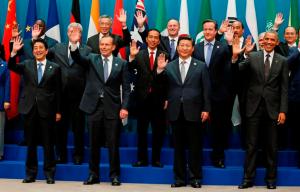
Yet, despite the show’s all at sea anchor, and perhaps because of him, it was shockingly real, live coverage. Expect reprisals. Heads, no doubt, will roll on Monday. The ABC’s inept coverage illuminated Abbott’s idle posturing perfectly, set the stage for his government’s inevitable collapse and gave the coup de grace to the G20 itself. On this day, the ailing G20 died and was reborn, stripped naked of any pretension to substance, revealed as a bone-crushing, hand-shaking, personal space-invading almost nipple rubbing photo opportunity come TV game show. International guests had to come on down as Tony Abbott centre stage came too close, held hands too long and grimaced shamelessly at the camera. This was the point of the whole shebang. Tony the media tart pressing flesh, pulling unwary unwilling world leaders into his chest, holding that handshake for the camera.
It cannot have been easy TV to make. Evidently Aunty had to economise on adequately briefing journalists covering the event and it did lack that handy extra camera to show us the faces of international leaders hanging on every Abbottism. Or, on the other hand if anyone present was paying any attention whatsoever least of all making the risky attempt to follow along.
A random, accidental shot of Putin showed him to be completely disengaged, while appearing to occupy himself with what may have been navy ballistics calculations on a notepad. The overall effect was strangely heightened as the PM’s halting opening domestic piffle appeared to be delivered into a vacuum or a stony indifference. But then to get your guests to listen, you need first to have something to say. And the means to say it. Eastley’s smooth flowing basso profondo effortlessly utterly upstaged Abbott’s halting staccato strine baritone. And shredded any final hint of credibility.
First, as anticipated, the Prime Minister was completely unprepared. When he warned earlier that it would be no talkfest, we did not expect him to lead by example. Instead of any inspiring words, any meretricious rhetoric or, heaven forbid, any vision statement, Abbott insulted world leaders with a platitudinous and hypocritical injunction to be honest with each other followed by an insufferably irrelevant and tedious rehash of his own deceitful, stale election slogans. To cap it off, Abbott’s tone was apologetic. World leaders were treated to his frustrations as he shared his inability to impose a $7 fee on GP visits. Not all was sharing. He blamed voters who love free government programs for supporting wasteful spending. In brief, he whinged to the world how hard it was to be Prime Minister. Inspiring stuff.
Second, the ABC coverage reinforced the superficiality of proceedings. Whilst we were assured that the hard work had gone on beforehand, nowhere was that in evidence, except perhaps by the absence of physical conflict. After the Prime Minister’s ponderous wasting of everyone’s time with a recap of the highlights of his trivial and unsuccessful domestic policy over the last fourteen months, there may have been a few observers who either fell asleep or were generously prepared to give his government the benefit of the doubt. Later shots spliced into the commentary revealed that this indeed was the case. When Joe Hockey faced the cameras to smarm his way through another flatulent barrage of platitudinous hokum purporting to be the consensus of the finance ministers, the intellectual and moral poverty of the Abbott government was as they say, firmly locked in.
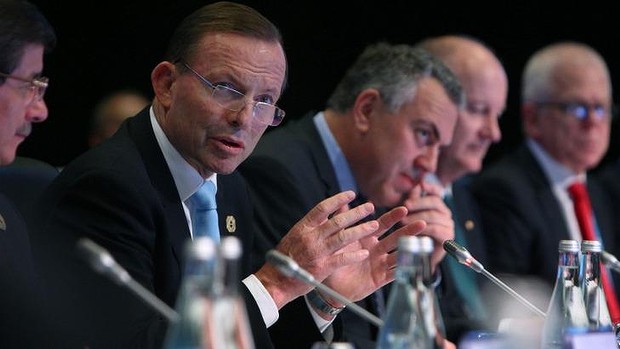
What leadership? Abbott and Hockey in tense G20 discussion.
The good ship G20 is adrift, rudderless, on the turbulent high seas of international finance. It has been for some years. The G20 is widely held to be ‘in serious transition‘ according to Canadian academic Professor Andrew F. Cooper. Whilst it won praise for being a unique forum for global economic cooperation in the GFC, it has failed to deliver on a series of pressing international issues. Climate change, growing inequality, growing unemployment, the global decline in the value of wages to GDP are but a few of its many pressing challenges. Whilst it would be unkind to say that the G20 has achieved little so far,clearly there is much work to be done. Is it up to the job? Is Australia up to the job of providing desperately needed leadership? Are we serious? Or are we putting lipstick on a pig? The evidence so far is damning.
The G20’s role during the GFC has been embellished. No record of decisive action or intervention exists to support its glowing reputation in some quarters. Apart from a few fans who talk it up, the balance of opinion is yet to be convinced. Expert observers and analysts differ on how useful it was even as a forum.
Action by the US Federal Reserve and Treasury, together with a G20 commitment not to raise trade barriers; fiscal expansion and agreement for tripling IMF ‘firefighting’ capacity, made a vital contribution to changing expectations to arrest a potential global economic free-fall. This is a popular view. Yet others remain to be convinced.
Chris Berg dismisses as ‘a fantasy’ the idea that the G20 played any significant role in the GFC. Certainly, he argues, it played no coordinating role; nations more or less acted on their own, with more or less success.
Yet the G20 has good intentions. Its aim of a GDP increase of 2% is a step in the right direction. But there is no action plan; no clear case that 2% is enough and no plan on how this might be achieved. No real leadership has been shown by the chairman, Tony Abbott. Indeed, so little has Abbott contributed so far that Australia’s turn to play host at a time of mounting international crises could well spell the kiss of death for the G20.
So far, Tony Abbott has conducted one brief photo opportunity and made the statement that this is the most important meeting in Australia’s history, ever. If this is the extent of his contribution, he risks appearing to treat the G20 with cavalier contempt. Cynics would reply that he needs to do less telling how important it is and do something to show that he himself recognises it. Optimists point out that there is still one week to go and we might yet see his grasp tighten.
Ironically, Abbott’s statement of the meeting’s importance echoes Tania Plibersek’s words when she expressed dismay in June that whilst visiting the USA, Abbott cancelled key meeting with the world’s top financial officials. It was as if he could not grasp the G20’s status let alone his role in it. Now he’s making a point of telling us he knows it is important.
Whatever its importance, without any leadership, without any concrete plan to match its lofty rhetoric, the G20 is like the Cheshire cat, in danger of vanishing, leaving nothing behind but its smile. Or is it a case of kiss me and wave me goodbye; the kiss of death? Tony Abbott may well have concluded that the G20 is moribund and perhaps he has resolved to hasten its demise by cynically accepting the public kudos of chairmanship without any of the responsibility.
Real leadership is critical to the G20’s continuance. Australia has a privileged opportunity to lead, a responsibility to lead and expectations to meet. Wayne Swan writes:
Leading the premier group of economies for international economic cooperation and decision making is a rare privilege. It is a coveted global leadership role. Australia needs to fully utilise it if we are to live up to our reputation as a nation that punches above its weight. It is also an opportunity to deliver on a number of reforms we have long advocated through the G20, reforms that have domestic and international upsides.
Will the G20 sail itself? It has such a motely crew that it demands a captain. Of course, the G20 has its technocrats to do the real work and Abbott’s light touch at the wheel will not have deterred G20 boffins from working on what Joe Hockey described in June as a ‘back to basics approach’.
What this means precisely is unclear but given the publicity from the prior gathering, the 16 November meeting will focus on economic growth. This is a worthy topic. Unemployment, poverty and inequality are increasing world-wide. Sustained long-term growth is vital to meet these challenges. But whilst Joe Hockey wants to set course towards 2% growth, this is not enough to fix the pressing problems. Nor is his government’s dry economic agenda likely to prove anything but a hindrance. A fixation with ‘fiscal consolidation’ and a narrow view of infrastructure spending, his government’s signature, will not fix growing unemployment.
The Abbott government has a die-hard laissez-faire attitude to promoting economic growth. Nothing original here. And there is plenty of evidence that it will not, cannot work. Leaving the market to create growth all by itself does not match the G20 experience in the GFC. Nor does it match today’s G20 rhetoric. It suggests a lazy retreat into ideology and the ignoring of the lessons of experience.
Abbott talks of lowering wages. He uses the weasel-word ‘flexibility’ to signify paying workers less. He talks of imported workers from China and India. It is understood that this is a cost reduction exercise. Bosses hire workers at lower wages. Reducing wages costs will make them employ more people. Yet it remains a theory.
Not only is it without evidence, it is also out of date: current developments in economic policy support raising minimum wages as a way of increasing demand for goods and services. In turn employment across the industries grows to meet the increased demand, domestically and globally. Businesses make more money. This parallels stimulus packages used during the global financial crisis to promote economic growth.
There are many other ways in which the Abbott government is totally at odds with G20 thinking. Out of touch with what leaders know has worked in the GFC. Its privatization perspective on infrastructure is but one example. Overall it is so totally at odds with current G20 thought and practice that it is difficult to see the Prime Minister as being equipped to even contribute to discussion, let alone lead the G20 on 16 November. Even if he was properly prepared. Even if he had a plan.
When then opposition leader, Tony Abbott announced his new ‘Border Protection’ asylum-seeker and refugee policy in July 2013, it seemed at first as if it were a bad joke: a grotesque parody of our nation’s rights and responsibilities as much as an absurd over-reach to a politically sensitive but minor issue: the arrival of sea-borne refugees on our shores. The name did not help. The term ‘border protection’ itself is grandiose and deceptive. It misleads by implying that our borders are threatened by asylum seekers and refugees. Typically from Iraq, Iran and Afghanistan our asylum seekers and refugees flee by boat from the Taliban, from civil wars and dangers we can barely guess at. Many of these are women and children. Boat arrivals represent a tiny fraction of those who arrive via our very porous borders. On average 1000 per year come by sea. Contrast this with 150,000 arriving annually by air. Border protection, like ‘turn back the boats’ is a costly political stunt which exploits ignorance and xenophobia for narrow political advantage. Ultimately it injures Australia’s international reputation, betrays our common humanity and consumes billions of dollars which could and should be better spent in education and other real priorities.
In 2013 Australians were promised that a ‘three-star commander’ would be put in charge of a military-led border protection campaign. It was a perplexing term to most of us. The US Army ranks generals with stars; perhaps, we wondered, this might be a new, local variant. It wasn’t. Australian forces use stars differently. But it worked, to some degree, as an attention-seeking attempt to bestow legitimacy and status. It sounded impressive if somewhat forced. The times demanded no less: Abbott proceeded to talk everything else up. Most notably he declared the waves of asylum-seekers arriving by boat to be a ”national emergency”, a term he has subsequently stretched to fit the economy and the ISIS and other jihadists’ threat. A three star commander, it was implied, surely would have the rank and the nous to fix the problem. And the power. As time would tell, however, this pseudo-military footing permitted the government to avoid accountability in “Operation Sovereign Borders”. Key questions as to what was happening were met with stony silence. Answers could not be provided to ‘operational matters.’
Operation Sovereign borders would not only boast a three star commander, it was to be a hamburger with the lot. Touting a streamlined efficiency that Liberal leaders love to pretend characterises their ‘business-like’ approach to government, Abbott promised that his ”Operation Sovereign Borders” would combine 12 agencies involved in ‘border protection under one command’, a military supremo to be recommended by Chief of Defence, General David Hurley yet not answerable to him. Commander kangaroo would instead report directly to no less an exalted entity than the immigration minister. But no-one need be told the substance of that reporting. It was left to speculation as to how this secretive streamlined unity would be achieved or how well it would work. Also left unsaid was that Hurley did not endorse the proposal. Nor was he consulted.
The irregular power structure was commended to the electorate as ‘a unified chain of command’. Again, anyone would think we were at war so greatly was the package larded with pseudo-military terms and assumptions. Anyone might have wondered at the proposal’s implicit advocacy of a military solution to a complex issue. When all else fails, fall back on brute force. Was this, somehow, the best our little nation could come up with? Some of us wondered whether the next step would be the proclamation of martial law.
For many the first reaction was disbelief. Surely no-one would take this Gilbertian dictatorship seriously. Surely anyone could foresee a problem with the chain of authority and its opaque operational secrecy. Surely the three stars would quickly lose their shine as commander kangaroo was laughed out of the water, or lost at sea. Surely we would come to our senses and remember our legal and moral obligation to those forced to seek asylum. Sadly, this was not to be. Quite the contrary: instead appear increasing signs of a widespread belief that “Operation Sovereign Borders” is ‘working’, as a Labor politician put it this week, (before others in the party remonstrated). The same comment by a journalist from the Guardian newspaper on Q&A a few days ago drew a round of applause. it was a chilling illustration of the power of propaganda.
Sadly, ‘border protection’ appears now to be embedded in Australian government policy and practice. It has seeped into our collective unconscious, that part of the national psyche too fearful to think straight. It is found in that unreasoned acceptance of rebranded, re-packaged cruelty, hostility and indifference to others in danger and distress that finds expression in ‘turn back the boats’, Abbott’s endlessly repeated slogan. And immigration minister Scott Morrison acts as if he is accountable to no-one, including the President of the Australian Human Rights Commission, Professor Gillian Triggs as evidenced in his boorish, bullying behaviour whilst giving evidence to The National Inquiry into Children in Immigration Detention. Certainly he has been able to spend billions, at a time of budget emergency.
Border protection dovetails neatly with the heightened paranoia recently invoked by the Abbott government in which it is held that we are at grave risk of attack from ‘those who hate our way of life’. Ostensibly to protect ourselves from terrorists, we accepted new liberties with language and have agreed to new laws which effectively permit the state to increase its surveillance and power over its citizens. The theatre of national security has also scored political popularity points for a poorly polling government into the bargain. A poll published in The Age today indicated a disturbing doubling of those Australians who felt their government could be trusted.
Border protection rears its ugly head in what is fondly misnamed our national conversation, a conversation which is so dominated by the agenda of vested interests and media that it is neither national nor a conversation. As Julian Burnside observes in his foreword to Marc Isaacs, The Undesirables, the phrase is misleading. For despite the newspeak, and despite the Abbott government’s militaristic procedures and posturing, the fact is that asylum seekers have a right to come to Australia. It is their human right. Australia is, of course, a signatory to the universal declaration of human rights, a declaration our nation helped to create.
Australia has an obligation under international law to admit asylum seekers. Instead, for narrow political gain, our leaders have persuaded us to pretend we are at war with them. It is time we completely threw out this case. it is untenable. it is mutually destructive. It does not become us. It does not meet our commitments to human rights. It denies our humanity. And it will break our budget. We do not have the resources to fight a war on asylum seekers on the water and a war on jihadists in the Iraqi desert. In the interests of humanity and our dwindling material resources, it is high time we stopped the Border Protection nonsense. Operation Sovereign Borders should be scrapped immediately. Scrap the language of illegals, border protection and all the associated newspeak which condones cruelty and promotes hatred. Send the three star Commander back into the navy. Billions of dollars could then be diverted into an investment in education. Australians could be helped to rediscover their true role in a world that is likely to have more rather than fewer asylum seekers and refugees. We could lead the world by demonstrating our enlightened understanding and natural compassion in taking in those who seek refuge here. And in the process, perhaps, we could rediscover what it means to be human in a world of growing hostility, division and indifference.
Ian McFarlane appeared on ABC Insiders today, Sunday 26 October to confirm that the Abbott government wants to wind back renewable energy targets. He also continued the Abbott ministry’s special blend of specious argument, deception and denial and its commitment to serving yesterday’s vested interests and industries. Interviews such as this increasingly reveal a government prepared to go to great lengths to misrepresent; delay, prevaricate; do almost anything rather than give any honest or open account of itself. Ministers increasingly seem to act as misrepresentatives of the people; ministers who misrepresent themselves and their actions with impunity as if that’s what all good politicians must do. The recent demise of Gough Whitlam should be sufficient example to dispel their cynical delusion were it not for their inherent wilful blindness.
Now, Ian ‘Chainsaw’ Mcfarlane is not a bad sort of a bloke for a native of Kingaroy. As Climate Change Spokesman for the Coalition in 2009, he worked on a Carbon Pollution Reduction Scheme with Minister for Climate Change Penny Wong, before a leadership spill deposed then party leader Malcolm Turnbull allowing Tony Abbott,to narrowly win leadership. Soon after, the policy was overturned. The member for Groom probably works well on bipartisan committees but it was painful to watch his attempts to defend his government’s reneging on an election promise. Painful also was the elephant in the room. Old king coal is alive and well and in control of LNP decision-making. Even worse was Chainsaw’s attempt to hide the decision behind statistics.
Questioned closely but good-naturedly by Barry Cassidy, McFarlane stonewalled. He resisted any construction Cassidy might offer on our behalf, especially that it was a broken promise and one which was calculated to cause hardship to those in the renewable industry. Instead of even the most modest concession all he could do was repeat his claim that everything was OK; the percentage as a real 20 percent. It was as if he believed viewers were stupid enough to be confused by the figures or taken in by the evasion. Or that if they weren’t it didn’t matter. His masters would look after the next election victory, too.
Other probing questions from Cassidy sought to provide valuable context into the decision making and the level of the government’s commitment. They were good questions which deserved straight answers. Straight answers might inform the people or fulfil the Minister’s duty to satisfy the people’s right to know. But once again, in what is becoming the Abbott’s government style, the people’s right to straight answers was brushed aside.
The minister kept his cards close to his chest, protesting that he was not going to negotiate on TV. Why weaken his position before beginning talks with other parties? Yet there were surely some details, he could concede, some insights he could safely communicate. A little less of the overweening contempt for being held to account would have been useful, too.
In the end, Chainsaw chose to be unhelpful. This tactic is becoming all too familiar. The style of his approach, his strategy of denial and withholding information resembles the would-be minister for Ebola, redoubtable Immigration Minister Scott Morrison who approaches interviews with all the hide, tact and tractability of a Mallee bull. Communicated is a smug superiority assisted by a condescending unwillingness bordering on contempt that he could ever get real, ever engage in real dialogue. The subtext is ugly. It is dismissive and vainglorious. Because you don’t count. We are in power. We will do whatever we can get away with. Run along Sonny, nothing to see here.
It was depressing TV. Here is an elected government in a western democracy once again flouting its responsibility to work towards a sustainable future, a democratically elected government that cannot muster the courage to make a straight statement about cutting its commitment to renewable energy. Mcfarlane explained the agreed target of 20% would now be revised downward to match the drop in energy sales. In other words, the energy policy on renewable targets is largely dictated by dinosaur mates in the coal-burning power generation industry.
In real terms it means a cut of about 40% and threatens many who have committed to the manufacture and installation of renewable power. It is another ignorant and retrograde step from a government that is prepared to back big capital and bugger the survival of the planet. A government that looks to its rich and powerful mates for its action plan rather than heed reality or look to the future. Or listen to its electorate. It’s always about short term political advantage. Climate change is absolute crap. Pollution doesn’t matter so long as the power company leaders continue to make obscenely fat profits.
The RET target back down is another broken promise in a series from our political leaders who promised whatever it took to get elected without any real conviction or commitment. One in power, it has practised a ruthless pragmatism in the service of vested interests who have everything to gain by winding back renewable energy targets, as if there were no tomorrow.
Your source for what's trending in the news!
davidtylerpoet
Exclusives | Investigations | News
Sometimes Uncomfortable Reading but…
A topnotch WordPress.com site
An exploration of the hazardous objects and features found in the Victorian home
Psychology & Psychoanalysis in the 21st Century
Musings from home and hearth
Adding my voice to Australian Politics
New, fearless, fresh and original Australian political comment, satire and more.
Political Enthusiasts, Proud ALP & PM Julia Gillard supporters! Dislike media bias. Hate racism, injustice and lies.
Real News - New News - Independent News
This WordPress.com site is the bee's knees
The AIMN is an online platform that provides a space for citizen and public interest journalists to engage in and contribute to independent media, focusing on politics, democracy, environment, and identity.
A topnotch WordPress.com site
SIT DOWN, HAVE A DRINK, RELAX.
Just another WordPress.com site