The Crime and the Cover-Up
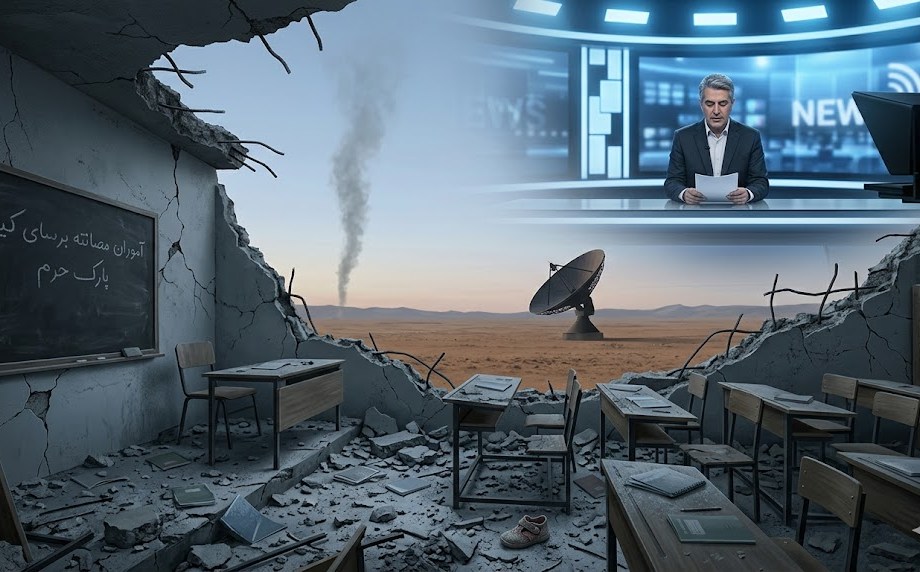
How can you spot failure in your press gallery? Simple. You know your news media has failed when your government sends special forces to a war it denies waging. When Pine Gap feeds targeting coordinates to bombers killing schoolchildren. And when 170 girls aged seven to twelve are obliterated at their desks in Minab, yet your small target PM takes to the ABC to parrot the belligerents’ justifications without challenge. Australia’s mainstream press hasn’t just failed this test for six weeks. It has “Ajax-ed” the crime, scrubbing far more than just blood from the ledger of history.
The language is the first giveaway. The ABC, our public broadcaster, describes the Minab massacre as “more than 100 children dead in a strike on an Iranian girls’ school.” Not murdered. Not by our allies. Just dead, as if they expired of natural causes. As if no one pulled the trigger. As if the laws of physics and morality somehow suspended themselves over Minab.
The Sydney Morning Herald goes further, calling it “a military error” that “cast a shadow on the US operation.” A shadow. As though the deaths of 170 children are a minor inconvenience, a smudge on the ledger of war, a footnote to the main event. Military error is almost a misdemeanour.
The 13th-century Persian poet Saadi wrote, “The children of Adam are limbs of one body, each created from the same essence.” But in Minab, 170 of those limbs; girls aged seven to twelve—were not rendered invisible. They were erased.
One moment, they were reciting lessons, laughing, passing notes. The next, a Tomahawk missile turned their classroom into a slaughterhouse, their desks into splinters, their futures into ash. There was no warning. No evacuation. No chance. Just the sudden, unbidden destruction of innocence, reduced in our media to a passive clause: “more than 100 children dead in a strike.”
Saadi’s poetry speaks of unity. This war speaks of annihilation. And our press, in its careful language, speaks of nothing at all. But behind the conspiracy of silence is the both-sides fallacy and behind that is the propaganda cartoon of the evil regime: the theocratic bastards had it coming to them anyway.
The Man Who Made the Monster
Why does our media fail? The answer, in no small part, is a 95-year-old former Toorak toff, who long ago traded his Australian passport for American power. Rupert inherited not just his father Keith’s media holdings, but also his knack for blending journalism with political power.
“Rupert Murdoch spent the next half-century seeing what happens when one man controls enough newspapers, TV networks, and politicians’ private lines to bend a ruling class or two to his will.
Rupert Murdoch didn’t just endorse the Iran debacle. He lobbied for it. According to Bloomberg, Murdoch, alongside Israeli Prime Minister Benjamin Netanyahu, privately urged Donald Trump to attack Iran. This wasn’t Murdoch the commentator. This was Murdoch the puppet master, working a president he helped install, pushing for a war his outlets would then cover with the considered neutrality of a cheerleader at a blood sport.
When the bombs fell, his empire’s headlines told the story: “DEATH TO THE DEVIL” (on the killing of Ayatollah Khamenei), “DON GETS LAST LAUGH” (after the US sank an Iranian warship), and, most chillingly, “NO MERCY.”It is the vocabulary of a tabloid covering a football match, not a free press covering a war. But then, Murdoch’s papers have form. It was his British tabloid, The Sun, that screamed ‘GOTCHA!’ on its front page after the General Belgrano was torpedoed in 1982, killing 323 Argentine conscripts, most of them young men who had no more chosen that war than the children of Minab chose this one. Different masthead, different hemisphere. Same owner. Same instinct. Forty-three years and nothing learned.
In Australia, Murdoch’s outlets aren’t just reporting the war, they’re gaslighting the public. As petrol prices surge by 40 percent; a direct cost of the Hormuz closure, a direct consequence of the war they cheered on, his tabloids don’t blame the bombs or the blockades. They blame Chris Bowen. The energy minister. The man holding the hose at the bowser. Never mind that the pump’s price is set by a war Murdoch’s papers demanded, a war his editors framed as necessary, a war his headlines sold as righteous. The distraction isn’t a side effect. It’s the strategy. The war isn’t just a story for Murdoch’s media. It’s a business model. The chaos, the fear, the soaring prices—they’re not bugs in the system.
They are the system.
As the Prussian military theorist Carl von Clausewitz observed, “War is the continuation of politics by other means.” In Murdoch’s hands, it is also the maximising of profit by other means.
The Language of the Bloodless War
There is a craft to how Western media reports war, and it is the craft of the anaesthetist. The goal isn’t to inform. It’s to numb.
The vocabulary is so ingrained that journalists reach for it unthinkingly: strikes, not bombings; targets, not schools; assets destroyed, not people killed; collateral damage, not dead children. The military issues a statement. Coalition forces conduct operations. The situation remains fluid. A facility is neutralised. By the time a reader deciphers “a strike on a facility in the vicinity of a girls’ primary school in Minab, Hormozgan Province, in which a number of civilian casualties were reported,” they have been successfully shielded from the truth: that an American Tomahawk missile or two turned a classroom into a charnel house.
This isn’t accidental. It’s systemic. During the Vietnam War, the US military briefed journalists daily at what correspondents came to call the Five O’Clock Follies, where body counts and “pacified hamlets” sanitised industrial-scale slaughter. It worked until photographers like Nick Ut showed the world what the war actually looked like: a nine-year-old girl, Phan Thị Kim Phúc, running naked down a road, her back on fire with napalm. That single image did more to turn public opinion than a decade of Pentagon briefings. It worked because it refused the system. It showed the thing itself.
There is no equivalent image from Minab in the Australian mainstream press. There are only statistics, spokespeople, and “reports of” and “alleged incidents.” The AI-generated battle graphics on the nightly news are clean and precise, little animated arrows on digital maps, ordnance arcing in parabolas toward rendered targets. It looks just like a video game because the people who design these graphics have learned from video games: abstraction is comfort, and comfort keeps people watching in between lashings of shock and awe.
When US Defence Secretary Pete Hegseth vowed to show “no quarter, no mercy for our enemies,” a law professor and editor at Just Security told Axios this would constitute a war crime under the Pentagon’s own Law of War Manual. The Australian press reported Hegseth’s words. The legal assessment received considerably less coverage. The headline wrote itself. The follow-up did not.
The Questions Not Being Asked
The silences in Australian newsrooms are deafening.
Why, when 61 percent of Australians want no part in this war, is the Albanese government’s posture of covert co-belligerence treated as a footnote? When the Herald Sun reported that around 90 SAS members were deployed to Al Minhad Air Base in the UAE in mid-March, Communications Minister Anika Wells did not rule it out on ABC News Breakfast.
Defence Minister Richard Marles declined to answer directly, assuring listeners only that there were “no boots on the ground in Iran.” A geographic technicality. Moral abdication. Our soldiers aren’t in Iran. They’re in the UAE, feeding data to bombers. The distinction is meant to absolve us. It does not.
Then there’s Pine Gap. Richard Tanter, who has spent more years studying Australia’s joint intelligence facility at Alice Springs than most defence ministers have spent reading their briefings, confirms what Canberra will not: Pine Gap isn’t just listening. It’s providing real-time intelligence for US strikes. Offensive, not defensive. Its 45 radomes and Advanced Orion satellites give Washington total surveillance coverage of Iran. As veteran activist, physician, author, and anti-nuclear advocate Dr Helen Caldicott, warns,
Pine Gap is the “nidus point” for nuclear war fighting. We’re not bystanders. We’re accessories.
And the press? Mostly silent. While Australians pay 40 percent more at the pump, Murdoch’s outlets blame the energy minister, not the war his papers demanded. The distraction is the strategy.
Roman historian Tacitus noted, “The more corrupt the state, the more numerous the laws.” In this case, the more complicit the media, the more euphemistic the language.
Who Profits?
Wars are rarely fought for the reasons stated. The stated reasons here are the prevention of Iranian nuclear ambitions, the destabilisation of Iran’s regional proxies, and the protection of the “rules-based order”; an order whose rules, ironically, prohibit the very aggression used to “protect” it. The real reasons are worth examining.
On Wall Street, defence firms including Lockheed Martin, Northrop Grumman, and RTX see their shares jump by four to six percent on the first day of strikes. The three firms’ combined shareholder gain on that single day is 25 to 30 billion US dollars. In Israel, Elbit Systems briefly became the country’s most valuable listed company, its shares up 45 percent since January. Thirty billion dollars of shareholder value was created in one day, before a single declared objective had been achieved, before a single piece of Iranian military infrastructure was confirmed destroyed. The money did not wait for the outcome. It knew the outcome was irrelevant. The outcome was the war itself.
Non-Gulf energy producers everywhere; US LNG exporters, Norwegian oil fields, Australian gas giants, suddenly found themselves in a seller’s market. Every molecule of energy that did not have to travel through Hormuz became more valuable overnight. American LNG terminals ran at full capacity, shipping cargoes as fast as physically possible. LNG margins doubled. Brent crude surged past 120 dollars a barrel.
In Australia, shares in Woodside Energy and Santos posted record quarters as the war in Iran tightened global fuel supplies. Westpac expects a multi-billion-dollar windfall for the country over the next five years. When the Greens proposed a windfall tax on LNG profiteers, Shell and Chevron howled, calling it a “knee-jerk sugar hit” and “the exact opposite of what Australia needed.” The audacity is staggering, but it is entirely consistent: the companies that profit from wars always find a language for why the profits are deserved and the costs are someone else’s problem.
There is also a political dividend. Before the strikes began, the fallout from the Epstein files was reverberating globally, piling scrutiny on powerful figures with connections to the White House. On the first day of Operation Epic Fury, the Epstein files vanished from the front pages of every Murdoch outlet. They have not returned. The war is the story. Other stories are not the story.
The Persian poet Rumi wrote, “You are not a drop in the ocean. You are the entire ocean in a drop.” Yet amidst the cacophony of this distraction, the ocean of public concern is reduced to drops of outrage, carefully directed, carefully contained.
The Press That Is Actually Doing Its Job
While the mainstream looks away, the independent and student press are holding the line.
Honi Soit, the University of Sydney’s student paper, called out the ABC’s use of “dead” instead of “killed”, language that absolves responsibility, that marks human life as disposable. Michael West Media exposed how Murdoch’s outlets scapegoat Chris Bowen for fuel prices while ignoring the war’s role. Declassified Australia did the forensic work on Pine Gap that the national press refused to undertake. These outlets aren’t fringe. They’re what journalism looks like when it isn’t carrying out other functions.
Clinton Fernandes at UNSW has been unequivocal about Australian complicity through Pine Gap, a truth the Albanese government would rather not discuss. Trita Parsi at the Quincy Institute for Responsible Statecraft has produced the sharpest analysis of the diplomatic failures that led here. Antony Loewenstein’s body of work, documenting Australia’s integration into US and Israeli military operations, was available to every editor in Sydney and Melbourne before the first Tomahawk was launched. They chose not to assign the follow-up. The sources were never the problem.
The AIMN has been something else.
No single mainstream outlet has produced, across six weeks of war, anything approaching this analytical range. The AIMN doesn’t have a Canberra bureau or a defence correspondent on retainer. It has writers who read widely, think independently, and are not frightened of where the evidence leads.
What This Means (Part 1)
Australia is not a bystander to this war. We are a silent co-belligerent, hosting the intelligence infrastructure, providing the targeting capability, deploying special forces, accepting the fuel price as the cost of alliance, and generating a multi-billion-dollar windfall for corporations that have always owned more of this country’s politics than its voters.
Our press could report this. Instead, it hands the government a language system in which none of this is happening, or if it is, it’s not our fault, or if it is our fault, it’s Iran’s fault for being destabilising, or if it’s not Iran’s fault, it’s Chris Bowen’s fault for the price at the pump. The system is seamless. It has an answer for everything except the question it cannot answer: What happened to 170 girls in Minab? Who killed them? And what are we going to do about the fact that our satellite dishes helped guide the missile?
A democracy that cannot report its own wars is not a democracy. It is a client state, managing its own consent, with a Melbourne-born mogul in New York making the calls, a former prime minister in Sydney pushing for boots on the ground, and a current prime minister on the ABC, reading someone else’s script in his own voice.
Part 2 will expose the mechanics of Pine Gap’s role, the corporate lobbyists writing AUKUS’s blank cheques, and the journalists fighting to drag the truth into the light before the next strike.


This piece is very necessary. Certainly Murdoch is one ‘puppet master’ – of the malevolent puppet with whose regime we remain allied. The other master is of course Netanyahu – Israel is now running the US military.
It is a serious concern that Australia has less to say about these illegal threats and attacks than the [American] Pope.
The MSM including the ABC have been complicit and egregious.
Remember also the Press Club platforming the arrogant, hectoring Israeli Ambassador who denied the Gaza genocide and the killing of journalists, and who our press gallery stroked with a feather – never challenged. He should be expelled. A disgrace.
On AIMN good reporting and commentary, Emma Shortis from The Australia Institute is always very clear about what Australia’s position SHOULD be.
LikeLiked by 2 people
The good Dr. Helen Caldicott is still alive. Born on August 7, 1938, the Australian physician, author, and prominent anti-nuclear activist continues to be active in her field. As of early 2026, she is in her 80s, living between Australia and the United States, and continues to voice warnings regarding nuclear threats.
LikeLiked by 1 person
Thanks, amphibious. I did meet her in a previous life. PND. Inspiring. My faux pas. Thank you.
LikeLike