PART TWO OF THREE
Trump demands unconditional surrender from a nation of 90 million. Iran elects a hardline new Supreme Leader and rules out any ceasefire. The MAGA coalition fractures. What began as targeted strikes has become a war without an exit, a plan, or a president capable of admitting either.
As Operation Epic Fury stumbles into its second week, the self-styled dealmaker posts on Truth Social on 7 March with the measured diplomatic nuance his admirers have come to treasure: “There will be no deal with Iran except UNCONDITIONAL SURRENDER!” Iran will be hit “very hard,” with unnamed areas and unnamed groups of people under “serious consideration for complete destruction and certain death.”
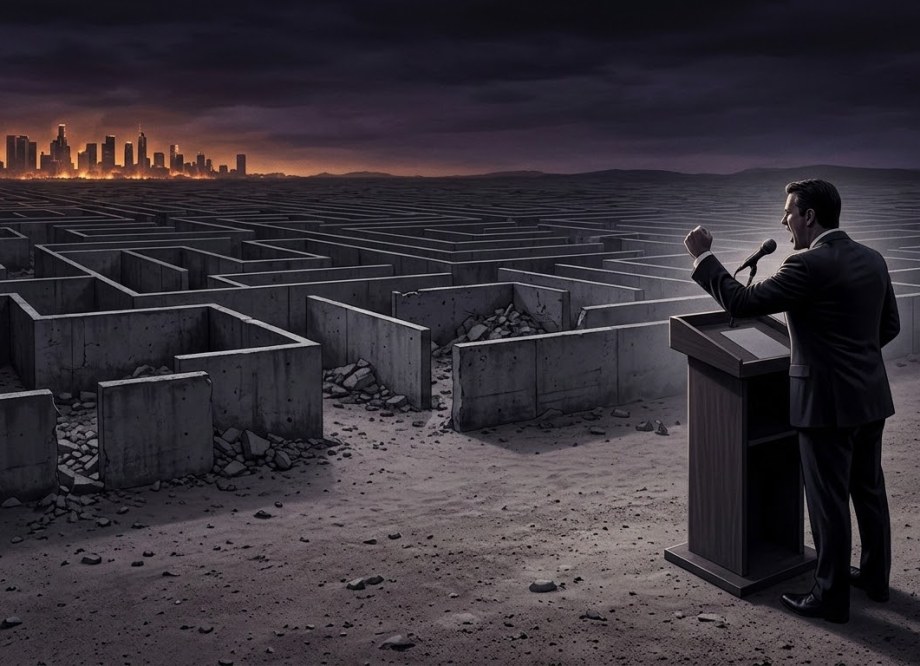
This is not the rhetoric of a man looking for an off-ramp. It is the rhetoric of a man who has driven his military into a cul-de-sac and has only one move left: put the foot down. In this theatre, that has one logical destination. Boots on the ground. Iraq 2.0. Bigger. Worse. And assembled, God help us, by this particular cast.
The only thing truly epic about Operation Epic Fury is the monumental scale of its self-parody: a war without a plan for the morning after, burning through $891 million a day, pushing oil above $100 a barrel for the first time since 2022, and distinguished above all by true believers who have confused their own certainty with competence. Barbara Tuchman, whose The March of Folly documented governments pursuing policies demonstrably contrary to their own interests, would have recognised the pattern immediately. She would not have been surprised. She would have been appalled.
‘I Don’t Say It’
At a rally in the war’s first week, Trump goes helpfully off-script.
“Like every president says, there will be no boots on the ground. I don’t say it.” He adds: “I say probably don’t need them, or if they were necessary.”
To the New York Post he swaggers: “I don’t have the yips with respect to boots on the ground.”
Equally yip-free, Defence Secretary Pete Hegseth reassures the nation: “You don’t have to roll 200,000 people in there and stay for 20 years.” How did this former Fox News jockey ever get to be head of a military obsessed with lethality; a Pentagon now renamed The Department of War?
Hegseth scraped into his job at Defense on a 51-50 Senate vote, with JD Vance providing the tiebreaker after three Republican senators vote against him. At his confirmation hearing, facing allegations of excessive drinking and sexual assault, he offers: “I’m not a perfect person, but redemption is real. I have failed in things in my life, and thankfully I’m redeemed by my Lord and Saviour Jesus.”
A religious nut with crusader tattoos etched across his chest is now running America’s war machine?
Crusader Hegseth is not wearing those tattoos as a fashion statement. He is a Christian nationalist who genuinely believes he is prosecuting a holy war, which means he is not running a cost-benefit analysis. Men who believe they are instruments of divine will do not look for off-ramps. Theologically speaking, an off-ramp is a failure of faith. Onward, Christian soldiers.
By 7 March, an Iranian Kurdish leader based in Iraq is telling reporters that a US ground operation is now “highly likely.” But they will pass on being cannon-fodder. Trump has personally been ringing Kurdish leaders Masoud Barzani and Bafel Talabani about “next stages of war in Iran.” Both are cool on the idea of sending Peshmerga fighters to die for the Great Satan, citing the devastating Iranian military response that any Kurdish incursion from Iraq would guarantee. The White House says Trump has not agreed to arm Kurdish forces, while simultaneously declining to deny that such discussions are occurring.
Axios reports that Trump has privately shown “serious interest” in deploying US troops inside Iran. A senior official clarifies the semantic game: “Boots on the ground for Trump is not the same as what it means for the media. Small special ops raids, not a big force going in.”
Senator Richard Blumenthal emerges from a classified briefing ashen-faced: “I am more fearful than ever that we may be putting boots on the ground.” Senator Elizabeth Warren’s video after the same briefing is curt: “It is so much worse than you thought. You are right to be worried.”
The emerging strategy is the oldest page in the American playbook: use someone else’s boots. Kurdish fighters, Iranian dissidents, internal resistance. The Americans supply the airpower and the money. What could possibly go wrong? History, from Vietnam to Iraq to every other catastrophic adventure powered by this particular logic, has a consistent answer.
Everything. As Hemingway said of going bankrupt, it happens two ways. Gradually-then suddenly.
MAGA’s Civil War
This strategic unravelling is compounded by a civil war erupting within Trump’s own coalition at precisely the worst moment. Tucker Carlson excoriates the strikes as “absolutely disgusting and evil.” America First isolationists see the conflict as a betrayal of the non-interventionist promises that delivered them Trump in the first place. Oil shocks are hammering the economy. Midterms are coming. Reuters notes the war “tests MAGA unity.”
Bloomberg is blunter: “MAGA is split.”
JD Vance, who once wrote that the best Trump foreign policy was not starting any wars, now performs the difficult acrobatics of a man balancing his anti-intervention convictions against his survival instincts. An NPR/PBS/Marist poll finds 56 per cent of Americans opposed to the conflict. For comparison, the 2003 Iraq invasion launches with 55 per cent support.
Trump is fighting a war that most Americans oppose before the first boot touches Iranian soil, and he is doing it with a base that is fracturing along the very fault lines his foreign policy adventurism has opened.
A bipartisan War Powers resolution is defeated 47 to 53 in the Senate, handing Trump 60 to 90 days before mandatory withdrawal without congressional authorisation. That clock is running. And for a president whose entire political shtick depends on base fervor, this domestic fracture is not an inconvenience. It is an Achilles heel being struck repeatedly by a Tomahawk missile.
The Dynasty Answers Back
On 8 March, day nine of the war, Iran answers Trump’s demand for unconditional surrender with something between a raspberry and a declaration of deadly defiance. The Assembly of Experts elects Mojtaba Khamenei, the 56-year-old son of the assassinated Supreme Leader, as Iran’s third Supreme Leader. The IRGC pledges full allegiance within hours. Hezbollah circulates his portrait captioned: “Leader of the blessed Islamic revolution.” Foreign Minister Araghchi appears on NBC’s Meet the Press to announce that Tehran is not seeking a ceasefire and will “continue fighting for the sake of our people.”
Trump has publicly declared Mojtaba “unacceptable” and announces that he requires American approval for the appointment. “He’s going to have to get approval from us. If he doesn’t get approval from us, he’s not going to last long.”
The Assembly’s response carries the serenity of people who have thought about this rather more carefully than their foe. The candidate has been chosen, they explain, because his father advised that Iran’s leader should “be hated by the enemy” rather than praised by it. “Even the Great Satan has mentioned his name,” a senior cleric adds with evident satisfaction.
The regime that was supposed to collapse has instead elected a new leader, pledged to continue fighting, and chosen him specifically because the US President found him objectionable. The plan is working perfectly, if you happen to be in Tehran.
Mojtaba Khamenei is, by all accounts, more hardline than his father. He is credited with supervising the crushing of the 2009 protest movement and is linked to the brutal crackdown on the January 2026 uprisings that kill thousands. He studies under a cleric who advocates executing youths for “Western immorality.” Now injured and living in hiding, with, as one analyst puts it, “a bull’s eye on his back,” he inherits a government at war with the world’s greatest military, at war with Israel, and at war with a significant portion of its own people. The IRGC rallies to him anyway.
This is the institution Trump’s air campaign was designed to break.
The IRGC Is the Regime
The Islamic Revolutionary Guard Corps is not a conventional military that dissolves when its supreme commander falls. It is a state within a state: an ideological institution with its own intelligence apparatus, its own economic interests, its own tunnel networks, its own regional proxy architecture extending from Lebanon to Yemen to Iraq. Its response to the opening strikes, launching retaliatory waves within four hours, does not indicate a rattled organisation. It indicates pre-planned contingency operations executed with professional precision by people who have been preparing for exactly this moment since 1979.
Trump demands unconditional surrender from this institution. He also demands the right to approve its new supreme leader. It is worth pausing on what this reveals about the man making these demands.
Trump’s insistence that he should vet Iran’s head of state is not a negotiating position. It is not even a serious political statement. It is the geopolitical expression of a personality that has never encountered a boundary it regarded as applying to itself. Psychiatrists have a name for the clinical inability to recognise other human beings as sovereign entities with their own legitimate interiority and agency. The word does not get deployed lightly in responsible political commentary. But watching a president announce “complete destruction and certain death” for unnamed groups of people, demand veto rights over a foreign nation’s constitutional process, and post this on a social media platform he owns, it becomes genuinely difficult to locate a more clinically precise description.
Sociopath.
Hannah Arendt warned us that the most dangerous political actors are not necessarily those consumed by obvious malice. They are those who simply fail to think: who act on impulse, vanity, and the assumptions of their own exceptionalism without the basic cognitive friction that comes from acknowledging that other people are real. Trump is not stupid. He is something more dangerous: a man of considerable political cunning who operates in an entirely self-referential moral universe.
In that universe, Iran is not a nation of 90 million people with a history, a culture, and a legitimate government. It is an obstacle. A deal that has not yet been made. A surrender that has not yet been extracted.
The man who built his brand on The Art of the Deal has, in nine days, managed to strengthen his enemy’s resolve, unify its IRGC, elect the one leader he publicly declared unacceptable, close the Strait of Hormuz, spike global oil prices, fracture his own base, and drive American public opinion into majority opposition. As dealmaking goes, this is a fairly comprehensive audit failure.
What began as a two-part series has, like the war it is covering, refused to stay within its original boundaries. Part Three, “Coda: The Mathematics of Catastrophe,” covering the missing faces, the strategic arithmetic, and the human cost, follows on Tuesday.
Part One, “Trump’s Team at War With Itself,” was published 8 March 2026.
 Urban Wronski Writes
One thought on “Trump, The Dealmaker’s Fatal Error”
Comments are closed.