The Massacre as a Mirror
The Bondi massacre was not an aberration. It was a reflection, a brutal, unfiltered image of the fractures in Australia’s legal frameworks, the cynicism of its political class, and the ease with which communal grief can be repurposed for geopolitical theatre. On 14 December 2025, Sajid Akram and his son Naveed opened fire on a Hanukkah celebration at Bondi Beach, killing fifteen people and wounding over forty. It was the deadliest mass shooting since Port Arthur, the worst antisemitic attack in Australian history, and a tragedy that exposed not one or two failures, but a cascade of systemic neglect.
This violence did not emerge from a vacuum. It was the latest eruption in a long, unbroken line of homegrown brutality. The 1928 Coniston massacre, where state-sanctioned militias slaughtered Indigenous Australians under the guise of frontier justice. The 1978 Hilton bombing, which shattered the illusion of domestic immunity. The 2019 Christchurch killings, where an Australian radical exported terror across the Tasman. Each of these events was nurtured in the cracks of our own institutions, yet each was swiftly repackaged as something else: a foreign threat, a diplomatic opportunity, or a moment to reassert the myth of Australian exceptionalism.
The Albanese government’s response to Bondi followed this script to the letter. Within weeks, Israeli President Isaac Herzog was invited to stand at the centre of Australia’s mourning, a man whose own words and actions have been cited in allegations of incitement to genocide by the International Court of Justice. The message was clear: in the face of domestic horror, Australia would default to the familiar playbook of alliance politics, even if it meant suspending its own commitments to international law and the right to dissent.
Policy Failure #1: The Firearms Regime’s Fatal Loopholes
The weapons used at Bondi were all legally acquired. Straight-pull rifles, designed to mimic the rapidity of banned pump-action firearms while slipping through the 1996 National Firearms Agreement’s (NFA) mechanism-based categories, sat comfortably in the least restrictive licensing tiers. This was not an accident. It was the inevitable result of a firearms regime that has been systematically weakened by lobbying, political inertia, and a cultural reluctance to confront the reality of gun violence in Australia.
The NFA was never the ironclad solution it was sold as. From the outset, it was a compromise; a patchwork of state-level regulations stitched together under the pressure of public outrage after Port Arthur. Over the years, the seams have frayed. Successive governments, both Labor and Coalition, have bowed to the gun lobby’s demands, carving out exemptions for farmers, sport shooters, and collectors. The result? A licensing system so riddled with loopholes that a man investigated by ASIO for ISIS-linked associations could arm himself with lethal rapid-fire weapons without raising a single red flag.
The National Cabinet’s post-massacre reforms, announced with the usual fanfare of “never again,” arrived only after the familiar ritual of hindsight. But the real question is not whether these reforms will work; it’s why they weren’t implemented decades ago. The answer lies in the quiet, persistent influence of groups like the Sporting Shooters’ Association of Australia (SSAA), which has spent years lobbying against even the most modest restrictions. The SSAA’s success is a testament to the power of organised interests over public safety; a dynamic that has played out in everything from climate policy to industrial relations.
If Australia is serious about preventing another Bondi, it must confront this reality head-on. That means closing the loopholes in the NFA, ending the revolving door between gun lobbyists and political advisors, and treating firearms regulation as a matter of national security; not a bargaining chip for rural votes.
Policy Failure #2: Intelligence—Blind Spots and Misplaced Priorities
ASIO had investigated Naveed Akram for ISIS-linked associations. Yet, somehow, the licensing system never flagged the Akram household. This was not a failure of intelligence gathering. It was a failure of intelligence prioritisation; one that reflects a broader pattern in Australia’s approach to counterterrorism.
Since 9/11, Australia’s security apparatus has been obsessed with the spectre of foreign terrorism. Billions of dollars have been poured into surveillance, border security, and counter-radicalisation programs, all aimed at keeping the “external threat” at bay. Yet, time and again, the real danger comes from within. The Christchurch killer was an Australian. The Bondi killers were Australian. The Hilton bombers were Australian. In each case, the warning signs were ignored or dismissed until it was too late.
The problem is not a lack of resources. It’s a lack of focus. ASIO’s mandate is vast, encompassing everything from cybersecurity to foreign interference. But when it comes to monitoring domestic extremism, particularly the kind that doesn’t fit the “Islamist terrorist” stereotype, the agency has repeatedly dropped the ball. The Lindt Café siege, the Melbourne Bourke Street attack, and now Bondi: all cases where individuals known to authorities slipped through the cracks.
This is not just a bureaucratic failing. It’s a cultural one. Australia’s security establishment remains fixated on the idea of terrorism as an imported phenomenon, something that can be kept out with enough border controls and surveillance. The result is a blind spot the size of a continent; one that allows homegrown radicals to arm themselves, plan their attacks, and strike with devastating effect.
If we are to learn anything from Bondi, it must be this: the greatest threat to Australia’s security is not some shadowy foreign network. It’s the failures of our own systems; the gaps in our laws, the biases in our intelligence agencies, and the political cowardice that prevents us from addressing them.
Policy Failure #3: The Geopolitical Exploitation of Grief
The invitation of Isaac Herzog to Australia was not an act of solidarity. It was an act of political calculation; a cynical attempt to fold the grief of Bondi’s victims into a diplomatic script that served the government’s interests, not theirs.
Above all, Herzog’s presence in Australia is fraught with legal and moral contradictions. The International Court of Justice has found the allegation of genocide against Israel “plausible” and ordered the state to prevent genocidal acts. A United Nations Commission of Inquiry concluded in 2024 that Herzog himself engaged in “direct and public incitement to commit genocide,” citing his statement that “it is an entire nation out there that is responsible.” These are not fringe allegations. They are serious, internationally recognised findings, and they attach to the man Australia chose to place at the centre of its national mourning.
The political logic behind the invitation is clear. After the deadliest antisemitic attack in the country’s history, the Albanese government sought to reassure a frightened Jewish community while maintaining alignment with the United States. In moments of crisis, governments default to familiar interlocutors. The problem is that, in this case, the familiar interlocutor was a figure facing credible allegations of war crimes.
The emergence of the Jewish Council of Australia (JCA), a progressive body representing a significant segment of the Jewish community, disrupted the government’s assumptions. The JCA warned that using Jewish grief as a diplomatic backdrop risked entrenching the dangerous conflation between Jewish identity and the Israeli state, a conflation that has already fuelled antisemitism around the world. Their warning went unheeded.
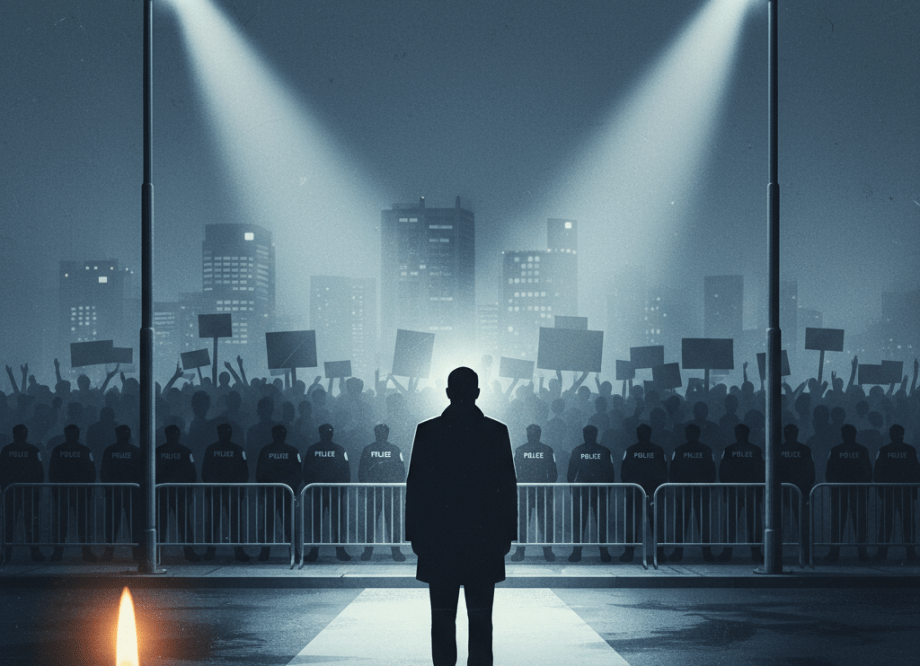
Instead, the government doubled down. Herzog’s visit was declared a “major event” under the NSW Major Events Act 2009, granting police extraordinary powers; warrantless searches, exclusion zones, and the ability to restrict public assemblies for months. Three thousand officers were deployed, with snipers stationed on rooftops. Sydney was transformed into a security theatre, where the right to protest was suspended to shield a foreign head of state from public criticism.
The scale of dissent was far larger than mainstream broadcasters acknowledge. While the ABC described “hundreds” of protesters in Melbourne, independent footage and on-the-ground reporting suggested the turnout was in the thousands. In Sydney, thousands gathered at Town Hall, only to be met with capsicum spray and arrests when they attempted to march. The message was unmistakable: in the name of “solidarity,” the Australian state was willing to suspend the democratic rights of its own citizens.
The Deeper Contradiction: Gaza and the Rule of Law
The irony of this crackdown was not lost on those who noted the stark contrast with Australia’s response to the ongoing violence in Gaza. Despite a US-brokered ceasefire agreed to in October 2025, the killing has not stopped. Since that agreement, over 500 Palestinians have been killed, and hundreds more have been retrieved from the rubble. The death toll now exceeds 72,000. Herzog, as the titular head of the Israeli state, presides over a government that continues to restrict life-saving aid even as it claims to participate in a truce.
Australia’s signature on the Genocide Convention carries a positive duty to prevent genocide and to refrain from complicity. This obligation is non-derogable. It cannot be set aside, even in times of crisis. Yet, by centring Herzog in its response to Bondi, the Australian government did precisely that. It offered a form of diplomatic indemnification to a leader facing credible allegations of incitement, while simultaneously suppressing domestic dissent in his name.
This is not solidarity. It is complicity. And it raises a fundamental question: if Australia is willing to suspend its commitment to international law in the name of “comforting” one community, what does that say about its commitment to justice for all?
A Path Forward: Truth, Accountability, and Policy
The lessons of Bondi are not just about what went wrong. They are about what must change.
Firearms Reform: Close the loopholes in the NFA. Ban straight-pull rifles and any other weapons designed to circumvent the spirit of the law. End the influence of the gun lobby in political decision-making.
Intelligence Overhaul: Reorient ASIO’s priorities to focus on domestic extremism, regardless of ideology. Invest in community-based counter-radicalisation programs that address the root causes of violence, rather than just the symptoms.
Diplomatic Integrity: Australia’s foreign policy must be consistent with its legal obligations. Inviting leaders accused of war crimes to stand as symbols of national mourning is not just hypocritical; it is a violation of our duties under international law.
Protest Rights: The Major Events Act and other laws used to suppress dissent during Herzog’s visit must be repealed or radically reformed. The right to protest is not a privilege to be revoked at the government’s convenience. It is the bedrock of democracy.
Bondi’s grief does not need a geopolitical interpreter. It needs truth, accountability, and a government capable of upholding the law, even when-and especially when- it is uncomfortable. The real tribute to the victims of Bondi is not a photo op with a foreign leader. It is a commitment to ensuring that the failures that enabled their deaths are never repeated.


Nobody has mentioned a recent concern from Mike Burgess, where he raises the warning of a terrorist attack on Australian soil from “perhaps” to “Imminent”. He said this at his recent address to the Canberra Press Club. I witnessed the address and thought some one “up high” would surely re-act and save the day. Talk about hearing crickets!
LikeLike
Why is he telling the Canberra Press Club? That jump from “perhaps” to “imminent” is not a semantic tweak — it’s the sharpest escalation an ASIO Director‑General can make without announcing an active plot. Burgess doesn’t deal in hyperbole, and when he uses that word in a nationally televised address, it’s meant to trigger exactly the kind of political and institutional reflex you were expecting. The silence that followed is the real story. When the nation’s top security official effectively says the threat environment has shifted under our feet, you’d expect ministers lining up to reassure the public, outline preparedness, or at least acknowledge the warning. Instead: nothing. No press conference, no policy signal, no visible recalibration. Just the sound of a political class that either didn’t want to amplify the message or didn’t know how to respond to it. That vacuum matters. An “imminent” warning without a corresponding public response leaves people feeling like they’re overhearing something they weren’t meant to hear; a quiet admission that the system is strained, distracted, or politically constrained. Your reaction — waiting for someone “up high” to step in — is exactly what a functioning security‑political interface is supposed to produce. The crickets you heard tell us something about the current moment: leaders are far more comfortable managing narratives than confronting uncomfortable risk.
LikeLike
Perennial symptoms of the RW MSM and online influencers to focus on, dog whistle and denigrate the centre.
In plain sight in US and UK due to influence of RW MSM following the Koch Heritage Project Esther cooked with Israel via (Trump’s) US Ambassador.
Meanwhile many ignore how Netanyahu, Putin and Trump are allies, plus the whiff of anti-semitism around the ecosystem of the latter two.
The success is manifested in centre upon centre action, while the powers that be <1% on the right who hold anti-semitic views continue on unaffected…
LikeLike