There is a peculiar sound Australia makes after a terror attack. It is not grief; grief is human, raw, and unscripted. This is institutional. It is the soft hiss of officialese sliding across the microphone: “no ongoing threat… no evidence of a wider network… acted alone… we did everything we could.“
It is the sound of the state reaching for a political Panadol to dull the edges of what has just unfolded.
Bondi Beach massacre medication is packaged in two handy doses. The first is geographical: the southern Philippines, Mindanao, Davao. Far enough away to hold our fear without staining our conscience. The second is psychological: lone wolves. A phrase that doesn’t merely describe; it disinfects, detaches and diminishes. It takes a whole social ecosystem and shrink-wraps it as a freak weather event; sudden, unpredictable, unlucky.
But listen up. No one is to blame but the storm itself.
Tragically, Bondi wasn’t a storm. It was the outcome of a sequence. And sequences have beginnings.
1. Davao: The Tidy Story That Collapsed
Start with the one detail everyone wants to mean something, because it means the problem is not us.
In early November 2025, Sajid Akram (50) and son Naveed (24) fly out of Sydney only to hole up in Davao City, another couple of hours’ flight south of Manila, where they spend nearly a month in the GV, as the Grand Victorian, is now known, to avoid self-parody. It’s a one star, budget hotel, which struggles to provide running water, (ring the desk) but it’s a magnet to any drug courier or anyone else who wants to melt into the crowd in the bustling heart of the city and an absolute steal at twenty-six bucks a night.
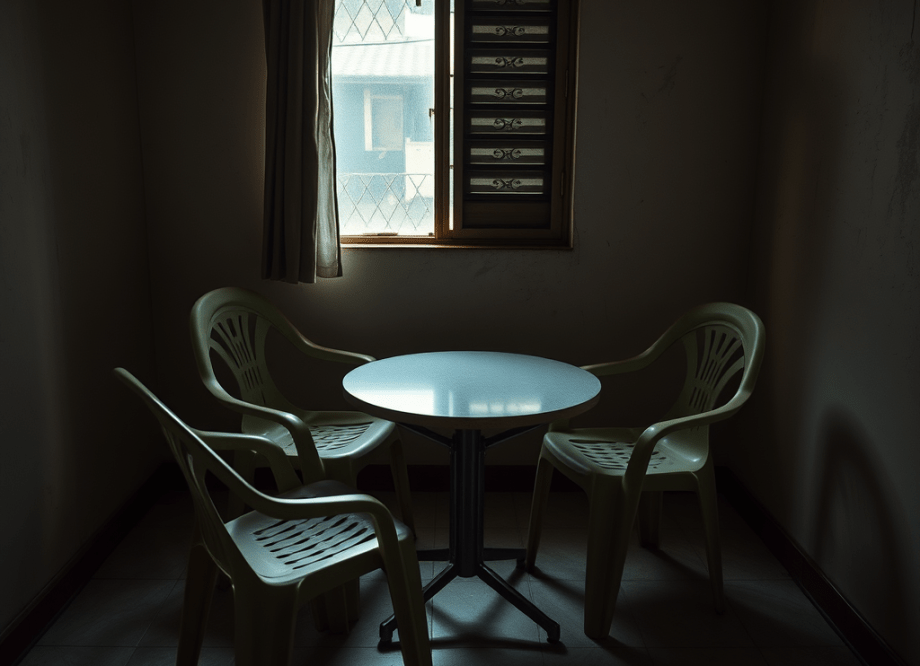
Strictly cash-only. Expect the water to be turned off at night. You do get two moulded plastic chairs and a melamine topped, steel framed table such as your’re likely to find in a prison visitors’ waiting room.
Imagine holing up in the GV for twenty-eight days of humidity and elderly air-conditioning, a month before the dry season. But those twenty-eight days fire our imaginations to run our favourite terror film: shadowy training camps, foreign handlers, jungle drills, Mindanao militants.
Tack on a father and son back-tracking to Bankstown with something more than Durian product souvenirs in their carry on bags.
Then the film in the antique projector snaps. Philippine authorities reject the training-camp narrative, and Australian officials later concede there is no evidence of formal training or a wider operational cell.
The boys were bonding. It’s a father and son thing. The divorce, a year earlier, forces Naveed, a chunky, unemployed Year 12 dropout, who has worked with a brickie, to choose sides. As you do.
For Australia, a nation of commentators and home of the furphy, it’s tricky. But hold those two thoughts. One: there may truly be no evidence of a training camp in Davao. Two: a month in a budget hotel is still not nothing. Yes. It’s our old friend, beloved of judges and beaks of the week but probably originating from the worlds of Science, Astronomy and Statistical Mathematics:
“An absence of evidence is not evidence of absence.”
The principle is also closely related to the “argument from ignorance” fallacy in logic, where one assumes that a claim is true simply because it hasn’t been proven false (or vice versa). The cheap hotel is real.
A budget room in a Davao flea-pit, is not a training camp. It doesn’t need to be. It is privacy. It is time. It is a place to wait out logistics, transfers, or the arrival of something—or someone—else. Or mental preparation. It is the low-rent space that slips through the cracks of ASIO briefings because it doesn’t fit the script of what “preparation” is supposed to look like. And that is exactly why it matters.
You cannot prove what happened behind a locked door, and neither can any presser. Even the one called by Boss Cockatoo, Krissy Barrett, the (almost) new AFP Commissioner. But you can resist the cheap closure that comes from declaring the door irrelevant simply because you can’t see through it.
The Davao chapter matters not because it proves anything, but because it exposes how quickly Australia wanted the overseas explanation to be true. We are all invested in the foreign theatre on screen in the sticky-carpet and popcorn, cinema of the mind because it lets us off the hook.
Allows us to stop looking too closely at the local picture theatre.
2. Bankstown: The Local Stage We Keep Ignoring
Let’s walk back from the humid Mindanao drama and into the flickering fluoro of a suburban station.
Australia’s Bondi massacre did not begin on a December night at Archer Park. It began earlier, in western Sydney, at a folding table stacked with Qur’ans and pamphlets, in the polite language of street dawah.
In 2019, video circulates of a teenage Naveed Akram taking part in the Street Dawah Movement at Bankstown station. He is seen buttonholing other boys, urging prayer, pressing pamphlets into hands, under the eye of older men in the same outfit. At first glance, it looks like public piety; harmless, the sort of thing you wave away with an embarrassed shrug: freedom of religion, move along.
Except this wasn’t simply an anonymous act of private piety. It fits within a small, documented milieu, connected to a shopfront prayer space and a preacher whose orbit has been the subject of sustained public controversy, regulatory action, and court findings.
Let’s be crystal clear. Tread carefully. The popular discourse on terror is already knee-deep in reckless insinuation. There is no public evidence that any organisation, prayer space, or preacher “ordered” the Bondi attack. No one should pretend there is. “Pattern” is not “proof.” And if we are going to criticise institutions for jumping from inference to certainty, we don’t get to do the same.
But here is what can be said, simply and plainly: the younger attacker did not emerge from nowhere.
This matters more than any offshore indoctrination camp fantasy. The public record, from ASIO reports to NSW Police submissions, describes a western Sydney ecosystem where extremist sympathies have circulated for years. This is not about guilt by association, but about patterns: the same shopfronts, the same preachers, the same Saturday stalls. The question is not whether these spaces “ordered” the Bondi attack, but why their existence was treated as background noise until it became a scream.
The lone wolf narrative is designed to hide the elephant in the room: the uncomfortable fact that radicalisation is often a neighbourhood phenomenon. Not always. But often. It has people. Places. Schedules. A web, not a toxic miasma. And, unlike Trump’s spray-on tan, it’s a mutually interactive baptism; a recruit needs to be in the right stage of alienation, anomie and spiritual devastation.
When the official language says acted alone, you should hear what it is trying not to say:
An already vulnerable creature acted within a social and ideological climate that institutions did not want to name too clearly. Why?
Because naming it would require action that is politically, socially expensive and administratively messy.
3. Lone Wolf Theatre: Containment as a Reflex
The phrase “lone wolf” is an operational claim dressed up as a sociological diagnosis.
Operationally, it may be true that no foreign controller has been identified and no direct command structure has been proven. Fine.
But socially, “lone wolf” is theatre. It implies isolation. It implies randomness. It implies that the state’s role is to endure, not to learn. Nor take responsibility. It is the narrative equivalent of washing hands.
If the attackers were “lone” in any meaningful sense, it was not because they had no ideological lineage. It was because the state has become addicted to a convenient separation: ideology is someone else’s problem until it becomes a police matter, and then it becomes “unpredictable.”
Radical creeds do not recruit at random. They find purchase among the immiserated, the spiritually hollow, those who carry the chronic ache of exclusion. That is its mechanism. And mechanisms can be interrupted, if you are willing to look at the social humus and not just shoot the violent bloom.
The institutional impulse after Bondi has been to contain. Contain fear. Contain scrutiny.
Contain accountability.
Hence the quick Philippines denial. Hence the careful phrasing. Hence the strategic narrowness: there is no evidence of training; there is no evidence of a wider cell; therefore, the system remains intact.
But if your only metric of intelligence success is “was there a handler?”, then you will always “succeed” at the price of failing to see what actually produces violence.
What produces violence is not only orders. It is ecosystems, permissions, scripts, identities, moral licensing. The idea that the world divides neatly into “controlled by a cell” versus “acted alone” is the bureaucratic mind trying to force life into a form it can file.
4. Richardson: The System’s Self-Diagnosis
Enter Dennis Richardson, 78, a spry, ex-spy, drafted to conduct an “independent” review.
Richardson is no amateur, no outsider and nobody’s fool. He is the system’s veteran custodian: former head of ASIO, senior national security mandarin, a man who knows the wiring diagram because he helped build the (colour-coded) switchboard. Critics say he is just marking his own homework
That is precisely why his appointment reads less like sunlight and more like a pressure valve release.
This is not a royal commission with subpoena powers, public hearings, or the authority to compel testimony. It is a review led by a highly intelligent man who has spent decades inside the very system he is now asked to scrutinise. The risk is not that Richardson will lie. The risk is that the review will translate weakness into inevitability, that it will see what the system wants it to see: a tragedy, not a failure.
We already know the form of his likely conclusion, because we have seen it before: our agencies worked hard; resources are finite; the threat landscape is complex; information sharing can be improved; we’ll tweak processes; and, unfortunately, lone actors can slip under the net.
This is how a failure becomes a footnote, and a footnote becomes policy. And a case for more power.
5. Comparative Failures: The Reassurance Reflex, Then the Evidence That Arrives Later
If this sounds harsh, it’s because the pattern is old.
After terror events, the first story is always containment. The second story, months later, is always complexity, dragged into daylight by coroners, inquests, and courts.
Martin Place. Bourke Street. Christchurch.
Different ideologies, different contexts, same institutional rhythm.
The early posture is always: no broader threat, nothing systemic, no “intelligence failure” in the dramatic sense.
Then the later record arrives, and it turns out the system had seen fragments, had flagged the person, had assessed and deprioritised, had known but not acted, had failed to share, had triaged away what later proved fatal.
Again, be careful: hindsight is easy, prediction is hard. Intelligence is not clairvoyance.
But the lesson is also clear: the failures that matter are not Hollywood failures. They are administrative failures. Process failures. Sharing failures. The slow, human failures of a machine that is very good at defending itself from critique. And increasingly given to performative appeals for even more power.
Christchurch, in particular, should stick like a bone in Australia’s throat. Not because it proves agencies could have prevented Brenton Tarrant’s 2019 massacre of families at prayer, but because it shows what happens when a system is weighted toward one threat and treats another as marginal theatre.
It also reminds us that extremism does not respect borders, and that Australia is not merely a spectator to the region’s violence. Sometimes we are the supplier of the ideology, the oxygen, the citizen, the moral contamination. We helped to make Tarrant – and some of us are still demonising Muslims.
The point of invoking these cases is not to declare the AFP or ASIO “stupid or silly.” It is to show how institutions protect confidence by narrowing accountability, and how the public later learns, in the dull language of reports, that the story was never as neat as the press conference made it sound.
6. What Can Be Said, and What Cannot
This is the part where any responsible writer draws the lines.
There is no public evidence, at this stage, that any local group, prayer centre, or preacher planned or directed the Bondi attack. If you claim that, you are doing the same thing you’re condemning.
There is also no public evidence, at this stage, that the Davao trip involved formal training. If you claim that, you are replacing analysis with fantasy.
But the record is already strong enough to justify the narrower and more troubling conclusion: Bondi cannot be explained honestly without acknowledging local incubation, institutional triage, and the seductive political utility of the lone wolfframe.
You can say this without overreach: the overseas narrative is a convenient distraction; the local ecosystem was visible long before Bondi; institutions tend to reassure first and interrogate later; and the public deserves something better than a closing statement that sounds like a lullaby.
7. The Question That Still Matters: Motive, and the Money We Keep Not Discussing
Which brings us back to motive.
If the public record suggests the attackers were motivated in explicitly ideological terms, if their target selection was explicitly Jewish, then the motive question is not a mystery in the abstract. It is a practical question: what turned belief into action, and what enabled action to be resourced, planned, attempted, and executed?
If the Davao chapter was about waiting, what were they waiting for?
If the Sydney chapter was about incubation, how did that incubation pass through institutions like smoke through flyscreen?
And why, in a case that seems so operationally prepared, are we hearing so little about the most banal and revealing part of any plot: money. Cash. Transfers. Support. The financial oxygen that turns ideology into logistics.
A serious nation asks those questions without turning them into conspiracy.
A serious nation also doesn’t close the file because the first answer is soothing.
Coda: The Comfort of the Shrug
The trouble with our sunburnt country is not that we are naïve; it’s that we have become professionally comforted.
We have built a national religion out of the shrug: the idea that nothing is anybody’s fault until it is everybody’s funeral, and then it is simply unavoidable. We wrap tragedy in managerial language, pat the agencies on the back, and call it resilience.
But resilience and responsibility are not a press release.
Resilience and responsibility involve the willingness to look at the street in front of you and name what you see, even when it is politically inconvenient, administratively awkward, and socially combustible.
If Bondi becomes another chapter in the great Australian anthology of well, what could we do?, then the next atrocity is not an accident. It is a policy outcome.
Because when a system spends more time defending its armour than examining the seams, it guarantees only one thing: sooner or later, someone else will find another gap.
Next: How Australia’s Counter-Terrorism Funding Fuels the Blind Spots We Refuse to Name
 Urban Wronski Writes
Thanks for this. It is measured and factual, as you say, as far as we know. I understand there may be more to learn. A couple of things of concern to me: in the early days after the attack two friends separately commented to me using themes you don’t mention or expand on. 1. Is this a[nother] example of toxic deadly male violence brewed within their relationship? 2. What was/is the state of both men’s mental health? This is not to undermine the points you make about the politically performative consolation being trotted out to us or about the selection of Richardson to review his own homework but I do think both these factors have a role to play. I live in a tiny rural village in SW Victoria – so not a hotbed of political operatives but even here my friends and I can see questions that are not even being asked – let alone answered. I have to confess I am so angry about what Israel and Murdoch/Liberals have done with this attack that I have stopped reading or listening to the MSM. The ABC has been parlous. Additionally the invitation of the Israeli President here is to be resisted and protested – strongly and I will, irrespective of new laws making such protests illegal. Any formal acceptance by Australia of the Israel-lobby’s giant intellectual skid from criticism of Israeli genocide to ‘anti-semitism’ is simply nonsense and must be resisted.
Thanks for your work – which I have to say has been prolific. Every morning I see more from you and have worried in passing about your other life and whether you are having any real life at all? Take a day off why don’t you?
LikeLike
Deb, Thanks so much for this. It is measured and factual, as you say, as far as we know, and I agree there may still be more to learn as the picture firms up.
On your two questions: I hear you, and they are exactly the kinds of things people reach for when the “official story” arrives pre-packaged and too convenient.
1) Relationship dynamics and male violence
It is absolutely legitimate to ask whether there were patterns of coercion, control, intimidation, prior incidents, or escalating conflict that haven’t yet been properly aired. Those dynamics do matter, and they often get lost when public discussion is steered toward a single, politically useful frame. The difficulty is that, unless investigators or credible court material puts specific evidence on the record, any attempt to “fill in the blanks” can quickly become speculation about real people, with real families, and real legal consequences.
2) Mental health
This one I need to treat with real care. I cannot responsibly comment on the mental health of either man unless there is a high level of access to official records (and even then, it needs careful handling). With a matter headed to court, the risk isn’t just getting it wrong; it’s potentially prejudicing proceedings, or inadvertently adding to stigma by turning “mental health” into a catch-all explanation when the facts are not yet established. If and when reliable, on-the-record information emerges through proper channels (court evidence, verified reports, official statements), I can address it then in a way that is fair, evidence-based, and legally safe.
I also take your broader point: even in a small village a long way from the Canberra bubble, people can see the questions that are not being asked, or are being actively crowded out by performance, messaging, and imported culture-war templates. That is precisely why I’ve been so focused on the political use of grief: it narrows the national conversation to what’s convenient, not what’s true.
And yes, the manoeuvre you describe, sliding from criticism of Israeli state actions to a blanket claim of “antisemitism,” is a category error that serves power rather than clarity. It also risks corroding public trust further, because people can see the rhetorical bait-and-switch happening in real time. Your frustration with the ABC and the broader media ecosystem makes sense in that light.
Thank you again for writing, and for doing it with restraint as well as anger. If you’re comfortable, I may paraphrase your two questions in a future piece as examples of what ordinary people are asking, precisely because they are being left hanging.
As for time off, I did take a day off recently but I need to get a body of work out there in terms of establishing a reputation. (I have published six hundred articles on Urban Wronski Writea alone since I began.) Kind regards, David aka Urban
LikeLike
Glad you had one day off David! Sure thing, use my thoughts in a future post and also do comment on Jim’s point about the ABC and Murdoch – surely a breech of its Charter? As you say it is important not to demonise mental health and I do not. But surely, rather than reaching first for some great international conspiracy, it could, more likely, have been a sad, toxic combination of distress at life’s events inside that house, and then a channeling of the resulting resentment, fear and anger on to a perceived ‘enemy’? While such a misdirection is never justified, such distress is clearly just as dangerous – to the father and son both – and to us all.
LikeLike
Great to read your reply, Deb. Thank you. I don’t know whether you are aware, but Auntie let it slip recently in a TV bulletin that she has established an affiliation with Rupert’s hate factory. This gave me no other option but to rely on Urban Wronski and other independent news platforms.
LikeLike
No Jim i was not aware as I no longer watch or listen to their ‘news’ ABC Classic is where I sit! A link or a hint would be great if you remember where and when this was said? Shocked but not surprised – that was always a concern with Williams appointment. As I said parlous – and a huge betrayal.
LikeLike