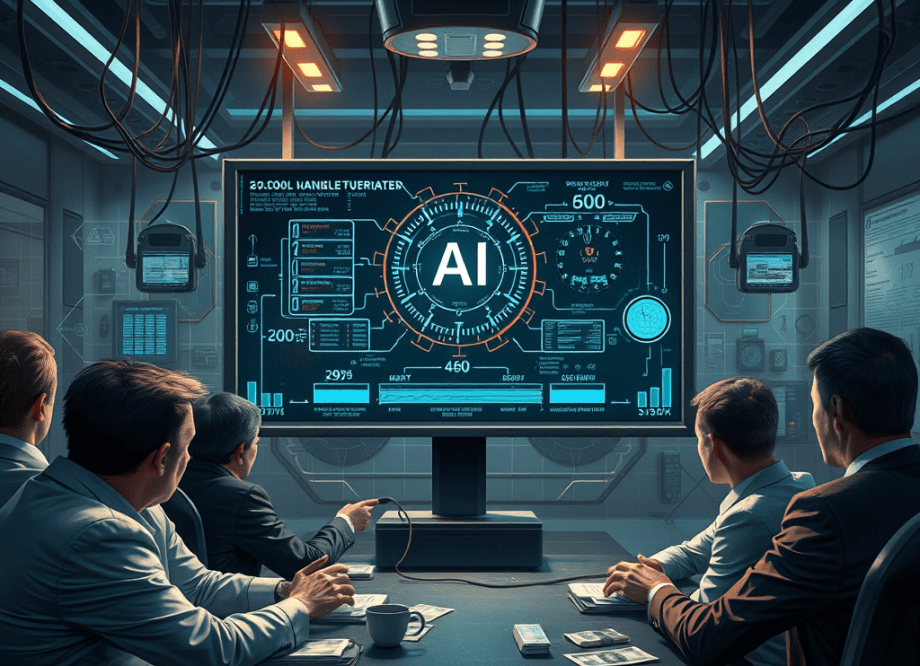
Microsoft has just quietly slashed expectations for Copilot, its much-hyped AI wonderchild that was supposed to revolutionise work. It turns out the thing can’t reliably perform even basic tasks. After billions in development and a marketing blitz that made Apple look frugal, business users discovered what should have been obvious: handing critical tasks to software that hallucinates is not a productivity boost. even if it does mimic what happens to the hapless, hand-picked lackeys in Trump’s mad administration.
We’ve seen this before. Every decade delivers a new three-letter saviour—IT, ICT, now AI—and every time the promise is the same: freedom from drudgery, limitless efficiency, an age of abundance. The only things that proliferate are hype, debt and disillusionment. And private consultancies to governments.
But AI, we’re told, is different. This time it’s real. This time the technology works.
Except it doesn’t run. A three-legged dog could beat it. And the bill; financial, environmental and social, is coming due faster than most realise.
What AI Actually Delivers
After consuming at least 1.2 trillion in investment, AI’s real-world results remain narrow. We’re not witnessing a revolution in productivity or knowledge, but rather autocomplete on steroids, decent translation tools, and a handful of useful applications in medical imaging and protein research.
The failure rates tell the story the marketing department doesn’t. MIT researchers find that 95 per cent of corporate AI projects fail to deliver meaningful value. A Boston Consulting Group study was grimmer still: only 5 per cent of companies saw measurable benefits. Even McKinsey, hardly an enemy of innovation, reports that AI initiatives routinely collapse under the weight of cost, complexity and unreliability.
When Copilot fails 70 per cent of basic commands, that is not a bug. It’s a dog. When ChatGPT and its cousins confidently present fiction as fact, that’s not a temporary glitch; it’s the technology doing exactly what it’s designed to do: predict patterns without understanding truth, context or consequence.
The promise was general artificial intelligence; machines that think and reason. Cool. What we have is narrow AI: competent at specific tasks, useless beyond them. The deceit lies not in that limitation but in pretending the miracle is inevitable, if only we keep the faith. Invest more money.
This is the millenarianism at AI’s core: a belief that current failure is irrelevant because salvation lies just around the (Wall Street) corner. As the boosters would have it, the singularity is near, the transformation certain. Just wait, believe, keep investing, and redemption will arrive; probably at next year’s DevCon.
It’s the same social logic that once urged peasants to bear earthly misery for heavenly reward. The priests now wear hoodies and expensive runners and the cathedral is a coal-powered data centre.
Markets and Planet Face Reckoning
The financial bubble
AI stocks are inflated by the same cocktail of speculation and magical thinking that produced every tech bubble from dot-com to blockchain. The script never changes: massive investment chasing promised returns that fail to appear, followed by a market correction when reality intrudes.
Wall Street’s finest, snouts are deep in the trough, oinking about “innovation” while their portfolios inflate like a Macy’s Parade float. They don’t need profits. They don’t need customers. They need narratives, preferably ones involving “disruption,” “blockchain,” or “the next Tesla.”
But analysts from Morgan Stanley and Gartner warn of a 2026 correction as delayed spending collides with debt-fuelled expansion. Washington’s AI-friendly policies, including the mooted 500 billion US dollar “Stargate” infrastructure project, have kept the bubble inflated. Yet the fundamentals remain paper-thin. When CFOs see their “AI transformation” yields marginal gains at best, the market will fall hard.
We’ve lived this before. The dot-com bust. The metaverse hype. Each time, the hype feeds the investment, and the fallout lands on ordinary people; workers, pensioners, anyone whose super is exposed to equity markets.
But at least previous bubbles didn’t help cook the planet.
The environmental debt
Here the danger turns existential. The industry that casts itself as the saviour of civilisation is driving the climate crisis at speed, all the while promising that AI will one day solve the very problem it creates. It’s a perfect circle of malignant delusion: burn fossil fuels to power AI, rely on AI to fix climate change, justify burning more fossil fuels to build more AI.
AI’s appetite for energy is staggering. Data centres now consume more power than many nations. In Ireland they are projected to account for 35 per cent of total electricity use by 2026. Microsoft’s own emissions have jumped sharply since launching AI services. Each data centre gulps enough water annually to meet the needs of hundreds of families, cooling servers that often generate marketing copy riddled with errors.
A small 1-megawatt data centre uses up to 26 million litres annually, matching the consumption of roughly 62 American families. (62 Australian families would use around 11 million). Training GPT-3 alone evapourated 700,000 litres of clean, freshwater alone in Microsoft’s data centres.
Picture a typical suburban street. Every home, every garden, every shower and washing machine. Now multiply that by thirty. That’s what a single data centre drinks each year so that tech companies can sell us “intelligent” assistants that still second-guess, parrot vacuity and hallucinate more than they know.
The UN warns AI’s energy use could double by 2030. At the very moment climate scientists are demanding rapid emissions cuts, we are expanding one of the fastest-growing sources of carbon pollution. As one researcher at the International Energy Agency put it recently, “these systems run on fossil imagination”.
AI is not going to solve climate change. For now, AI is climate change; intensified by the very corporations claiming environmental leadership.
Why We Keep Falling for It
Decades of technological “revolutions” reveal a grimly predictable sequence.
First comes the promise: everything will change. Remember when every child supposedly needed to learn coding because that was the future? The reality was fragmented, precarious work while the profits flowed upward.
Next comes the gold rush: speculation, subsidies, consultants, the usual feeding frenzy. Governments tip in public money to de-risk private profit. Evangelists multiply like cane toads.
Then comes reality. The technology under-delivers, costs soar, and the fallout is socialised. Workers lose jobs to systems that malfunction. Communities lose water to data centres. Taxpayers underwrite infrastructure built for Microsoft, not municipalities.
AI adds a uniquely toxic twist: its millenarian faith makes dissent taboo. To question the “inevitability” of transformation is to be branded backward or afraid of progress. A luddite. Every faith movement does this. Scepticism is reframed as heresy; caution becomes cowardice, commonsense a type of ignorance.
We’ve seen this closer to home. Think of the 1983 Prices and Incomes Accord, when Labor’s rhetoric of shared productivity gains masked a quiet entrenchment of neoliberal orthodoxy. The argument then is the same one now: short-term sacrifice for long-term abundance. We know who ends up missing out.
AI follows the same script, just with better branding. “Efficiency” means surveillance. “Productivity” means job cuts. “Smart workplaces” mean workers more easily monitored and replaced. The promised revolution serves the same old beneficiaries.
This is pattern recognition, not paranoia. No productivity technology introduced under neoliberalism has delivered broadly shared gains. Why would this time be different?
The Costs of Waiting for Miracles
The greatest danger of AI’s millenarian promise is that it delays real action.
- Climate change? Don’t worry, AI will optimise the grid. Never mind that AI’s own power demand keeps rising.
- Inequality? AI will generate abundance. Never mind that it currently transfers wealth and wages from work to capital.
- Democratic decay? AI will improve governance. Never mind that it has already supercharged surveillance, propaganda and disinformation.
The function of millenarian thinking is to excuse inaction. It comforts us when problems seem too complex to confront. But as James Baldwin puts it, “nothing can be changed until it is faced.”
We already know what works: rapid decarbonisation, mass renewable deployment, grid reform, sustainable agriculture, reforestation, adaptation planning.
None of this requires miracles. It requires political will.
Each year spent waiting for technological salvation is a year not spent insulating homes, building public transport or restoring ecosystems. Each billion funnelled into speculative AI ventures is a billion not invested in proven solutions.
The opportunity cost is measured in lost time, and time is the one thing we no longer have.
What Happens Next
The believers will say AI just needs time. So did the blockchain crowd. So did the metaverse evangelists. Meanwhile, the emissions curve bends upward and the waterways near new data centres are sucked dry.
The critique is no longer fringe. Economists, energy analysts and even consulting giants now acknowledge AI’s diminishing economic returns and growing ecological cost. When the same firms that sold the dream start lowering their projections, disillusionment is not far behind.
Australia is particularly exposed. The Albanese government, like others, is banking on AI-led productivity to mask structural weaknesses. It subsidises data centres and applauds “AI leadership” while our manufacturing base hollows out, our emissions targets slip, and yet another generation of workers faces automation without security or reward. One example, will suffice.
Microsoft led a two-year informal alliance of data centre operators to influence the Albanese government and encourage federal spending on digital infrastructure, which evolved into the formal peak body Data Centres Australia.
The government embraced this courtship: New South Wales streamlined data center approval processes while Victoria created incentives to “ruthlessly” chase data center investment in greenfield sites. Under recent environmental law “reforms”, new data center approvals may be fast-tracked if co-located with renewable power, meaning less time to consider biodiversity and other environmental impacts.
Faith holds only until failure becomes impossible to ignore. And we’re nearly there.
Manufacturing Hollowing Out
The contradictions are brutal. While Prime Minister Albanese promised to “rebuild” Australia’s declining industrial and manufacturing base into a manufacturing “powerhouse” the reality tells a different story.
Australia’s manufacturing industry has fallen to only around 5% of the economy in 2024, down from 14% in the late 1970s, the lowest manufacturing share in the OECD. The main reason? East Coast gas prices tripled since LNG exports commenced, driving electricity price rises that have collapsed roughly 1,400 manufacturers since 2022-23.
Major closures punctuate the decline: Qenos, Australia’s only major plastics plant, closed in 2024 due to expensive energy costs, while Oceania Glass, Australia’s only architectural glass firm, shut down in March 2025 after 169 years.
Orica’s CEO was blunt about the investment calculus: given a choice between the US with its pro-manufacturing policies and cost-competitive energy versus Australia, “my incremental dollar would always go first to the United States”.
Seeing Through the Algorithm’s Gospel
The alternative is not cynicism. It’s realism.
AI tools can support valuable work: medical imaging, translation, protein mapping. They deserve careful integration, not religious veneration. The problem is not the code, but the creed; the insistence that belief alone will redeem us.
What we need now is the hard, thankless, unglamorous work:
- Rapid rollout of renewables and grid upgrades.
- Large-scale public investment in climate resilience.
- Strengthening worker power and rebuilding the social wage.
- Democratic reform to counter corporate capture.
- Education that cultivates critical thinking, not obedience to hype.
These demands aren’t utopian; they are practical. They just require confronting power rather than worshipping it.
The millenarian dream of AI promises transformation without conflict, progress without redistribution, abundance without accountability. It’s a comforting fantasy for those who own the servers.
But reality doesn’t care for fantasy. The climate will not wait for algorithms to mature. The unemployed won’t eat hope. Rivers diverted to cool data centres will not refill because a press release claims efficiency.
As Hannah Arendt warned, “The most radical revolutionary will become a conservative the day after the revolution.” The miracle, when it finally arrives, is always smaller than promised.
At some point, “give it time” becomes “we’re out of time.”
The emperor’s new algorithm has no clothes. The revolution was a marketing plan. The only thing AI is transforming is the rate at which we deplete money, energy and hope.
If we can stop applauding long enough to look honestly, we might still remember how to build futures that serve people, not platforms. The crowd only has to stop believing for the illusion to disappear.
Time to stop waiting for miracles, and start doing the work of reality.
Coda: The Structural Contradiction
The Albanese government has moved decisively away from the market-oriented reform tradition toward more industrial subsidies, protectionism, and interventionism symbolized by the Future Made in Australia agenda, yet this intervention prioritizes attracting foreign tech capital over protecting domestic industry or workers.
The productivity obsession serves as ideological cover; AI-led gains promised to mask deeper failures: deindustrialization from energy policy collapse, emissions accounting tricks replacing genuine decarbonization, and automation risks offloaded onto workers repackaged as “opportunity” through re-skilling rhetoric.
Australia is banking on technological solutionism (AI productivity) to paper over structural decay (manufacturing collapse, climate targets missed, worker precarity) while subsidizing the very data infrastructure that accelerates these contradictions.
 Urban Wronski Writes
When has mankind not believed in “miracles”? This is just the process of transferring responsibility from self to some God like being. Sadly, to date, all the God like beings have failed us.
LikeLike
Here is the next great Con in the sky. And everyone is sucking it in like there is no tomorrow. We can hardly get GPS navigation in a car to work without getting lost, Never mind some massive Data centre contemplating its Silicon chip navel, on the meaning of life. And still wondering what is the question.
LikeLike