David Martin Shoebridge has been leader of the Greens for four days. In that time he has choked up on national television. He has been tagged an ecopopulist. He has been accused of prejudice. A Murdoch hack has charged him with being “snobby” to a police officer.
The Prime Minister, Anthony Albanese, tells him to go after One Nation instead. He found it “somewhat concerning” that, “at a time when we see a rise of a far right-wing party, Senator Shoebridge took the opportunity to actually criticise Labor.” Leave his government out of this.
Four days. That’s quick work. It’s also very old work.
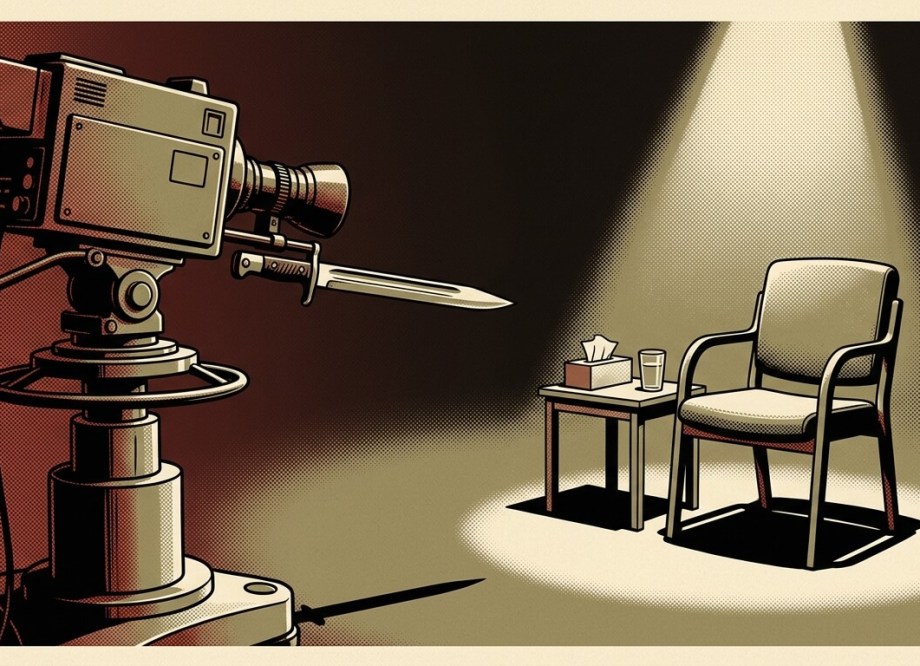
Fleet Street called it monstering. In 1914, Kitchener’s propagandists did it with Belgian babies. Our corporate scribes have a four-day-old leader on the bayonet.
It would be easy to answer in kind. Find the villains, name them, shame them, go home. That’s the trap. Naming and shaming is their trade, not ours. The people doing this are seasoned operators and they are shameless. They aren’t confused and they aren’t stumbling. They are building something. The useful question isn’t who they are. It’s how the thing is built.
Start with Wednesday night. Sarah Ferguson had the new leader on 7.30 for eleven minutes. Her first question set the tone. “To get to know you, who is your key philosophical or political inspiration?”
Shoebridge named John Kaye, his mentor in the NSW Parliament, “a person of incredible principle, incredible courage,” dead since 2016. His voice caught.
“Oh, that still bothers you?”
“It still does. It’s a hard start to this interview, Sarah.”
“Why does it still move you in the way it does?”
He told her. She asked whether Kaye had expected him to become leader.
“You’d have to ask John.”
“Can’t.”
“Can’t,” he repeated.
A minute later the weeping man had become a bruiser. He and his deputy, Ferguson said, “came out aggressively” to “play hard ball.” Then: “Is that what voters want? An aggressive attitude towards Labor?”
Too soft to lead. Too hard to trust. Both charges inside three minutes.
The psychologists call it a double bind. The Tudors had a better name. Henry VII’s Lord Chancellor, Cardinal John Morton, had a rule for squeezing taxes out of the merchants of England. If a man lived well, he could plainly afford to pay. If he lived frugally, he must have money put away, so he could afford to pay.
Either way, he paid. Morton’s Fork. Shoebridge was skewered on it before he’d finished his first answer.
The ABC’s write-up knew exactly where the story was. “New Greens leader David Shoebridge gets emotional before launching attack on Labor“. First the tears, then the attack. The soft man, then the angry man. Then the “ecopopulist”. A character arc, pantomime villain included, ready for the promo.
This is the getting-to-know-you interview, and every new leader gets one. Who are you, really? What moves you? Who did you lose? It feels humane. It isn’t neutral. It turns the leader into the story, and once the leader is the story the argument is scenery.
Call it what it is: identity politics.
Identity politics is at its worst when it reduces the complex, dispersed and often contradictory workings of power to a cast-list of heroes and villains. It turns politics into the story of one man or one woman, oppressor or victim, with the facile implication that change is driven from the top down, by the capture or replacement of symbolic authority rather than by the patient reform of institutions, relationships and material conditions by a process of mutual agreement.
And there was an argument. “Four years of Labor and people are anxious pushing their trolley down the supermarket aisle if they’re going to be able to afford it at the check-out,” he said. The economy had been run for “this elite 1%, obscene corporate profits.”
That is a class argument. Ferguson didn’t ask him a single question about how he’d tax the 1%.
She asked what seemed at least half a dozen about the CFMEU. He had opposed putting “a corrupt and violent CFMEU” into administration. Didn’t he deny “the violent and corrupt history of the CFMEU”? “And the history of driving out opponents?” Had he “shifted” his position? Was he “opposed to, or in favour of” the administration? Had he “come round”?
Nobody disputes what the inquiries found about the CFMEU. Shoebridge didn’t either: “Nobody is denying what has been demonstrated in public inquiries.” Half a dozen loaded questions weren’t about finding out his position. They kept the new Greens leader standing beside the building industry’s thugs for as long as the clock allowed. The logicians call that guilt by association.
Listen to the register. “Corrupt and violent.” “Driven out of the union.” “You don’t deny the… history.” That isn’t an interviewer’s language. It’s counsel’s. Ferguson was cross-examining a hostile witness in a case he was never a party to.
The brief came from Geoffrey Watson SC. His report on the Victorian branch, Rotting from the Top, was tendered to Queensland’s CFMEU inquiry in February. Watson found that under John Setka the branch had become “a violent, hateful, greedy rabble,” that it “was no longer a trade union, it was a crime syndicate,” and that “a decent person who spoke out against corruption, was shouted down and told they were a ‘dog,’ or a ‘rat’.”
“Shouted down,” in Watson. “Driven out of the union” and “driven out of the industry,” on 7.30.
Watson, “a lifelong believer in trade unions,” took care to separate Setka’s branch from the union before him: “militant, but always lawful.” The question on 7.30 made no such distinction.
Neither David Shoebridge nor the Greens appear anywhere in the report’s 139 pages.
Elected that morning. Cross-examined that night. He hadn’t yet chaired a single regular party room meeting, and here he was on national television, verballed by association and implication.
It sent a chill up this viewer’s spine. Gerard Henderson would complain it wasn’t tough enough.
Then Ferguson supplied the populist label herself. “Does that mean you see yourself in the mould of someone like the Greens leader in the UK?” And his, “what’s the right way to describe it? ecopopulist approach, particularly targeting the economic elites?”
She asked the question. She went looking for the word. She found it. She said it twice. Then she answered for him: “Is that your mould?”
Shoebridge never said “ecopopulist.” He talked about mortgages, and kids homeless and couch surfing, and obscene wealth. The word was hers. She put it in his mouth.
When Shoebridge said the Greens had to find a way around “a mainstream media that doesn’t want the message heard,” she took it personally. “What message do I not want to hear?” He had said nothing about her. He had said that a handful of billionaires own most of the country’s media. She heard an insult. That’s the personalising reflex: a structural argument turned into a personal slight, and then answered as one.
Her sign-off: “it’s the beginning of getting to know you and your policies better.”
Getting to know you at the start, getting to know you at the finish. The policies came last, in the goodbye.
Two days later the word was in the ABC’s web address. Clare Armstrong, the ABC’s chief digital political correspondent, headlined her piece “Voter anger is fuelling Greens’ populist move to take on the right“. She lined up Shoebridge’s Greens beside the British Greens under Zack Polanski, who “explicitly embraced ‘eco-populism'”, and beside the left in New York and Germany. Shoebridge’s offence was this sentence: “We’re not here to make the Labor Party any better. The Greens are here to replace them.”
A label is the cheapest move in logic. It does the arguing so the writer doesn’t have to. “Populist” puts Shoebridge in the same box as Pauline Hanson, the woman he has just promised to fight. Armstrong’s own piece does it in a few paragraphs: the Greens’ move is “populist”, and One Nation is “the populist right”. Nobody has to show that a wealth tax and a racist dog whistle are the same thing.
The word quietly says so for them.
Then came the trick question. At his press conference a News Corp reporter asked whether he would “mend bridges” with the Jewish community. Look at how it’s built. It’s the “have you stopped beating your wife” question. Any answer accepts that the bridges were burned, and that he burned them.
Logicians call it a loaded question. Newsrooms call it a door-stop.
Shoebridge said he’d keep “working alongside Jewish Australians who are fighting genocide, who are speaking up for core values that they hold dear.” He would “champion their voices, to be solid allies with them.”
Labor’s Josh Burns called this “pretty shocking.” “The Jewish community should not be put into categories of good and bad based on their views of what is happening in the Middle East,” he said. “That is not progressive leadership. That’s prejudice.”
He said it would “send chills up the spines of many people in the Jewish community.”
Put the two quotations side by side. Shoebridge named the people he stands with. Burns heard him name the people he stands against. That’s a straw man: rebuild your opponent’s argument in a weaker, uglier shape, then knock that one down. It works best on subjects where nobody dares check the joins.
Shoebridge’s office replied that progressive Jewish Australians “consistently tell us their opposition to genocide and their deep cultural history of humanism and peace is being deliberately ignored by journalists.” The question came from News Corp. The outrage came from Labor. The headlines came from everyone.
Then the Murdoch press finished the job by complaining that it hadn’t been done properly. In his Media Watch Dog column on 3 October, Gerard Henderson accused “Comrade Ferguson” of failing to grill Shoebridge on his “‘snobby’ behaviour to a police officer” and his “double standards on DEI matters”.
He did allow that Ferguson “asked some challenging questions.” Even Henderson heard it.
The snobbery charge rests on a video Shoebridge posted himself in May, shot at a roadside drug test on the way into Nimbin’s MardiGrass. Henderson kindly prints the transcript.
“So we are also recording audio and video, Senior Constable Hardy is my name.”
“Yeah, Senator David Shoebridge is my name.”
The officer gave his rank. The senator gave his. It ended with “Okay, cool.”
The DEI charge is that the Greens chose Shoebridge over Mehreen Faruqi. Henderson notes that Faruqi “is a woman of colour,” and that Shoebridge and his deputy, Steph Hodgins-May, are both white lawyers who “could form part of a white sight-screen at a red-ball test cricket match.”
The papers that have spent ten years sneering at diversity, equity and inclusion have suddenly found DEI worth defending, provided they can use it on a Green.
Step back and look at the whole week. The ABC and News Corp act like enemies. Here they ran the same play from opposite ends of the field. 7.30 did it with a tissue in one hand and the CFMEU in the other.
News Corp didn’t bother with the tissue.
Both made Shoebridge the subject and his argument the footnote. The tears, the label, the association, the loaded question and the straw man are five tools from one kit. Herman and Chomsky had a name for the noise a system makes when somebody steps outside the permitted range of debate. They called it flak.
Fleet Street’s word is still the best one. Monstering. You don’t defeat the man’s argument, you make a monster of the man, and the argument dies with him.
What’s being monstered here isn’t one senator from New South Wales. It’s a kind of politics. Call it the politics of conscience: rent, a wealth tax, a genocide in Gaza that Australia keeps finding reasons not to call by its name. It is about who owns what and who pays. Who steals your wages. Who pays the piper. And who gets to blow the whistle.
Set it against the politics that gets the soft lighting. Who are you? Where are you from? What do you feel? Who made you cry? That is identity politics as business as usual, and business is fine with it.
It can be profiled, sympathised with and wheeled out at the next leadership spill. It doesn’t touch the 1%. It’s a politics the system can absorb.
A politics of conscience can’t be absorbed. It can’t be answered on its own terms either, because its terms are numbers: rents, profits, a body count. So it has to be turned into something else.
A crying man. A populist. A bigot. A snob.
None of this makes Shoebridge a saint, and his supporters should resist the opposite mistake. The superhero is the monster’s twin. Both turn politics into a story about one man. Mehreen Faruqi, beaten for the leadership by a party room vote, said “without a member vote, we cannot call ourselves a grassroots party“.
She’s right. If the Greens mean what they say about change from below, they can start by letting the members choose who leads them.
Change doesn’t come from a man on a television set, whether the lighting is soft or the knives are out. It comes from below. That’s if we are still talking about democracy, human decency and the politics of consensus.
Shoebridge told 7.30 the trick is to find a way around “a mainstream media that doesn’t want the message heard.”
The senator can rest his case.


This is a fantastic breakdown of the snide Ferguson – pretending to be interested in Senator Shoebridge. Clare Armstrong – just yet another Murdoch Manque infiltrating the ABC – so no surprise there – never read her.
The ABC should be very ashamed of these performances.
LikeLike