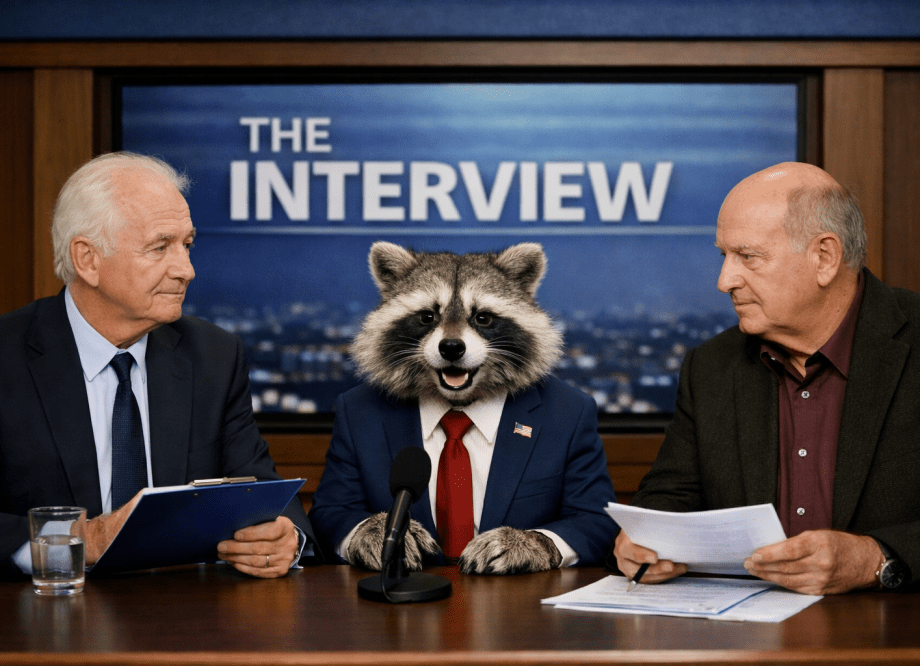
DAWE: Mr Vice President, thank you for coming in.
CLARKE: Great to be here, Bryan. Terrific studio. Very fair country, Australia.
DAWE: You’ve just come from negotiations with Iran.
CLARKE: Correct.
DAWE: How did they go?
CLARKE: Tremendously. Tremendously well.
DAWE: Iran has rejected every proposal put to them.
CLARKE: That’s one way of looking at it.
DAWE: What’s another way?
CLARKE: They’re still talking.
DAWE: They’re not, actually. Tehran said, and I’m quoting here, “there is nothing left to discuss with people who bomb you during negotiations.”
CLARKE: Right, and look, that’s a starting position.
DAWE: It sounds more like an ending position.
CLARKE: Bryan, in diplomacy, endings are just beginnings with better lighting.
DAWE: (pause) Who told you that?
CLARKE: I did. Just now. I’m quite good at this.
DAWE: Let’s go back to basics. What was the American objective going into these talks?
CLARKE: To bring Iran to the table.
DAWE: Iran was already at a table. You bombed them while they were sitting at it.
CLARKE: A different table.
DAWE: A better table?
CLARKE: Our table.
DAWE: And they didn’t come to your table.
CLARKE: Not as such, no.
DAWE: So the objective was not achieved.
CLARKE: The objective evolved.
DAWE: Into what?
CLARKE: Getting them to acknowledge that a table exists.
DAWE: And did they?
CLARKE: They sent someone to stand outside the building where the table was.
DAWE: That’s not acknowledgment. That’s geography.
CLARKE: In diplomacy, Bryan, geography is half the battle.
DAWE: Mr Vice President, the Strait of Hormuz has been closed for six weeks. Oil is at a hundred and twenty dollars a barrel. Iran has struck US bases across six countries and rendered many of the thirteen American facilities in the region effectively uninhabitable, at a cost of some eight hundred million dollars in damage in the first two weeks alone. What has the United States actually achieved?
CLARKE: We have significantly degraded Iran’s capacity to feel comfortable.
DAWE: That’s it?
CLARKE: That’s enormous, Bryan. Comfort is a strategic asset.
DAWE: You went to war over a strategic asset.
CLARKE: We went to war to deny them one.
DAWE: And in the process, you denied it to the entire world economy.
CLARKE: Collateral discomfort. Regrettable.
DAWE: Now, the original war aim, as stated by President Trump on day one, was regime change in seventy-two hours.
CLARKE: The President said he expected a rapid resolution.
DAWE: He said, and I have the transcript, “three days, max, probably two, maybe one, we’ll see, could be hours.”
CLARKE: He’s an optimist.
DAWE: It’s been forty-two days.
CLARKE: He’s a resilient optimist.
DAWE: The Ayatollah he was supposed to topple is dead, but Iran has a new Supreme Leader, the Strait is still closed, thirteen US service members have been killed, several hundred wounded, two C-130s were left burning on a dirt strip outside Isfahan, and the President declared it the greatest military operation in American history.
CLARKE: In terms of ambition, yes.
DAWE: What about in terms of outcome?
CLARKE: We’re defining outcome more broadly now.
DAWE: How broadly?
CLARKE: (thinks) Ongoing.
DAWE: Let’s talk about your specific role. You flew to Oman. Then to Geneva. Then reportedly to a location you declined to name.
CLARKE: Correct.
DAWE: What happened in Oman?
CLARKE: Productive preliminary exchanges.
DAWE: Meaning?
CLARKE: They gave us tea. We thanked them. We left.
DAWE: Geneva?
CLARKE: More tea. Different cups. The Swiss make an excellent cup.
DAWE: And the undisclosed location?
CLARKE: (long pause) Coffee, actually.
DAWE: Mr Vice President, are you describing a negotiation or a tour of international beverage culture?
CLARKE: In diplomacy, Bryan, shared refreshment is the precondition for shared understanding.
DAWE: And what do you understand about Iran’s position now that you didn’t understand before?
CLARKE: They’re very serious people.
DAWE: Anyone could have told you that.
CLARKE: Not everyone went to find out in person.
DAWE: Pete Hegseth said this week that the military option remains fully on the table.
CLARKE: It does.
DAWE: You said the diplomatic option remains fully on the table.
CLARKE: Also correct.
DAWE: These are contradictory positions.
CLARKE: We have a very large table.
DAWE: (stares)
CLARKE: Look, Bryan, the President has made clear that all options are available to him at all times and the sequencing of those options is a matter of presidential discretion informed by the best intelligence and the counsel of his senior advisors of whom I am one.
DAWE: What does that mean?
CLARKE: Nobody knows what’s happening next. Including me. But I’m the one they send to say it nicely.
DAWE: Finally. When does this end?
CLARKE: When Iran accepts our terms.
DAWE: Which are?
CLARKE: They stop everything they’re doing.
DAWE: And in return?
CLARKE: We stop doing what we’re doing to them.
DAWE: That sounds like the definition of a ceasefire, which Iran has proposed repeatedly and the United States has rejected.
CLARKE: (long pause)
It sounds better when we say it.
DAWE: Mr Vice President, thank you for your time.
CLARKE: Tremendous country, Australia. Very fair studio.
Clarke exits. Dawe looks at his notes. He looks at the camera.
DAWE: He flew forty thousand kilometres for the tea.
Blackout.
Footnote: This is a tribute to the satiric genius of Clarke and Dawe. For readers unfamiliar with the format: the late John Clarke played a rotating cast of politicians and public figures with serene, imperturbable self-confidence; Bryan Dawe played the interviewer attempting, with mounting futility, to extract a straight answer. The format is deceptively simple. The questions do the work. The answers do the damage.
 Urban Wronski Writes