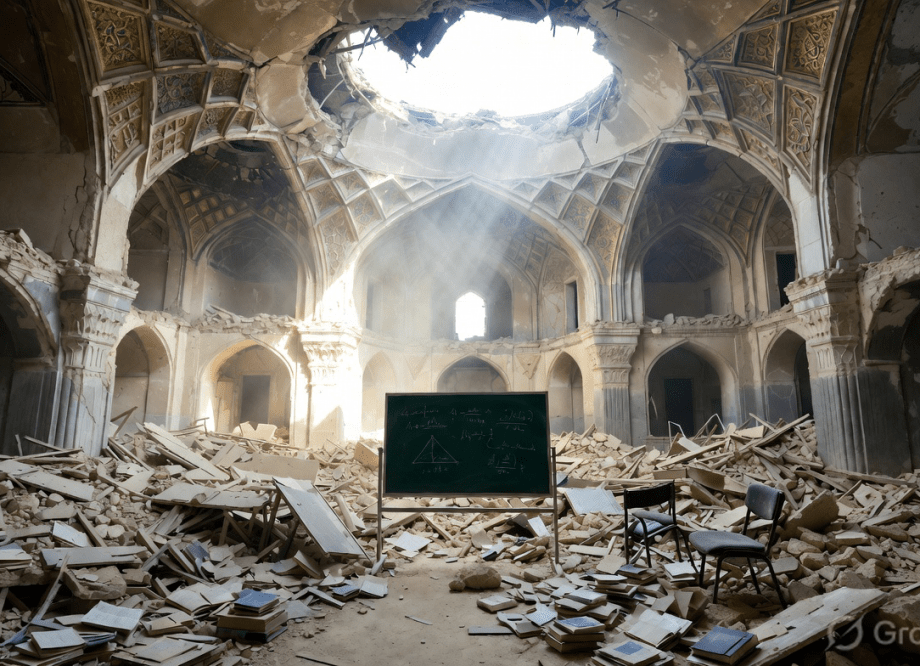
“Human beings are members of a whole, in creation of one essence and soul. If one limb is afflicted with pain, other limbs uneasy will remain.”
— Saadi Shirazi, 13th century. Inscribed on the wall of the United Nations, New York.
On the morning of April 7, twelve hours before his own deadline for Iran to reopen the Strait of Hormuz, Donald Trump reached for his phone and posted to Truth Social:
“A whole civilisation will die tonight, never to be brought back again. I don’t want that to happen, but it probably will.”
Imagine that. Not the bluster. Not the performance. The specific, timestamped, archived declaration of a sitting president of the United States that he was prepared to erase, in a single night, a civilisation that stretches back at least four thousand years. Iran is the country that gave the world algebra and the concept of human rights before Greece had assembled a parliament.
Its poets were mapping the terrain of the human soul while Europe was still working out how to build a chimney. Hafez, Rumi, Saadi himself, whose words hang today on the wall of the United Nations. The Persian miniature. The Cyrus Cylinder, the first recorded declaration that conquered peoples retained their dignity.
All of it, Trump was happy to announce, was on the table. Before breakfast. From his phone.
Intent, Unmasked
For decades, prosecutors at Nuremberg and its successors have laboured to establish what war criminals intended before they acted. They decoded euphemisms, reconstructed chains of command, sifted intercepted cables for the one phrase that showed destruction was deliberate, not incidental. The law requires intent. And intent is hard to prove.
Trump spared them the effort. His intent arrived pre-packaged, timestamped and filed for eternity on his own platform. Legal scholars say it may be one of the clearest public statements of genocidal intent made by a head of state in the modern era. Not whispered to a subordinate. Not encoded in bureaucratic language. Posted. Broadcast to millions. With a full stop at the end.
Trump knew there would be no consequences. The United States has never ratified the Rome Statute. No international tribunal would dare touch a sitting American president, and both Trump and his lawyers knew it before he hit send. The post was not a slip. It was a demonstration: that the rules apply to everyone except the people with enough bombs to ignore them.
Within his own party, Senator Lisa Murkowski called it an affront to 250 years of American ideals. Senator Ron Johnson hoped it was just bluster. And then came the moment that ought to be preserved in political amber: Marjorie Taylor Greene tweeted, in full capitals, “25TH AMENDMENT!!! Not a single bomb has dropped on America. We cannot kill an entire civilisation.”
When Marjorie Taylor Greene becomes the voice of restraint, civilisation isn’t just in the departure lounge. It’s already at thirty thousand feet, and nobody is flying the plane.
Ninety minutes before his deadline, Trump announced a fortnight ceasefire brokered by Pakistan. A big day for world peace, he said. Then, almost immediately: Big money would be made. Not law. Not justice. Not the weight of a catastrophe averted. Money, tacked onto the announcement like a footnote to everything else that matters.
The man who threatened to erase five millennia of history at dawn was haggling over LNG futures by dinnertime. This is the engine driving the war: not security, not strategy, not any coherent theory of American interests. Profit, dressed in the language of national security and laundered through the congressional offices of every senator who holds Lockheed Martin stock.
Memoricide: The War on Knowledge
There is a word for what has been done to Iran’s universities, libraries and cultural institutions since February 28. The word is memoricide: the systematic erasure not merely of lives but of the memory that gives those lives meaning, the accumulated knowledge that connects a people to their past and their future. It is, under international humanitarian law, a war crime. It is also, in the context of this war, a strategy.
Since the first strikes, the United States and Israel have targeted over thirty Iranian universities, killing professors in their offices and students in their classrooms (figures sourced from ACLED conflict monitoring data and Declassified Australia’s running assessment as of April 8). Fifty-five libraries have been damaged, two obliterated. Fifty-six museums and historical monuments struck, nineteen in Tehran alone. Among them: the national archive, which housed Ottoman-era documents, Qajar-period manuscripts, and records of the Constitutional Revolution of 1906, Iran’s first democratic experiment. Gone. Because someone decided, in advance, that Iranians do not deserve the memory of their own attempts at self-government.
Sharif University of Technology was hit on the third day. Iran’s MIT. The alma mater of Maryam Mirzakhani, the first woman in history to win the Fields Medal, the highest honour in mathematics. Sharif’s engineering graduates helped build Silicon Valley. Its researchers had spent two years training artificial intelligence models in Persian, serving hundreds of Iranian companies attempting to participate in the century’s defining technology. The attack destroyed their IT centre, wiped their databases, and took their servers dark. Masoud Tajrishi, Sharif’s president, said without hesitation: the enemy targeted these buildings because it did not want Iran to achieve AI capability. He is almost certainly right. This is not collateral damage. It is targeted deindustrialisation, aimed at the nervous system of a civilisation.
The day after the strike, a mathematics professor stood in the wreckage of a bombed lecture hall and taught an online class. He lectured on algorithms to graduate students who could no longer reach campus. No cameras, no audience, no applause. Just a man and his subject and his students and the rubble behind him. It was an act of defiance so quiet, so absolute, that no general’s press release could touch it.
The Pasteur Institute, a century-old scientific collaboration between Iran and France, a public health lifeline for ninety million people, now lies in ruins. Strikes have been reported near the Bushehr Nuclear Power Plant, with Iran’s atomic energy organisation warning of potential radioactive contamination. The IAEA has issued no statement. Netanyahu’s military has publicly boasted of destroying 70% of Iran’s steel production capacity. Trump has said it would take Iran twenty years to rebuild if the US withdrew today. A hundred years if the war continues.
These are not military objectives. They are the calculations of men who have already decided, at some level they will not name openly, that their targets are not quite human enough for the rules of war to protect. That calculus has a history. It does not end well for the people doing the calculating.
An Iranian legal academic, picking through the ruins of a bombed campus, recorded a student telling her: “My professor’s office was still burning a little. That’s where I used to wait for office hours. To ask questions. To appeal my grade.” To appeal my grade. The bureaucratic ordinariness of it. The life that existed there, and now does not.
Trump promised to bomb Iran back to the Stone Age. This is what that promise looks like from inside a burned lecture hall.
The Business End: A Weapon’s Debut in Blood
On February 28, the United States did not just begin attacking Iran. It used Iran as a testing range.
Weapons analysts examining strike footage in the southern city of Lamerd identified the signature of the Precision Strike Missile, the PrSM, pronounced “prism,” as if the naming committee had aspirations toward poetry. A short-range ballistic missile manufactured by Lockheed Martin, the PrSM detonates above its target and sprays tungsten pellets across a wide radius, engineered specifically to maximise casualties in open or semi-enclosed spaces. Lamerd was its combat debut.
The strike hit a sports hall where a girls’ volleyball team was training. It hit the adjacent primary school. Both sites were clearly marked as civilian on Google Maps, Apple Maps and Wikimapia, separated from the nearby IRGC compound the Pentagon claimed to be targeting. Ground-level images show the distinctive pockmark pattern of tungsten pellets in the walls of both buildings.
Journalist Negin Bagheri reported on the victims. Among them: Helma Ahmadizadeh, ten years old, a fourth-grader, who boarded an ambulance on her own feet and told her coach that it felt like something had gone into her body. There was no visible blood. She died later that day. Elham Zaeri, eleven years old, a volleyball player, was killed alongside her. A sixth-grade boy playing soccer outside died with his coach. Twenty-one people were killed in Lamerd. A hundred more were injured.
US Central Command posted to Facebook: “In a historic first, long-range Precision Strike Missiles were used in combat during Operation Epic Fury, providing an unrivaled deep strike capability.” Admiral Brad Cooper said he could not be prouder.
Prouder. There is a ten-year-old girl who boarded an ambulance by herself and there is a US admiral who could not be prouder. These two facts exist in the same world, on the same morning, and the institutional culture that produces the admiral is the same culture that decided Lamerd was an acceptable laboratory. That culture has a name: it is the military-industrial complex that Eisenhower warned about in 1961, now so thoroughly embedded in American political life that a weapons system’s combat debut is announced on Facebook like a product launch, because for the people running this war, that is precisely what it is.
Nuclear nonproliferation expert Jeffrey Lewis, reviewing the footage, noted it was the first look the world had taken at “the business end of the system.” The business end. Girls doing volleyball training. The phrase does not know what it is describing, and that unknowing is the point.
The Lamerd massacre was overshadowed within hours by Tomahawk cruise missile strikes on the Shajareh Tayyebeh girls’ elementary school in Minab, which killed 175 people, predominantly children and their teachers. The United States used what analysts have described as a triple-tap strike pattern: three successive hits timed to eliminate survivors and the first responders who came to help them. The third strike is the one designed to kill the people trying to pull children from the rubble. That is not a targeting error. It is a doctrine. Pete Hegseth has repeatedly defended the unfairness, the cruelty, the New Barbarism.
“This was NEVER supposed to be a fair fight. It isn’t. We’re hitting them while they’re down, and that’s how it should be.”
The Secretary of War has also boasted about unleashing “overwhelming and punishing violence,” telling troops they “kill people and break things for a living,” and rejecting past restraints. He needs to get a grip. Visit a grieving Iranian family.
Sara Shariatmadar was six years old. Her father stood outside the rubble and could not move toward it, and could not move away. His hands knotted and unknotted at his sides. He looked up each time a paramedic emerged from the dust, and then returned to staring at the ground.
A father whose sixteen-year-old daughter Zahra died in the same attack began to describe the aftermath to journalists. He did not finish his sentence. Some things cannot be completed.
When Trump was asked at the White House Easter Egg Roll whether he was worried about committing war crimes, he said: “I’m not at all concerned.”
He is not at all concerned. That is the sentence we carry forward into every conversation about this war, about this administration, about this moment in American history. Not a slip. Not a misunderstanding. A considered answer to a direct question, delivered with the breezy confidence of a man who has learned, through a long life of avoiding consequence, that the rules were never really written with him in mind.
The Rules Exist. The Men Who Wrote Them Are Watching.
The Genocide Convention was adopted in December 1948, three years after the last of the camps was liberated and the world looked at what human beings had done to other human beings and tried to write law capable of preventing it again. The delegates who gathered in Paris were not naive. They knew that law without enforcement is aspiration. But they also knew that articulated principle, named clearly and embedded in international architecture, changes what is possible. It narrows the space in which atrocity can be treated as normal. It gives future prosecutors something to hold.
Had Trump posted his Truth Social declaration in 1946, he might have faced the dock at Nuremberg. The prosecutors there established the precedent that intent, publicly stated, is evidence. That destroying a civilisation’s cultural and intellectual heritage is a crime distinct from and additional to the killing of its people. That ordering the destruction of civilian infrastructure, knowing civilians will die, is not a policy choice but a violation of the laws of war that existed even then.
None of those precedents are being applied. The International Court of Justice is not convening. The IAEA has not visited Bushehr. The Security Council is paralysed by the veto Washington has never been shy about using. The rules exist. They are simply not being enforced, by anyone with the power to enforce them, against anyone with enough bombs to make enforcement dangerous.
That is not a failure of international law. It is a failure of political will, distributed across every government that has remained silent, every parliament that has not sat in emergency session, every leader who has issued a statement of concern and returned to business as usual.
Australia is not innocent in this. Pine Gap processes targeting data. AUKUS embeds us further into the alliance architecture that makes these wars possible. Anthony Albanese has expressed concern. He has not withdrawn Australia from the intelligence arrangements that put Australian fingerprints on every strike. That silence is a choice, and choices have names.
Saadi wrote his verse in the thirteenth century. He was a man who had seen war, and slavery, and displacement, and the particular cruelty of rulers who regarded those beneath them as tools rather than persons. He wrote about membership: the idea that humanity is not a club with conditions of entry but a shared estate, and that what is done to any part of it diminishes the whole.
The United Nations inscribed his words in marble because the twentieth century had demonstrated, at the cost of sixty million lives, that he was right. When one limb is afflicted with pain, the others cannot remain at ease. They can pretend to. They can scroll past, change the channel, issue a statement and return to the weekly agenda.
But something in them knows. Something in all of us knows.
A Mathematics professor teaches algorithms in a bombed lecture hall. A father in Minab cannot finish his sentence. Helma Ahmadizadeh told her coach something had gone into her body, and she was right, and she died at ten years old on the combat debut of a weapon its manufacturer is proud of.
Trump’s declaration on the morning of April 7 was not only a threat to Iran. It was a statement about what kind of world the most powerful nation on earth intends to inhabit, and what it intends to make the rest of us inhabit alongside it. Every civilisation that has ever existed built itself on the premise that the people who came before left something worth inheriting, and that the people who came after deserved to receive it. That premise is what was threatened on April 7. That is what is being destroyed in Minab and Sharif and the national archive and the Pasteur Institute and the burned office where a student used to wait to appeal a grade.
We are all diminished by this. That is not sentiment. It is what Saadi understood eight centuries ago, and what the rubble of Iranian universities is demonstrating again, at a cost none of us were asked to vote on and none of us will be permitted to ignore forever.
 Urban Wronski Writes