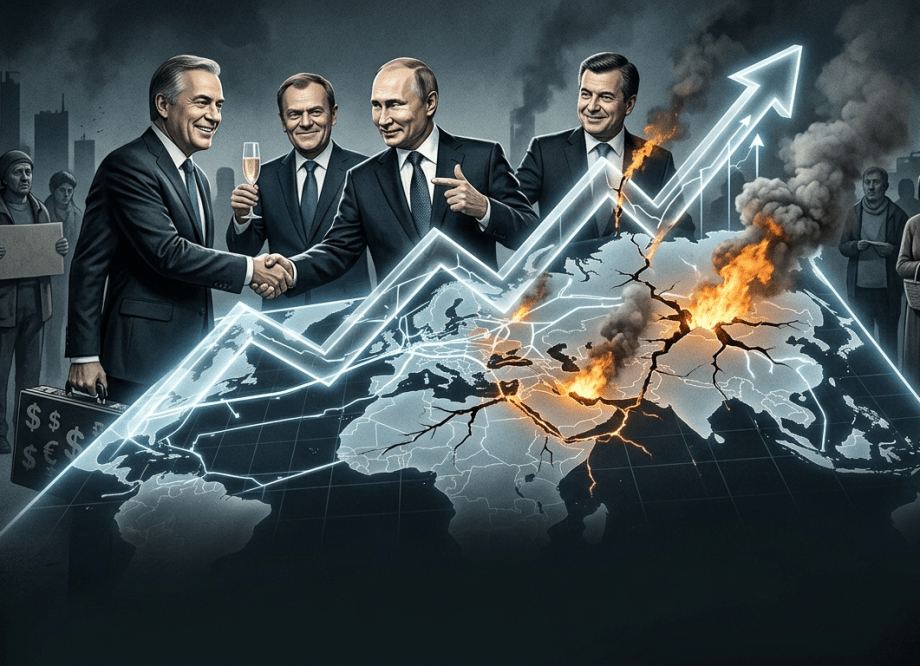
Why the LNG profit theory of war collapses under the weight of reality
Let’s begin with a small act of heresy.
A compelling argument is not the same thing as a true one. The more elegant it appears, the more suspicious you should become. My previous piece advanced a clean, seductive thesis: that corporate profit, specifically LNG market share, is the hidden engine of the US-Israel war on Iran.
It was neat. It was coherent. It followed the money with the satisfying certainty of a line drawn on a map.
And like many arguments that explain too much too easily, it risked explaining the wrong thing entirely. Elegant theories are often just reality with the inconvenient parts sanded off, the blood wiped clean, the contradictions politely shown the door.
The case goes like this. The real purpose of the US-Israeli attack on Iran is not nuclear non-proliferation, not regime change, not the defence of Israel. It is market share. Knock out South Pars, the world’s largest natural gas field, and American LNG producers flood the European and Asian markets that Iran was positioning to enter. The profits are astronomical, the motive is commercial, and the rest, the flags and the speeches and the grief, is dressing. Follow the gas, not the flag. Always follow the money.
It is a satisfying thesis. It flatters the reader with its cynicism, which too often passes for sophistication, particularly in an age that mistakes distrust for intelligence. And it contains enough truth to be genuinely dangerous as an analytical framework, because it crowds out the complications that actually determine what happens in the real world, a world which has never once agreed to behave like a spreadsheet. Time to go beyond specious attractiveness, and beyond the narcotic comfort of thinking one has seen through everything.
If an argument seems too good to be true, it probably is. Start with the price. LNG is not priced in Washington or Houston. Natural gas trades on global spot markets, and the price is a function of aggregate supply and demand across dozens of producers and buyers simultaneously. When Iranian production goes offline, the price rises for everyone, including QatarEnergy, Woodside, Shell and TotalEnergies. There is no mechanism by which American producers capture a structural price advantage simply because a competitor’s field has been bombed. The thesis requires Iran’s former customers, primarily China, India and Turkey, to redirect their long-term contracts to American suppliers. China, which was buying Iranian gas at a sanctions-discounted price under a twenty-five year strategic partnership, is not about to sign long-term supply agreements with Cheniere Energy out of goodwill toward Washington. The commodity price is set globally, and it does not play favourites. Markets, unlike ministers, cannot be briefed into compliance.
Then there is the reconstruction timeline. The argument rests on a three-to-five year recovery window during which American producers have the field to themselves. But the rest of the world’s gas production landscape does not sit on their hands waiting. The conflict itself has already rung the opening bell for a global investment race. Australia’s Browse Basin alone contains reserves estimated at fifteen trillion cubic feet. Mozambique, Tanzania and Canada all have projects that were marginal at $70 per barrel and are suddenly compelling at $110. The war is not preserving market share for American producers. It is creating competitors. The handbrake only works if the road ahead is empty, and it is not. In geopolitics, as on the highway, everyone accelerates at once, and the pile-up comes later.
The cost calculation, moreover, is considerably less rosy than the windfall narrative suggests. The direct financial cost of Operation Epic Fury runs into tens of billions of dollars before the first reconstruction invoice is issued, and the economic dislocation visited on the American economy itself will dwarf the military appropriation.
Oil at $114 per barrel, European gas prices up sixty percent, Asian LNG up forty percent, Maersk and Hapag-Lloyd suspending Hormuz transits entirely, the Ras Laffan complex on fire and Qatar’s force majeure declaration rippling through supply chains from Rotterdam to Yokohama. Economists are using the word recession more often now, which is another way of saying that ordinary people will be asked to pay for an argument they were never invited to make. A recession is not good for LNG revenues. A recession is not good for the capital expenditure programs needed to develop the new fields the thesis promises. And corporations that resort to war as a market strategy absorb risks that no board risk register ever adequately captures: sovereign risk, reputational risk, regulatory risk, the risk of investing in infrastructure that a future government, court or climate agreement will strand before the debt is repaid. War is a poor instrument for margin management, and an even worse one for risk control. It is, however, a very efficient way to socialise losses while privatising gains.
There is also the inconvenient question of what happens to South Pars itself. The bombs destroyed compressor stations and processing infrastructure. They did not vaporise the gas. It is still there, beneath the seabed, waiting. Iran’s National Iranian Oil Company rebuilt after the Iran-Iraq War in the 1980s, when Iraqi strikes on Kharg Island were supposed to terminate Iranian export capacity permanently. They did not. Resources have a habit of outlasting the strategies devised to seize or suppress them, and the empires that attempt both.
And Iran now has partners with compelling strategic interests in accelerating reconstruction. China has signed a twenty-five year cooperation agreement with Tehran and has every reason to provide capital, engineering expertise and equipment. Russia has the technical knowledge and the geopolitical motivation. A Sino-Russian-Iranian consortium managing South Pars reconstruction is not a fantasy. It is a logical extension of existing architecture within the Shanghai Cooperation Organisation. The West would sanction it. China would ignore the sanctions, as it has been doing since 2018. Sanctions, like moral outrage, are often loudest where they are least effective.
Then there is what gets called natural gas. Call it what it is: methane. The industry label is a marketing invention designed to make a potent greenhouse gas sound like a walk in the countryside. According to the IPCC Sixth Assessment Report, methane has a global warming potential eighty-three times that of carbon dioxide measured over twenty years, and even measured over the conventional hundred-year period it remains twenty-eight times more damaging. When it flares into the atmosphere during extraction, processing, pipeline transport and conflict damage, it is not a bridge fuel. It is an accelerant. And any argument that treats expanded LNG production as an economic prize ignores the cost it imposes on everyone else on the planet, a cost for which no invoice is ever sent to Cheniere Energy’s shareholders. The atmosphere, inconveniently, does not vote, lobby or donate. It simply accumulates.
History, for its part, moreover, has a poor opinion of those who go to war for resources. Japan’s decision in 1941 to seize the oil fields of the Dutch East Indies, because the American embargo had given it less than two years of naval fuel reserves, is the canonical example of resource logic leading a nation into catastrophe. Japan got the oil fields. It also got the United States, the full weight of American industrial production, and four years of relentless attrition that ended at Hiroshima and Nagasaki.
Germany drove its armies to the Caucasus for Baku’s oil and got Stalingrad. The British and Americans overthrew Iran’s Mohammed Mosaddegh in 1953 to protect their oil concessions and spent the following seventy years managing the blowback, including, ironically, the 1979 revolution that created the adversary they are now bombing. United Fruit orchestrated the 1954 coup in Guatemala to protect its banana plantations and bequeathed the region decades of political trauma. The pattern is consistent: the resource logic is always cleaner than the reality, and the reality always presents an invoice that was not in the original business case. History does not so much repeat as it itemises, and it never forgets to send the bill.
Compound all of this with the renewable energy wildcard and the equation becomes genuinely vertiginous. Every major energy shock in living memory, 1973, 1979, 2022, has accelerated the transition away from the fuel that caused it. Europe, burned twice in three years by dependence on politically volatile gas supplies, is electrifying at a rate that would have seemed delusional in 2019. The very price shock that the LNG-motive theory celebrates as the payoff may be, over any realistic investment horizon, accelerating the demand destruction that makes the payoff much shorter and smaller than promised. Higher prices mean more heat pumps, more solar arrays, more political will for grid-scale storage. The geopolitical premium built into gas at $110 per barrel is not a profit. It is a signal. And the signal says: find something else. Markets adapt. Systems shift. The ground moves under the thesis even as it is being proclaimed, usually by people who insist nothing fundamental is changing.
So yes, the LNG windfall is real. Some of the people who argued loudest for this war will book their gains, at least for a time. But a contributing factor is not a sufficient cause, and mistaking one for the other is how analysis curdles into ideology, and ideology into policy, and policy into catastrophe.
The world is more crowded than the theory allows. The market is more contested. The consequences are more unruly. Wars do not behave like trades, resources do not obey business plans, and history does not honour the logic that summoned it.
What looked like a masterstroke begins to resemble something else entirely: a wager mispriced, a system misunderstood, a reality that refuses to sit still long enough to be monetised. And like so many such wagers before it, the bill will not be paid by those who placed it.
Nor will it be softened by any sudden outbreak of conscience among the glad-handed oligarchs who cheered it on. They will not be passing the hat among themselves. Their hands are already in your pockets.
As Bertolt Brecht once observed, the point is not who pays for the war. The point is who pays for it twice.
 Urban Wronski Writes