“We did Iwo Jima. We can do this.”
Senator Lindsey Graham tells Fox News, Trump’s Tin Drum, Sunday. Graham, a Linda Reynolds with a security clearance and a direct line to the Oval Office, is evoking Iwo Jima, an icon of US heroism, which cost 26,000 US casualties to 21,000 Japanese who mostly fought to the death. Graham wants Trump to get Marines to seize Kharg Island, an eight kilometre-long coral outcrop 25 kilometres off Iran’s coast, a depot that despatches 90 per cent of Iran’s crude oil exports.
Graham, a retired Air Force Reserve colonel, who helped coach Netanyahu on how to scare Trump into launching this war in the first place, invokes the bloodiest battle in US Marine Corps history to make the case for a ground operation against a country of 93 million people, in a war in its 26th day, with at least 13 American service members already dead, roughly 200 wounded, and the global economy plunged into the worst energy crisis in recorded human history according to the International Energy Agency.
Fellow Republicans call the comparison reckless. They are being polite.
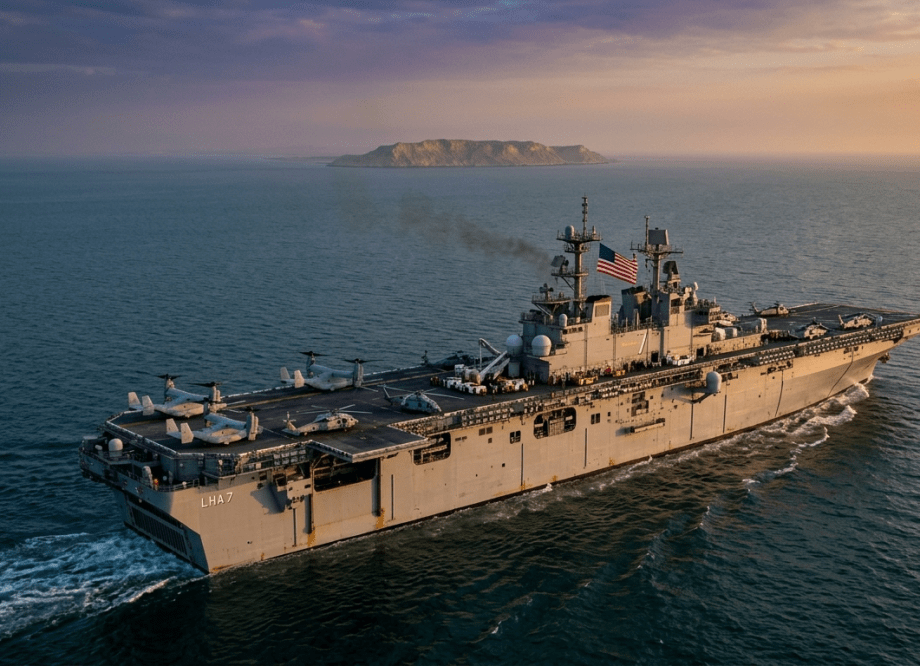
But the Marines are already at sea. That is the state of this war today. 7,500 or so Marines from three amphibious assault groups are only days off arriving in the Persian Gulf. The 31st Marine Expeditionary Unit, 2,200 strong, is aboard the USS Tripoli, redeployed from Okinawa. The 11th Marine Expeditionary Unit, another 2,500, is coming from California aboard the USS Boxer.
A third group is en route behind them. Top Brass are weighing the deployment of an additional combat brigade from the Army’s 82nd Airborne Division: 3,000 soldiers capable of deploying anywhere in the world within 18 hours. The Pentagon has submitted detailed preparation requests to Trump. The White House has confirmed preparations are underway while declining to say a decision has been made.
A White House official tells the BBC directly: “The United States military can take out Kharg Island at any time.”
Trump, asked Thursday whether he was putting troops anywhere, said: “I’m not putting troops anywhere.” He then added: “If I were, I certainly wouldn’t tell you.” From the Great Equivocator, that’s a definite maybe that can only mean yes.
TACO was like this before he illegally attacked Iran. He said it about the Hormuz deadline before he blinked on it. The credibility of the denial is precisely what you would expect from the preceding 25 days from any demented pervert and convicted felon, desperate to stay out of jail and luckless so far at diverting the Democrat’s obsession with his past bestie, Jeffrey Epstein.
The Island in the Crosshairs
Kharg Island is eight kilometres long and five wide. A bleached, tawny limestone plateau, it squats like a toad in the deep water of the northern Persian Gulf, allowing supertankers to dock directly. Some load up to 7 million barrels a day. Iran stores 28 million barrels of crude there. Before this US-Israeli attack, Kharg handled 90 per cent of Iran’s oil exports. Most go to China, which takes 11.6 per cent of its seaborne oil imports from Iran. Control Kharg, and you control the financial lifeline of the Iranian state.
Trump has wanted this for 38 years. In 1988, he told The Guardian: “I’d be harsh on Iran. One bullet shot at one of our men or ships and I’d do a number on Kharg Island. I’d go in and take it.” Now is his chance. On 13 March, US CENTCOM bombed over 90 military targets on the island, destroying the runway, naval base, air defences, and mine storage facilities. Military analysts claim that those are exactly the targets you neutralise before an amphibious assault.
A White House source quoted in Axios describes the plan with all the subtlety of locker-room machismo: “We need about a month to weaken the Iranians more with strikes, take the island and then get them by the balls and use it for negotiations.”
Not so fast. Historical comparisons by independent analysts are not upbeat at all. ”Explaining History”, this week, invokes Gallipoli 1915 and Dien Bien Phu 1954. Gallipoli, saw a naval campaign to force the Dardanelles became nine months of slaughter and ended in failure, with 250,000 dead. Dien Bien Phu, witnessed French forces occupying a valley under enemy-held high ground learned, fatally, that fixed positions without secure supply lines are death traps.
Kharg Island sits 24 kilometres from the Iranian mainland. Iran’s 93 million people include expert asymmetric warriors. An Australian think tank makes the same Gallipoli comparison this week, noting that Kharg presents “the worst elements of each, combined with twenty-first-century weaponry that makes permanent occupation under fire a strategic impossibility.”
Then there’s the shock to the stock market. JPMorgan’s bean-counters calculate the economic consequences of disabling the island: the loss of Iran’s storage buffer and the scarcity of viable export alternatives would “rapidly trigger upstream shut-ins across major southwest fields,” potentially removing up to half of Iran’s 3.3 million barrels per day of national output from global markets. On top of a Strait of Hormuz already effectively closed, on top of oil already at $114 a barrel, on top of an energy crisis the IEA has compared to the 1973 shock, the 1979 shock, and Russia’s Ukraine invasion, combined.
Former US Army Major Harrison Mann, writing for Responsible Statecraft, describes a Kharg assault as landing “somewhere between a suicide mission and a self-imposed hostage crisis” The World Socialists warn that Trump can’t chicken out now: “Merely by sending troops in such large numbers to the region, their deployment has become all but inevitable. The alternative would be a humiliating withdrawal by Washington.” That is the trap. The Marines are in motion. The feasibility of any retreat is diminishing with every nautical mile.
Tel Aviv, Tuesday and Wednesday
While the strategic debate about Kharg Island diverts Washington, Iranian missiles destroy apartments in Tel Aviv.
On Tuesday, Iran fired at least eight separate missile barrages at Israel. A missile carrying 100 kilograms of explosives, its warhead equivalent to 220 pounds of high explosives, struck a street in a posh residential neighbourhood in central Tel Aviv. Israel’s defence systems let it in. NPR visited the site: a crater in the middle of the road, the facade of the apartment building beside it badly damaged, cars crushed nearby. Six people were injured at four separate sites across the city. Police Superintendent Fadida Yaniv confirmed the Tel Aviv damage was caused by an Iranian warhead. A kindergarten in Rishon LeZion was struck. Gaping holes were torn through a multistorey apartment building, with emergency teams searching for trapped residents.
Since 2 March, Iran has launched 337 separate attack waves against Israel. Cluster munition warheads have been used repeatedly, each capable of dispersing dozens of explosive submunitions across a radius of 10 kilometres. Eighteen Israeli civilians have been killed and more than 4,713 injured. Approximately 5,000 Israelis have been displaced from their homes. Hezbollah has now launched 865 separate attack waves from Lebanon since 2 March, with 22 March recording 85 waves in a single day, described as the highest level of activity since the war began. Thirty per cent of Israel’s population has no shelter at all.
Intelligence correspondent Yossi Melman, writing from Tel Aviv, says he wakes three to five times a night to run to a shelter. Fragments from intercepted missiles land near where he lives. He calls it a war of attrition with no sign of ending. He calls the assassination strategy that Israel has pursued, killing the Supreme Leader, killing Larijani, killing the intelligence minister, killing dozens of military commanders, a strategy that “doesn’t lead us anywhere.”
But Trump is pictured bragging about it, like any Mafia Don murdering his opponents is merely taking care of business.
The Israeli military, for its part, told NPR it needs several more weeks of fighting to achieve its war goals. Netanyahu acknowledged Trump’s diplomatic pause without endorsing it. “In parallel, we continue to attack, both in Iran and Lebanon,” he said. He showed the US ambassador his punch card.
The Cost in Hard Numbers
The cost of this war demands to be stated plainly, because plain statement is what its architects assiduously avoid.
The first six days of Operation Epic Fury cost the United States $12.7 billion, of which $11.3 billion was munitions alone, according to the Center for Strategic and International Studies. That is $1.3 million per minute in munitions costs. By 19 March, three weeks in, The Guardian extrapolated the total to more than $18 billion. The same day, the Pentagon requested $200 billion in supplemental war funding. Harvard economist Linda Bilmes has estimated the total future cost to the US government at more than $1 trillion, with $600 billion in future medical costs for troops, modelled on Gulf War precedents.
An Iranian Shahed drone costs approximately $7,000 to build. A THAAD interceptor missile costs $12 million. The US is burning through its Pacific interceptor stockpiles at a pace that the Center for Strategic and International Studies has described as creating a readiness deficit that the defence industry cannot quickly erase. Reckless haste is what they mean. Russia and China are counting every interceptor fired. They do so with the patience of people who understand that attrition is a long game and that the side with more Shahed drones than the other has THAAD missiles is not losing it.
The economic damage extends well beyond the Pentagon’s ledger. Oil at $114 a barrel. The IEA coordinating the largest emergency reserve release in its history, 400 million barrels, which amounts to just over 3 million barrels per day against a supply disruption of 11 million. US petrol at $3.94 a gallon. European gas storage at 30 per cent capacity going into a refill season that requires 60 billion cubic metres just to meet regulatory minimums. The ECB has abandoned its rate-cutting cycle. UK inflation heading for 5 per cent. Goldman Sachs forecasting elevated prices through 2027.
Trump needs interest rate cuts six months before the November 2026 midterms. The Federal Reserve, watching oil-driven inflation with growing horror, is less likely to provide them with every additional week of this war. He launched the war in part to bury the Epstein files. The files are still there. The war has cost $18 billion in three weeks. The Marines are en route to the Persian Gulf.
Trump Declares Victory, Iran Denies the Talks Exist
On Tuesday, Trump told reporters that Iran had made “a very significant prize” offer in negotiations to end the war. He would not say what the offer was. Iran’s Foreign Ministry said no talks were taking place. Pakistan’s Prime Minister, in a gesture of diplomatic optimism, offered to host negotiations and tagged both Trump and Iran’s Foreign Minister on X.
The offer has not been taken up.
This is the state of the diplomacy: one side claiming productive conversations and significant prizes, the other denying the conversations exist, and Israel, 40 minutes after the last announcement of productive conversations, launching what Al Jazeera described as unprecedented strikes on densely populated residential districts of Tehran.
Mission creep meet mission miasma. The glut of justifications of America and Israel’s ex post facto war on Iran, beggars belief. The Israel military’s formal position, delivered to NPR on Tuesday by a senior officer in its operations directorate, is that the war has “degraded Iran’s chain of command” and that it needs several more weeks to complete its objectives.
Trump’s position is that there are productive talks.
Netanyahu’s position is that they continue to attack in parallel. Iran’s position is that there are no talks.
The Oman foreign minister, the same man who announced peace was within reach the day before the bombs fell, is working intensively on safe passage arrangements for the Strait of Hormuz and noting, with restraint that must cost him something, that this war is “not of Iran’s making.”
The alliance, meanwhile, has not recovered from the South Pars rupture. A White House official told Axios plainly: “Israel doesn’t hate the chaos. We do. We want stability. Netanyahu? Not so much.” Netanyahu confirmed he struck South Pars without US knowledge, said he honoured Trump’s request to stop further energy strikes, and then launched unprecedented residential strikes in Tehran 40 minutes after Trump’s peace announcement.
His office has not responded to questions about the diplomatic pause. He is carrying a punch card.
Where This Leaves Australia
The alliance that Anthony Albanese committed to without conditions, without consultation with the Australian public, and without disclosing what was actually requested of Australia by Washington, is now directing 7,500 Marines toward an amphibious operation that independent military historians are comparing to Gallipoli. It has burned $18 billion in three weeks. It has killed 1,500 Iranians, 15 Israeli civilians and four Palestinians in the occupied West Bank, at least 13 American service members, and 1,072 Lebanese. Iran has reported that 17,000 of its people are injured. It has closed the Strait of Hormuz, produced the worst energy crisis in recorded human history, and generated a $1 trillion liability on the American balance sheet. It has fractured publicly and visibly over the South Pars strike and the 40-minute gap between Trump’s peace announcement and Israel’s residential bombardment of Tehran.
Pine Gap’s 45 satellite radomes continue to provide real-time intelligence over Tehran. The 100-plus ADF personnel at Al Minhad, Bahrain and Qatar continue their work. The Wedgetail continues its battle management. The AUKUS submarine base at HMAS Stirling continues to host American boats. Three Australians were aboard the USS Minnesota when it sank the IRIS Dena. The Australian public has not been told what additional participation was requested and declined.
Anthony Albanese is calling for de-escalation.
Lindsey Graham is calling for Iwo Jima.
The Marines are moving.
Somewhere in Washington, a well-pressed White House official is saying they need about a month to weaken the Iranians, take the island, and get them by the balls. Down-under, in Canberra, we are all the way with DJT, accomplices in an illegal military adventure that is spiralling out of control into world war three but we’re just not going to discuss operational matters.
We are only a little bit pregnant. Our handkerchief remains immaculate. The crease in the trousers is arrow-straight.
The crater in the middle of a residential street in Tel Aviv is approximately two metres across and fills with the acid rain that falls when you illegally bomb a country’s oil refineries and energy sources, along with civilian targets such as hospitals and schools.
 Urban Wronski Writes