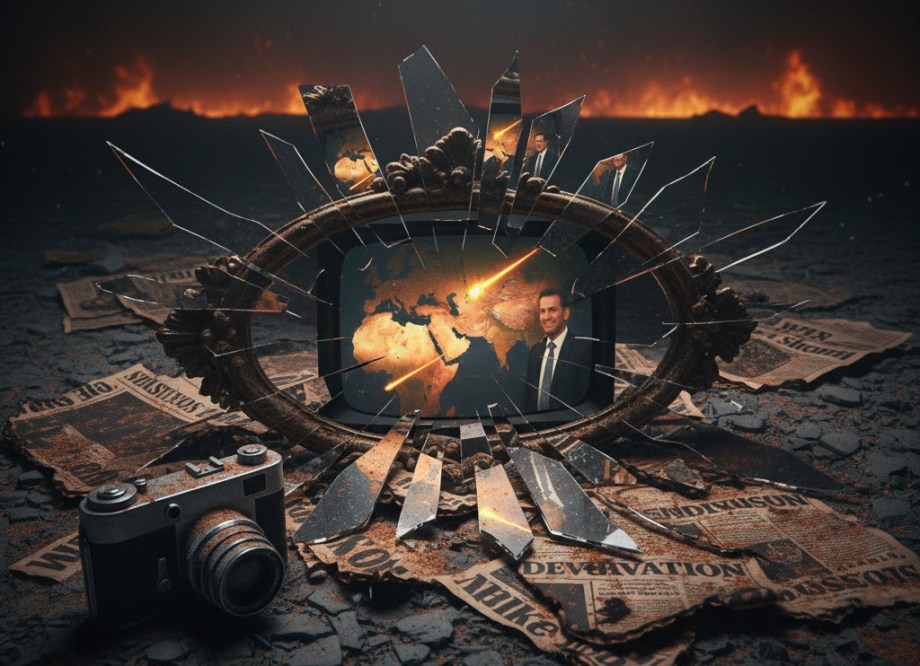
They told you Iran’s missiles were being swatted from the sky like blowflies at a backyard barbecue. They told you the Iron Dome was holding the line, the Patriot batteries were doing their job, US and Israeli air power was surgical, precise and winning. They told you this on the ABC. They told you this on Sky. Nine chimed in. They told you this in headlines written in Washington and repackaged in Sydney as news.
They were, as a matter of technical, forensic, peer-reviewable fact, telling you nonsense.
Theodore Postol is not a conspiracy theorist blogging from a basement. He is a Professor Emeritus of Science, Technology and International Security at MIT who won the Leo Szilard Prize from the American Physical Society, who served as scientific adviser to the Chief of Naval Operations, and who made his reputation doing something the defence establishment hates above all else: counting the actual hits.
After the Gulf War of 1991, when George H.W. Bush stood at the Raytheon plant in Massachusetts and declared the Patriot missile “41 for 42” with Scuds, Postol told Congress the real intercept rate “could be much lower than 10 percent, possibly even zero.” The establishment laughed. Then a House Government Operations Committee investigation confirmed the Patriot had destroyed roughly 9 percent of Scud missiles. Postol had been right. The generals had been lying.
Postol has been running the same forensic eye over the current conflicted conflagration, and his verdict, published in the first week of March 2026, is that Iron Dome and Patriot intercept rates against Iranian missiles are successful at only “a few percent at most” and the systems are depleting fast. More of a tattered straw hat than any iron dome. When decoys are added to the equation, he says, “instead of having one ballistic missile that you have a near-zero chance of intercepting, you’re going to have 20 targets.” This, he concludes flatly, is “a total fraud perpetrated not only on the public” but on the political class itself.
We have our own iron dome in our news services. You did not hear this on the ABC’s 7.30. You will not hear it on Sky. Or Seven or Nine. Not because it is wrong, nor merely because truth is an inconvenience in war, but because empirical, objective truths are not what our corporate media and its masters want us to know.
Our mass media is not only exceptionally practised at lying about war. It is war’s most ancient story. Phillip Knightley documents it in “The First Casualty,” his 1975 history of war correspondents, tracing the systematic manufacture of military optimism from the Crimea through Vietnam. Truth, he argues, is not merely the first casualty of war. It is the first target, chosen deliberately, because a public that knows what is actually happening might ask the odd awkward, inconvenient question about why it is happening at all.
In the current conflict, the mechanisms of that targeting are unusually visible if you care to look.
Israel’s military censor, a type of Iron MajorDomo, has imposed what amounts to a total blackout on reporting that would reveal the genuine damage Iranian missiles are inflicting.
(Iran is not “levelling” Israeli cities, but it is succeeding in a war of attrition. By forcing Israel to spend its high-end interceptors on “junk” drones and cluster-missiles, Iran is attempting to hollow out the Israeli defence budget and public patience while waiting for a window of total exhaustion.)
The Committee to Protect Journalists has documented the detention of CNN Türk’s Emrah Cakmak mid-broadcast in Tel Aviv following Iranian strikes, with phones confiscated and equipment seized.
AFP has confirmed that reporters are prohibited from filming near interception sites, security zones, or showing the aftermath of strikes on military infrastructure. The BBC’s Persian service has reported new restrictions on live coverage of sirens and strike impacts.
What do we get to see? German journalist Sophie von der Tann, comparing the current rules to those she encountered during Israel’s June 2025 campaign, notes that what passes the censor is civilian rubble, which can be attributed to Iranian imprecision, while military damage is classified into invisibility.
The effect of this scheme is to create a parallel reality in which Israel absorbs Iranian fire with stoic invulnerability while Iran’s own infrastructure burns.
The burning is real on both sides. The stoic invulnerability is not.
The parallel reality is then dutifully transmitted by Australian media operating under what might charitably be called a strong and abiding prior assumption, if not industrial strength-race-horse-quality, blinkers that the US-Israeli account of any given engagement is bound to be true.
This is not a new problem. The embedded journalist wheeze that produced such reliable optimism from Iraq and Afghanistan was itself an evolution of the press management practices that shaped Vietnam coverage until My Lai blew it to shreds. The embed, as a concept, trades access for deference. You travel with the troops, you eat with the troops, you file under military review, and after a while the troops are not the story you are covering but the community you belong to. Your narrative, inevitably, becomes their narrative.
Australian audiences watching the ABC or the five million of us per month who read the Murdoch press in one of its platforms are not receiving embedded journalism in the formal sense. They are receiving its functional equivalent: a reliance on official US and Israeli sources, a structural unwillingness to interrogate intercept rate claims, a framing in which Iran’s retaliatory strikes on Gulf neighbours are “attacks” and America’s initial blitz was a “campaign,” in which Australia’s deployment of missiles and surveillance aircraft to the region is “defensive assistance” rather than participation in a war we had no vote on.
This last point is not incidental. Pine Gap’s role in the targeting kill chain for Operation Epic Fury has been reported, quietly, in the specialist press. The Al Minhad Air Base in the UAE, which houses the Australian Defence Force Headquarters Middle East, was directly struck by Iranian drones.
Australian LNG producers Woodside and Santos have seen their share prices rise more than 9 and 10 percent respectively since the war began, as Qatari competition burns. Australia has a set of material interests in this conflict that our media, by and large, declines to make explicit.
The first casualty of war is truth. But Knightley’s deeper insight, the one that gets less airplay, is that the lies are not random. They serve purposes. They protect share prices, alliance relationships, political careers and the comfortable assumption that the side we are on is the side that does precision strikes; while the other side does atrocities. The lies are not a failure of journalism. They are journalism performing its actual function in a media system that is structurally, financially and culturally aligned with the captured state and its allies.
The corrective is not to simply invert the narrative and declare Iran the winner. It is to demand the standard that Postol applies: show me the video, count the contrails, establish what actually happened rather than what the briefing said happened. It is to notice that the experts most systematically excluded from Australian prime time, the Wilkersons and Postols, are not fringe voices. They are decorated, credentialled, establishment figures whose offence is that they exercise their critical faculties; they do the arithmetic.
It is to remember that in 1991 a US president stood in a missile factory and declared a 97 percent success rate, and a man with a slide rule and a conscience spent the next year being ridiculed until the congressional committee confirmed he had been right all along.
Question the sirens. Count the holes. Read the sources your TV talking head has decided you do not need.
The first casualty demands a coroner, not a cheerleader.
 Urban Wronski Writes
And so it has always been, truth leaves a nasty taste in a politicians mouth. Now with the consolidation of the media, the truth is hard to find.
LikeLike
Apart from the buboe of Pine Gap and the NW Cape VLF submarine communication station 8kms from Exmouth WA demonstrating that this country is inextricably involved in targetting & executing “kinetic” aggression, the despatch of the RAAF surveillance E-7A Wedgetail and 85 personnel is a further commitment to essential complicity in the Isramerican war of aggression (the specific UN term for the ultimate war crime).
It is needed to replace the 5 THAAD radar stations in the various satrap emirates which Iran has destroyed – IOW, we are now active participants in aggression.
Close your eyes, Rejoice and Shut Up.
LikeLike