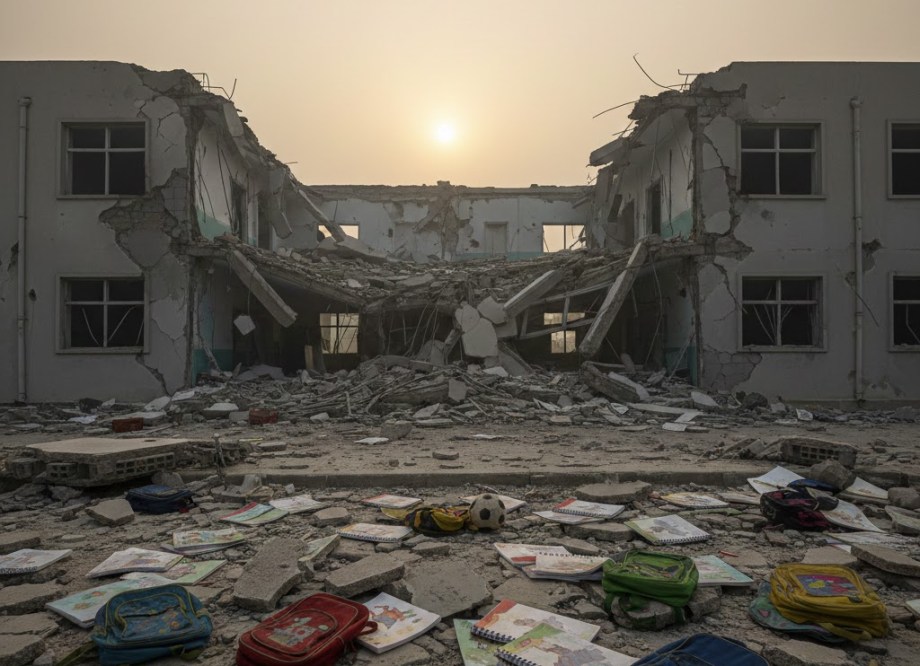
148 girls died in Minab. The school had been separated from the nearby military base for a decade. International law exists for precisely this moment. So why is no one reaching for it?
Sara Shariatmadar was six years old. A second grader. Saturday morning she went to school, as six-year-olds in Iran, do, perhaps with a lunchbox, perhaps dragging her feet, perhaps chattering to a friend. Sara did not come home.
Her father stands outside the rubble of the Shajareh Tayyebeh girls’ elementary school in Minab, southern Iran, Minab is located north of the Strait of Hormuz and close to Bandar Abbas, about 25 km from the Gulf of Oman. Sara’s father does not move toward the building; nor can he move away. He knots his hands together. Separates them. Knots them again. Every time a paramedic emerges he raises his head, then returns to staring at the ground. He is still doing it when reporters find him.
What do you say to such a man? What language exists for this? There are no words for such grief.
One hundred and forty-eight children, a figure is confirmed by the local prosecutor and reported by CNN, were killed when Australia’s allies, US and Israel, bombed their school on the morning of 28 February 2026. Ninety-five more were wounded. One hundred and seventy girls had been inside when the first missiles hit. The victims ranged in age from seven to twelve. Teachers’ bodies were found on classroom benches. Backpacks lay in the rubble.
A second Israeli strike hit a school east of Tehran, killing at least two more students. Of course, it will all be explained away. Close to a military base. Or the fog of war, a favourite in the BRS legal defence.
CNN geolocated the Minab school and confirmed, through satellite imagery, that the building sits approximately 60 metres from an Iranian military base. The base is real. The proximity is real. But the satellite record also shows, clearly and unambiguously, with a decade’s worth of imagery to draw on, that the school and the base have been physically separated since at least 2016. The school was once part of the military compound. It has not been for ten years. That separation is visible from space. It was visible to every intelligence agency that planned this operation.
That distinction matters enormously under international law. We will return to it.
Let us be clear about what international humanitarian law; the body of law that civilised nations constructed after the Second World War specifically to prevent this kind of monstrous atrocity, actually says. The Geneva Conventions and their Additional Protocols are unambiguous: civilian objects, and in particular schools, are protected. An attack against a civilian object is a war crime. If there is doubt about an object’s status, the law presumes it is civilian. Proximity to a military installation does not strip a primary school of its protection; and proximity to a base from which a school has been separated for a decade, confirmed by satellite imagery available to any competent intelligence service, provides precisely no legal cover whatsoever. The principle of proportionality further prohibits attacks where the anticipated civilian harm is excessive relative to any military advantage gained.
One hundred and forty-eight dead children is not proportionate to anything.
The Rome Statute, which established the International Criminal Court, is equally plain. Intentionally directing attacks against civilians, or against civilian objects, constitutes a war crime under Article 8. So, too, does launching an attack in the knowledge that civilian casualties will be clearly excessive relative to the anticipated military advantage. The architects of the Nuremberg trials; Americans among them, lest we forget, established the foundational principle that orders from above do not excuse the commission of such acts. Superior orders are not a defence. They never were.
So who stands accused?
Donald Trump announced the strikes himself, in a video on social media, declaring “major combat operations in Iran.” He called it a campaign to eliminate “imminent threats.” Benjamin Netanyahu called it removing an “existential threat.” The attack was launched, we now know, while Iran had agreed never to stockpile enriched uranium and while active diplomatic negotiations were still in progress. Oman’s Foreign Minister Badr al-Busaidi, a mediator, issued a public statement saying he was “dismayed” that “active and serious negotiations have yet again been undermined.”
UN High Commissioner for Human Rights, Volker Türk, deplored the strikes publicly and immediately.
As for the school: CENTCOM spokesperson Tim Hawkins confirmed that his office was “aware of reports concerning civilian harm resulting from ongoing military operations” and was “looking into them.” The Israeli military said it was also “looking into reports of fatalities.” That was the full extent of the official response to 148 dead schoolgirls.
The silence where accountability should be is its own statement.
This is not the fog of war. This was broad daylight. A building full of children, not soldiers, not weapons caches, not centrifuges. Children. The staff member who survived told reporters she used to watch the girls playing in the yard every day.
After Saturday, she saw their bodies in the corners of classrooms.
We have been here before, of course. The grinding logic of impunity has become the signature condition of twenty-first century warfare. Israel levelled Gaza with American bombs and American diplomatic cover, killing tens of thousands of civilians, and the International Criminal Court issued warrants that the United States promptly announced it would not honour.
Russia’s war on Ukrainian civilians proceeds with brazen indifference. The Geneva Academy warned just weeks ago that international humanitarian law is at a critical breaking point; that the past two years proved devastating to civilians with little evidence of willingness among warring parties to limit the barbarity inflicted on the most vulnerable.
Now a girls’ school in Minab.
The usual machinery of evasion is already grinding into gear. The proximity of a military base. The fog of targeting. The regrettable but inevitable costs of what is presented as not only a virtuous, just and heroic war – but a war Iran’s peoples called for to be rid of a dictator. Cue people in Canberra celebrating, their laughter and cheers a discordant reminder of the tin ear of the propagandist.
CNN’s satellite analysis has already punctured the proximity argument before it can gain traction. The school was separated from the base a decade ago. That is not fog. Not ambiguity. It is a fact, visible from space. And available to every intelligence service that spent months planning this operation. It is a fact that will be available to any future tribunal examining the evidence.
We will not hear, in the official statements, about Fatima al-Zahra Mohammad Ali, age nine, whose father lost his leg in the Iran-Iraq war and waited at the school gates until four in the afternoon, when his daughter’s body was finally pulled from the rubble.
We will not hear about Sara Shariatmadar’s father and his knotting hands. These are the facts that do not fit the briefing notes, the Truth Social posts, the press conferences about military necessity and strategic objectives and the long arc of justice bending toward peace.
History has a long memory, even when justice moves at a glacier’s pace. Radovan Karadžić spent years as a fugitive before The Hague caught up with him. Charles Taylor ran Liberia for years before ending his days in a prison cell in Britain. The architects of My Lai were eventually named, even if most escaped punishment. The arc bends slowly, agonisingly slowly, when you are the father of a six-year-old girl standing outside a bombed school in Minab, but it does bend.
Trump and Netanyahu should be indicted for war crimes. And as allies we are complicit. Hence, the pronoun “we” in the title. Don’t hold your breath expecting the federal government to censure the US and its ally and Middle East proxy. Albo needs to pick up the phone. Call Trump. Remonstrate. Tell the President of regime change that he deserves to be indicted for bombing a school full of children.
Indicted not as a rhetorical flourish. Not as political point-scoring. As a precise legal proposition, grounded in the conventions their own nations helped write and ratify; the same rules which, for decades, the US has loudly proclaimed to the world as the foundation of civilised conduct in conflict.
The law exists. The evidence exists. The satellite imagery exists. The bodies exist, under the rubble of a school that had been a school, only a school, nothing but a school, for ten years.
It’s now a crime site. What we are waiting for? What we are always waiting for is the political will of a world that keeps building legal fences to prevent atrocities and then stands aside, shuffles its papers, and looks at the ceiling while atrocities are committed.
Sara Shariatmadar’s father is still standing outside the wreckage. His hands are still knotting together.
We owe him, at the very least, the honesty to call this what it is.
 Urban Wronski Writes
The usual excuse by Israel for bombing a school or hospital is it was a “control & command centre” for Hamas…oops, IRGC.
Not that it matters when the hegemon is involved.
Imagine if Iran had publicly declared that Naziyahoo’s home was targetted to ‘decapitate’ the 2nd worst, most evil & destructive nation on this particular planet.
There would be righteous outrage & rending of garments in the Chancelleries throughout complicit toady West.
As for our PM, his grovelling “All the way with USA” was an embarrassment when mewled by Holt 60yrs ago and remains so.
The less said about his statement of support for the current atrocity would still be too much, such gems as “…to prevent Iran continuing to threaten international peace and security.”
Two countries have threatened international peace and security, destroyed countries and killed millions in the last 60yrs and continue to do so with total impunity.
LikeLiked by 1 person
All good points, amphibious. And as yet not a murmur from our leaders that the US-Israeli attack on Iran is illegal. The US broke the law getting into this war (no self-defence justification, no Security Council authorisation, constituting the crime of aggression), broke the law conducting it (civilian targeting, assassination of a head of state, deliberate rollback of civilian protection mechanisms), and did so after firing the lawyers who might have stopped it. The legal framework is not ambiguous. The violations are, as one professor put it, about as plain as they could possibly be.
LikeLike
The school in Minab is 25kms inland, EAST of the Strait of Hormuz, over 1,800kms from Israel as the “upgraded” F151A Eagle flies.
Their combat range of <1,300kms is inadequate for the Israeli strike on a school east of Tehran without mid-flight refueling which ONLY the USAF can provide when back in safe airspace, ie west of the Iraq border when returning.
Even with extra fuel tanks these sexy boy toys…sorry, fighter jet bombers the range can be extended to <3,000kms but ONLY by ditching missiles for use as fighters not bombers – even then air refueling is necessary to return
IOW, Minab was hit, not by the valiant, beleaguered, only M/E democracy, world’s most moral military™ © etc ad nauseam, but by USN Cruise or Tomahawks from the big, bad, beautiful armada wallowing safely out of range around in the north Arabian Sea, probably off the coast of Pakistan their glorious, sometime ally, currently doing the Lord’s work punishing Afghans for kicking the hegemon’s lardarse for 20+yrs.
LikeLike