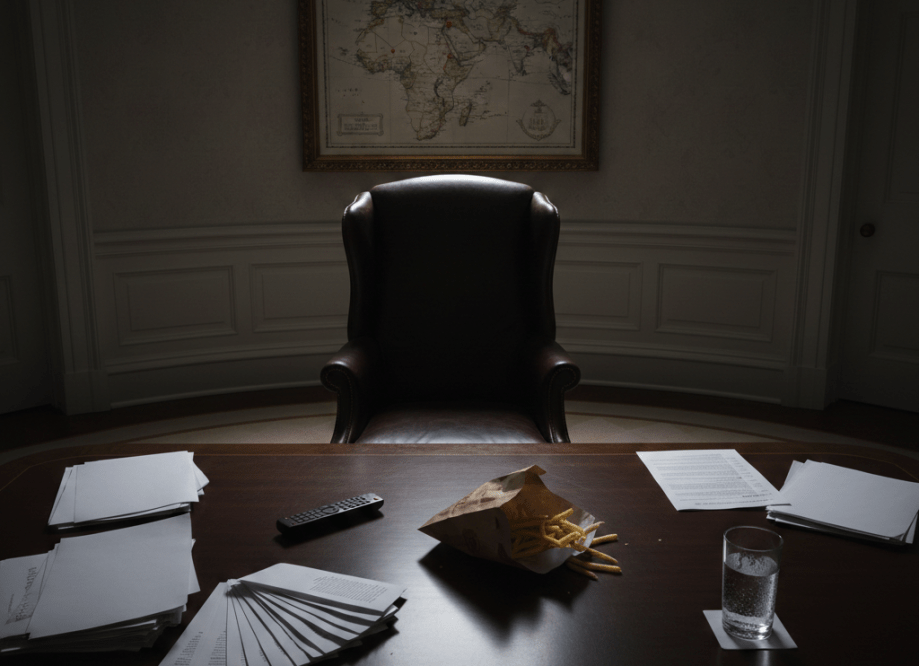
The Emperor Has No Marbles: Trump’s Frontotemporal Dementia and the Psychopathology of US Imperial Decline
3:15 a.m. in Tehran, June 2025, all hell breaks loose in Iran’s airspace: Seven B-2 Spirit stealth bombers, flying dark from Whiteman Air Force Base in Missouri, a round trip of thirty-six hours, drop a total of fourteen GBU-57 Massive Ordnance Penetrators, thirty-thousand-pound bunker busters aimed at Fordow buried eighty metres inside a mountain, and Natanz.
The big bombs have never been used before. Not so new but just as deadly, over thirty Tomahawk cruise missiles, launched from USS Georgia, an Ohio-class guided-missile submarine lurking in the Gulf of Oman, targets Isfahan’s nuclear conversion facility. F-35s and F-22s, fly suppression runs ahead of the bombers, drawing Iranian surface-to-air missile fire so the B-2s can pass undetected through airspace Iran didn’t know had already been penetrated. Iranian radar operators didn’t know the attack had happened until the bombers were back outside Iranian airspace. Midnight Hammer strikes fast, deep and deadly.
But the real damage is happening 10,000 kilometres away, inside the skull of a president whose mind is no longer fit for the office, let alone the empire. When Donald Trump declares, “We obliterated their nuclear program!” in the war’s aftermath, his own intelligence chiefs exchange glances. The IAEA reports no weaponisation. The Mossad says Iran’s centrifuges may still be spinning. Yet Trump’s brain, like the empire he commands, is a low information zone. What follows is not strategy, but the dangerous spectacle of a superpower steered by a man whose most volatile weapon is his own deteriorating mind.
This is not hyperbole. It is the consensus of neurologists, psychiatrists, and forensic experts who, by early 2026, have amassed a damning dossier on Trump’s cognitive state. His wide based gait the right leg swinging “like a dead weight,” as Dr. John Gartner puts it is “very diagnostic” of behavioural variant frontotemporal dementia (bvFTD), a condition that erodes judgment, language, and impulse control. His verbal slips are not gaffes. They are symptoms.
In December 2025, he confuses Norwegian Prime Minister Jonas Gahr Støre with a “terrorist guy from ISIS” during a press conference. A month later, he claims to have “aced” a cognitive test, a sure sign his dementia is being monitored by those running his administration, including Stephen Miller, Peter Thiel, and their shadowy counterparts.
His rallies, once chaotic but coherent, now feature rambling digressions, mid sentence pauses, and the occasional nap. At a NATO summit in Brussels, photographers capture him shuffling like “a man 20 years older,” his gait unsteady, his movements sluggish. The White House blames a “slippery stage.” Neurologists are scathing but in the Trump era, no-one heeds specialists any more. Or science.
The President’s obvious bruises from unexplained falls, his dozing in meetings, his unscripted rages all are red flags waved by a body and mind in freefall. And yet, the empire carries on as if nothing is amiss. Or too terrified to tell the truth. Or too busy banking investment dividends.
The Psychopathology of Power: When the Commander in Chief Cant Command
Frontotemporal dementia does not just impair you. It amplifies your worst traits. Trump’s narcissism, always dangerous, has by 2026 become disinhibited, erratic, and untethered from reality. As Dr. Zoffmann notes, bvFTD turns personality disorders into “more aggressive, more impulsive, more primitive” versions of themselves.
So it is with Trump’s presidency. His threats “We’ll hit them so hard their grandkids will feel it” are not calculated deterrence. They are the unfiltered id of a man losing his cognitive brakes.
The catalogue of gaffes grows by the week. In January 2026, he tells a crowd in Ohio that he “just took a cognitive test and aced it,” adding, “Nobody’s ever done that before, not even the young guys.”
The boast is telling. Cognitive tests are not graded on a curve, and the fact that he feels the need to brag about passing one suggests his team is monitoring his decline. A month earlier, he refers to Nikki Haley as “Nikki Nazi,” a slur so bizarre that even his most loyal surrogates struggle to defend it. At a rally in Georgia, he mistakes his wife Melania for his former press secretary, calling her “our great Sarah Huckabee.” The crowd laughs nervously. His staff does not.
His gaffes are more frequent, more extreme. In a February 2026 interview with Fox, he refers to President Xi Jinping as “the guy from North Korea,” a mistake he makes twice in the same conversation. When a reporter points out the error, he snaps, “You know what I meant. You’re just trying to trap me.” The outburst is classic Trump, but the confusion is new. So is the defensiveness. So is the way his face flushes with frustration, as if he is struggling to keep up with his own thoughts.
On the one-year anniversary of his second term, Trump stood at the podium for 104 minutes, rifling through a prop stack of papers and muttering to himself. “Hm, I’m just looking at these charges, it’s just pretty incredible… Many murderers. Many, many murderers. People that murdered.” CNN cut away after 40 minutes, with anchor Brianna Keilar calling it “pretty winding even by Trumpian standards.” Video journalist Aaron Rupar posted the footage with the caption “folks, this is some really weird shit. the president is not well.”
This is a man who is being managed. His handlers indulge him precisely because he sows confusion while they get on with the main game of constructing a state with all the trappings of fascism. And the handlers? The handlers get what they want. Musk gets regulatory capture. Miller gets the immigration enforcement state he’s been drafting since 2015. The Federalist Society gets the judiciary. Heritage gets the administrative state hollowed out and restaffed from Project 2025.
None of this requires Trump to be coherent. He just has to be loud. Unpredictable is also good.
The system enables him. Congress, bound by partisan loyalty, cowardice, or an insatiable appetite for power and the spoils of office, has never invoked the 25th Amendment, despite hundreds of medical professionals including Dr. Bandy X. Lee, a forensic psychiatrist at Yale, and Dr. Lance Dodes, a retired Harvard psychiatry professor signing petitions warning of “probable dementia.” The media, obsessed with the spectacle, treats his slurred speech and ramblings as “Trump being Trump,” not as the neurological emergency they are. The Pentagon, meanwhile, continues to assemble the largest Middle East buildup since 2003 not because of a coherent strategy, but because no one is left to say no.
This is how empires collapse: not with a bang, but with a synaptic misfire: an ageing, directionless populist president, who loves to hate but who can no longer remember his enemies’ names.
The War as Symptom: Iran, Israel, and the Failure of Reason
Last year’s twelve day war with Iran is not a clash of civilisations. It is a clash of realities one in which Trump’s unwinding mind enters the cold, steel, cage fight of geopolitics, and loses its bearings.
The pretext for war is flimsy. Laughable. Trump claims Iran is “days away from nuking Tel Aviv.” His own intelligence agencies disagree. The IAEA finds no weaponisation. But in the mind of a man with FTD fueled paranoia, facts are optional. The strikes on Tehran are militarily precise but strategically catastrophic. Iran’s nuclear program is delayed, not destroyed. The non-proliferation regime is shattered. And the US? It is left with two carrier groups in the Gulf and no exit plan; a classic case of impulse over strategy, the hallmark of a leader whose brain can no longer weigh consequences.
As Iran’s economy implodes and protests rage, Trump tweets threats and dozes through briefings. The world watches as the most powerful man on earth confuses allies for adversaries, past for present, and bluster for policy. The ceasefire that ends the war is not a resolution. It is a pause; one that Trump, in his increasingly erratic pronouncements, seems incapable of leveraging.
By February 2026, as US and Iranian envoys meet in Geneva, he is ranting about “deep state traitors” to a Florida rally. The Strait of Hormuz, through which 20 percent of global oil flows, remains a tinderbox. And the president? A man unmoored, his mind as unstable as the empire he commands.
The Geopolitical Consequences: A World on the Brink
The geopolitical fallout from Trump’s cognitive decline is, however, not abstract. It is measurable, immediate, and dangerous.
First, there is the collapse of deterrence. Trump’s erratic threats; his promise to “totally destroy” North Korea one day, his praise of Kim Jong un the next have left allies questioning America’s reliability. When he confuses Xi Jinping with the leader of North Korea in a live interview, it is not just a gaffe. It is a signal to Beijing that the US president is no longer capable of coherent diplomacy. The result? China accelerates its military buildup in the South China Sea, calculating that Trump’s instability gives it a window of opportunity.
Next comes the unravelling of alliances. Trump’s cognitive decline has turned US foreign policy into a series of ad hoc reactions. His decision to pull troops from Syria, without consulting allies, leaves Kurdish forces exposed and Turkey emboldened. His sudden demand that NATO members “pay up or we walk” sows doubt about America’s commitment to collective defence. European leaders, once reassured by US stability, now whisper about the need for an independent EU defence force a direct consequence of Trump’s unreliability.
Above all is the escalation of conflict. Trump’s impulsive strikes on Iran, justified by fabricated intelligence, have not just failed to achieve their objectives. They have accelerated Iran’s nuclear program. With IAEA inspectors expelled and the non proliferation treaty in tatters, Iran now operates without constraints. The risk of a nuclear arms race in the Middle East is higher than ever. Meanwhile, Trump’s threats to “bomb the shit out of” any country that crosses the US have not deterred adversaries. They have provoked them. Russia and China, sensing weakness, are testing US resolve in Ukraine and Taiwan. The world is not just watching Trump’s decline. It is exploiting it.
Finally, there is his erosion and abrasion of global trust. When a US president cannot pick fact from fiction, when his word is no longer trusted, the entire international order suffers. The dollar’s role as the global reserve currency is in doubt. Alliances fray. Adversaries grow bolder. The result is a world where no one knows what the US will do next because no one, including Trump, can predict it.
The Catalogue of Collapse: A President in Freefall
The examples are mounting, a litany of moments that would be comical if they were not so terrifying.
In January 2026, during a speech at the World Economic Forum in Davos, Trump refers to Ukrainian President Volodymyr Zelensky as “the guy from that country, you know, the one with the war.” The audience murmurs. Zelensky’s name is on the teleprompter. Trump ignores it. Later, he tells reporters that he has “a great relationship with the leader of Poland,” a country whose president, Andrzej Duda, he has never met. Trump waves away a reporter who points this out,
“I’ve met a lot of Poles. Great people.”
In Texas, he tells a rally he “just signed a bill to build the wall,” a vow he made in 2016 and has repeated, for a decade. The crowd cheers. The wall is still incomplete. The bill does not exist.
In a February 2026 interview with The Wall Street Journal, he asserts that his administration “ended the Korean War,” a war that concluded in 1953. When pressed, he insists, “I did more than anyone. We got the hostages back.” There were no hostages. There was no deal. There is only the increasingly desperate performance of a man who can no longer separate fiction from reality.
Trump’s boasts are becoming more grandiose and more unhinged. He tells a crowd in Arizona that he has “the best memory of any president in history,” a claim that would be laughable if it were not so tragic. He upstages this by asserting that he “single handedly defeated ISIS,” a task that required years of coalition efforts and thousands of lives. His aides no longer bother to correct. They simply let the lies hang in a crazy, unchallenged, unchecked, chokehold on reason; a MAGA-miasma of lies.
The Reckoning: An Empire on Autopilot
“Empires do not die from external attacks. They rot from within. Rome had its Caligulas. The Habsburgs had their mad emperors. America has Trump—a man whose frontotemporal dementia is not just a personal tragedy, but a systemic failure.
The question is no longer whether Trump is fit for office. It is whether the office itself is fit for survival when the institutions meant to check a failing leader—Congress, the media, the military—look the other way. History will not forgive the silence. The 25th Amendment exists for moments like this. The Goldwater Rule was meant to protect patients, not presidents.
If the American people still believe in self-governance, they must ask:
What does it say about a nation that watches its emperor lose his marbles and does nothing? The Tomahawks aimed at Tehran are just the beginning. The real crisis is in Washington. And the neurological impairment, the mental degeneration of its elderly president, is ultimately a catastrophic failure of the American body politic and its immune system.
 Urban Wronski Writes
Whilst the front of house may be dementing in front of the customers (just as the last President was), the back room plots on for more important folk and disaster capitalists keep writing the script for the next episode. Drastic pruning of the human population is clearly on their agenda as is tech substitution of a lot of labour/skill. Meanwhile, the local management keeps on cracking down, making destructive decision after destructive decision (environment, Muslims, climate, the poor) for our own local disaster profiteers and foreign interests. We aren’t rebelling, we don’t have Minnesota or the equivalent of Governors making a counter stand. Who’s the more decadent?
LikeLiked by 1 person
‘At a press conference in March 2026, he is asked about the ongoing negotiations with Iran. He responds by praising his administration’s handling of the “China virus,” a pandemic that ended years earlier.’
typo re the date or?
As far as I know we haven ‘t made it March yet…
LikeLike
Sobering. Congressional members must hang their heads.
Lloyd Driscoll
LikeLike
If the members of Congress had any morality or ethics they would be turning in their graves…oh, wait.
The US Constitution provided for three branches of government of equal power – Executive, Judiciary and Legislative – specifically to keep the others in check.
It also required that there be mid-term elections, when ALL members of the lower House are elected, along with a third of the Senators (who have 6yr terms) seek re-election to allow the electorate to endorse or reject government actions.
Since WWII voter participation has been decreasing – only 3/4 of citizens are registered to vote.
Generally fewer than 2/3 of the electorate vote at all – the turnout in 2020, almost 67%, was the highest for over a century, 17M/5% more than in 2016 as if determined not to repeat the error.
Apart from personality disorders there have been many Presidents unsuited to command due to health, substance abuse or dementia in the modern era.
JFK was heavily medicated with a complex, often secret cocktail of drugs—sometimes 10 to 12 medications a day—including steroids, painkillers, stimulants, and sedatives (and threatened by J Edgar Hoover over his dalliances).
Nixon a paranoid drunk and Reagan was diagnosed by Dr Helen Caldicott in 1982 with incipient dementia which was admitted after leaving office.
Clinton was an ethics & morality free zone who discarded every claimed principle to survive his many scandals, aptly described by the Hitch in his book “No-one Left to Lie To.”
The less said about Shrub, the idiot Dauphin, scion of single termer Preppie Bush, the better.
There are some who claim that Obama was a good President but his record proves otherwise.
Unlike currently, Trump’s many pathological tendencies were corralled and ameliorated in his first term by the soi-disant “adults i the room”.
His shock win saved the world from the unapologetic warmonger HRC who, with her emigre gal-pal Nuland would have started the Ukraine war in 2017.
It was reported that Obama decided to run in April 2008 on ABC Good Morning America) after she cackled about threatening to turn Tehran into an ashtray.
LikeLike
Trumps Government will let him rant on, While they get on with total subversion. What the American population is doing or thinking is beyond any rational act. All we can hope for is a Democratic outcome at the MidTerms and all who are involved in this Government are in Jail forever.
LikeLike