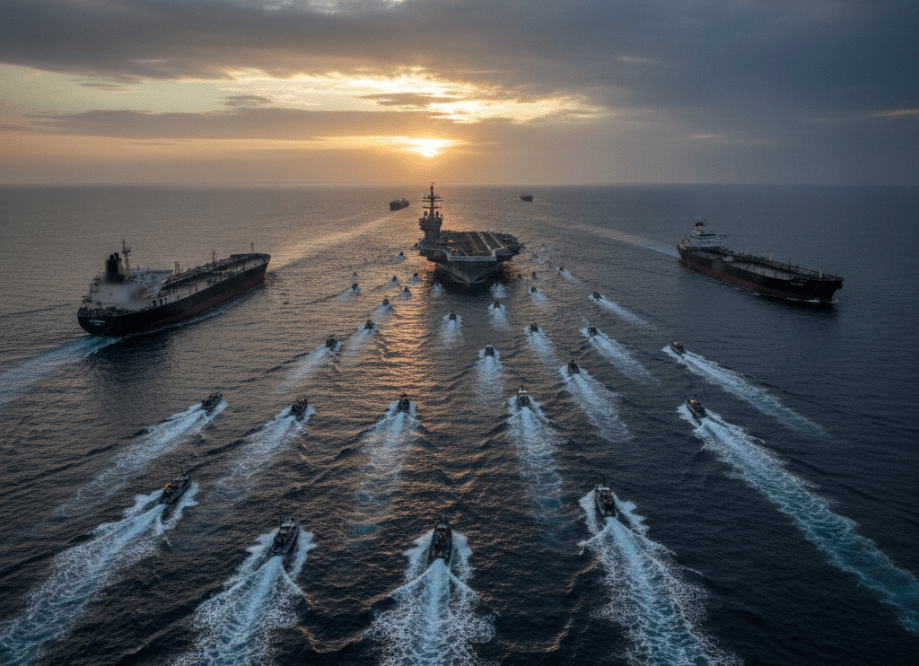
The Shadow Fleet’s Silent War
The Strait of Hormuz at dawn is a study in contradictions. The air hangs thick with the acrid tang of diesel and the metallic bite of salt, while the water, flat as a sheet of beaten tin, hides currents treacherous enough to swallow a ship whole. Local fishermen, their faces weathered like the driftwood they burn for fuel, know the snags by heart: the submerged wrecks of tankers scuttled in the Iran-Iraq War, the sudden whirlpools near Qeshm Island, the deceptive calm before the shamal winds howl down from the mountains.
Here, in this 21-mile-wide throat, 20 per cent of the world’s oil chokes through a bottleneck guarded by the US Navy on one side and Iran’s Revolutionary Guard on the other.
But the real battle isn’t fought with destroyers or drones. It’s waged in the shadows of global shipping lanes, where Iran’s shadow fleet, nearly 300 tankers strong, slips through sanctions like smoke through a keyhole. These aren’t rusting hulks. They’re a floating, evolving empire: 1.3 to 1.6 million barrels of crude oil moving daily through clandestine ship-to-ship transfers, their cargoes laundered via falsified manifests and BRICS back channels. The fleet’s growth is relentless. Oil-on-water volumes have surged from 110 million barrels in 2022 to nearly 200 million by late 2025, a 45 per cent jump in a single year. Every tanker that evades detection is another nail in the coffin of US sanctions.
The mechanics of deception are basic but brutally efficient. Under cover of darkness, Iranian crude is pumped onto shadow vessels in the middle of the Gulf, their transponders switched off, their names repainted mid-voyage. By the time the oil reaches China’s teapot refineries, it’s been reborn as Malaysian blend or Russian export. The system runs at full stretch, and it’s working. China’s strategic reserves swelled by 100 million barrels in 2025, with Iranian crude accounting for a quarter of the influx. Beijing doesn’t just buy oil; it buys time, leverage, and a silent middle finger to Washington’s sanctions regime.
The Trader’s Gambit
Chen Wei doesn’t look like a bloke who moves millions of barrels of sanctioned oil. At 44, he’s slight, with a wiry frame bent from long hours hunched over a desk rather than the deck of a tanker. His office in Ningbo overlooks the port, where the air smells of low tide, tar and diesel fumes. A framed photo on his desk shows him standing beside a grinning Iranian official in Bushehr, the sun glinting off the pipelines behind them.
“We don’t call it Iranian oil,” he says, swirling a cup of jasmine tea so dark it’s almost black. “We call it opportunity.” His phone buzzes, a text from a contact in Bandar Abbas. Another shipment is ready.
“The Americans think they control the market,” he continues, tapping the screen. “But markets are like water. They always find a way through.”
Chen’s network is a textbook in modern sanctions evasion. His company, a mid-tier trader with a nondescript name, acts as a cutout for state-owned enterprises. The paper trail is immaculate: cargoes are relabelled as Oman crude or Iraqi heavy, payments routed through shell companies in Dubai and Kuala Lumpur.
“The key,” he explains, “is to make the oil invisible before it even leaves the Gulf.” He pulls up a spreadsheet on his laptop; columns of numbers tracking shipments, payments, and the ever-shifting web of front companies. “This isn’t smuggling,” he says. “It’s logistics.”
The real magic happens at sea. Chen describes the ship-to-ship transfers like a choreographed dance: two vessels meet in international waters, hoses snaking between them under the cover of night. The Iranian tanker, its transponder dark, pumps its cargo onto a waiting ship flying a Liberian flag. By morning, the oil is no longer Iranian. It’s just another cargo in the vast, anonymous flow of global trade.
“Do you ever worry about getting caught?” I ask.
He laughs, a sharp, humourless sound. “Caught by whom? The Americans? They’re too busy chasing their own tails.” He gestures toward the window, where a line of tankers stretches toward the horizon. “See those? Half of them are carrying Iranian oil. The other half are carrying oil that was Iranian five days ago.” He takes a sip of tea. “The only risk is the price dropping too low. Then the margins get tight.” His phone buzzes again. Another deal closed.
The Permian’s Slow Bleed
Three thousand miles away, in the dust-choked towns of West Texas, the consequences of Chen’s trade play out in shuttered diners and boarded-up storefronts. The Permian Basin, once the engine of America’s energy renaissance, is now a casualty of the shadow fleet’s success.
Carlos Mendoza’s hands are stained with oil, though he hasn’t worked a rig in six months. We meet in a diner in Odessa, where the air conditioner battles the 105-degree heat and the scent of fried onions clings to everything. He spreads his pay stubs across a laminate table: $92,000 in 2023, $76,000 in 2024, $48,000 last year.
“They call it the ‘Tehran Tax,’” he says, nodding toward an idle pumping jack nearby. “I call it robbery.”
The numbers are written in the hollowed-out main streets and the For Sale signs on every other property. Rig counts in the Permian dropped 15 per cent in 2025, the steepest decline since the pandemic. Production costs have risen 18 per cent, eaten alive by inflation and supply chain snarls. Break even prices now average $68 per barrel, higher than Saudi Arabia’s, higher than most of the world’s.
At $55 a barrel, the price Iran’s shadow fleet ensures, the mathematics just doesn’t stack up.
Carlos slides a photo across the table. It’s his crew, grinning in front of a fracking site, their faces smeared with grease and pride. “That was two years ago,” he says. “Now? That rig’s dark. That crew’s scattered. And that oil?” He taps the photo. “It’s sitting in a tank in China, paying for some ayatollah’s new yacht.”
Outside, a tumbleweed rolls past the diner’s plate-glass window. The wind howls across the empty parking lot, carrying the scent of dust and diesel. Carlos stares at his hands. “They tell us we’re fighting for energy independence,” he says. “But we’re just fighting to stay afloat.”
The Albatross
Back in Washington, the numbers pile up on desks in the Treasury Department and the State Department, each one a testament to the futility of the current strategy. $477 million per day to maintain the US Navy’s presence in the Gulf. $1.3 trillion proposed for the 2027 defence budget, a 20 per cent increase from 2025. $0—the amount of Iranian oil revenue actually stopped by sanctions in the past year.
The albatross isn’t around Tehran’s neck. It’s around Washington’s.
A senior State Department economist, who asks not to be named, leans back in his chair and rubs his temples. His office overlooks the National Mall, but he might as well be staring at a brick wall. “We’re not fighting Iran,” he says. “We’re fighting simple arithmetic. Arithmetic always wins”
On his desk, a single sheet of paper lists the costs of the current standoff: $29 billion in lost revenue for US shale producers in 2025. 120,000 jobs gone in Texas, North Dakota, Oklahoma. $37 billion in Iran-BRICS trade, up 68 per cent since 2023.
He taps the paper. “Every time we tighten the screws, they just find another way to turn them,” he says. “And every time they do, we lose a little more.”
Outside his window, the Washington Monument juts into the sky, a stark white obelisk against the gathering storm clouds. Somewhere beyond it, in the warrens of the Pentagon and the labyrinth of the Treasury, the machines of American power grind on.
But here, in this quiet office, the truth is simple: the Strait of Hormuz isn’t just a choke point. It’s a mirror. And what it reflects isn’t victory. It’s the slow, inexorable tide of a war America can’t win.
 Urban Wronski Writes
I am glad Iranian oil is getting out. Should the USA completely cut off oil to China, the shit would really hit the fan and I don’t believe even Trump wants that?
LikeLike
Jonangel, A total US oil embargo on China would spike global prices, disrupt supply chains, and hit US exporters hard—China has already slashed US crude and LNG imports via tariffs (up to 49%), pivoting to Russia, Iran, and domestic output, leaving American infrastructure stranded. This “decoupling” has already caused US export crashes and job losses in energy states like Texas.
LikeLike
The elephant-sized leaky barrel in the room of 21stC society is energy in civil society generally and specifically for military toys that go bang OIL.
Like an inverted pyramid resting on its capstone.
It was said that dinosaurs were a huge body with a tiny brain.
Whether true or not, it illustrates the dilemma of the Benighted States which was founded with a total prohibition on a standing army.
The Federation Papers show the grim awareness that historically such forces had been used by rulers against the citizenry rather than external enemies – not wanted in newly free colony.
Until recently the hegemon spent more than the rest of the world combined on its military.
Reagan-era neocons claim that it was their overspending which sent the USSR broke trying to compete.
Once that may have mattered.
Now it is stretched & thinly spread with overextended supply chains.
Asymmetrical warfare is the NOT ‘new black’ – cheap, easily produced weaponry altering balances of power have been around since prehistory.
Bronze weapons were the nukes of their age, expensive & requiring great expertise to produce – iron weapons were a fraction of the price.
At Crécy, Poitiers & Agincourt yeoman archers destroyed elite armoured knights, the once invincible equivalent of tanks.
Intra-European power relationships were upended by crossbows, cheap, easily produced by any blacksmith and ideal for urban warfare – an old German proverb from the Hanseatic League “City air makes men free!” – where the troops of feudal princes were almost useless.
Then came gunpowder and in the 18thC the six gun – the Equalizer.
Currently wallowing in the north Arabian Sea, off the coast Pakistan (perhaps Trump will declare Baluchis a threat…?), the 5th Fleet of the USS Lincoln & the protection vessels dare not come within range of Iran’s surface missiles – minimum 1000-1500kms.
The flotilla has a limited stock of munitions – at most a fortnight in full action.
Lotsa luck replenishing that at “home” base – BAHRAIN.
The lumbering behemoth may be dead but it hasn’t yet stopped moving and its death throes can still do a lot of damage, especially to self image in defeat.
LikeLike