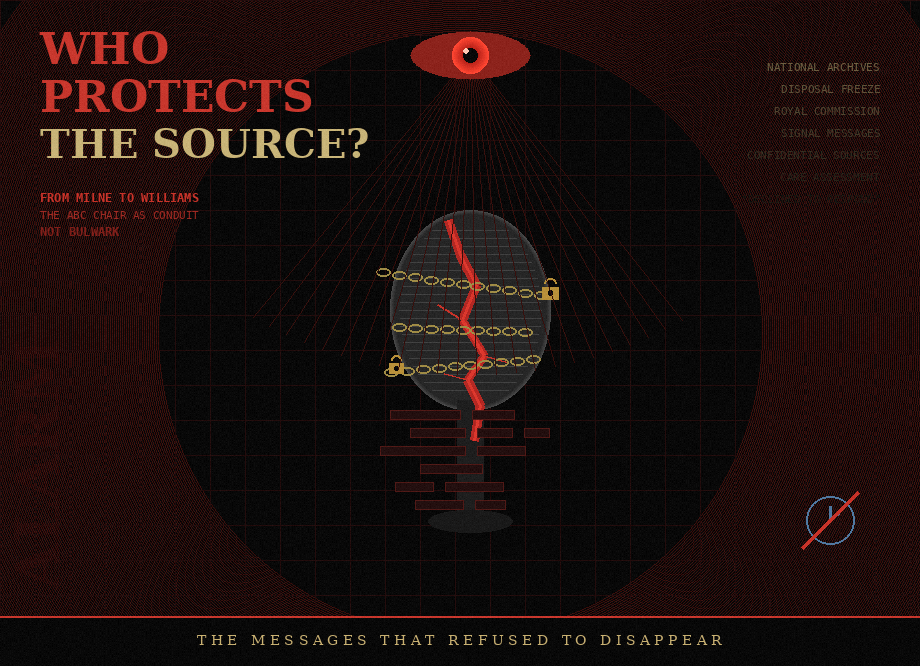
BRYAN: Good evening. Tonight I’m talking to the man in charge of making sure journalists at our national broadcasters keep absolutely everything.
JOHN: Good evening, Bryan. Delighted to be here. Although I should mention I’m now legally required to retain a record of this conversation.
BRYAN: You’re required to retain this interview?
JOHN: Everything, Bryan. Every word. Every pause. Every awkward silence. It’s all going to the National Archives.
BRYAN: Can you explain to our viewers what’s happened?
JOHN: Certainly. The National Archives has issued a disposal freeze notice to the ABC and SBS in connection with the Royal Commission on Antisemitism and Social Cohesion.
BRYAN: And what does a disposal freeze mean, exactly?
JOHN: It means you can’t dispose of things, Bryan. The clue is very much in the name.
BRYAN: What sort of things?
JOHN: Records. Documents. Messages. Carrier pigeons. Anything relating to social cohesion, antisemitism, religious extremism, radicalisation, and the Bondi attack.
BRYAN: That’s quite a broad net.
JOHN: It’s a magnificent net, Bryan. You could trawl the Coral Sea with this net.
BRYAN: And this includes disappearing messages?
JOHN: Yes, well, this is the interesting part. We’ve told staff that messages on Signal and similar apps must no longer disappear.
BRYAN: But the whole point of disappearing messages is that they disappear.
JOHN: They did disappear, Bryan. They were wonderful at disappearing. World-class disappearing. But now they have to stop disappearing and start appearing. Permanently.
BRYAN: So journalists who use Signal to communicate confidentially with sources—
JOHN: Will need to keep those messages, yes.
BRYAN: But journalists use disappearing messages specifically to protect their sources.
JOHN: And they’ve been doing a marvellous job of it, Bryan. Really first-rate source protection. But now we need them to protect the messages as well.
BRYAN: Doesn’t that rather defeat the purpose of protecting the sources?
JOHN: Not at all. We’ve assured staff that the notice only requires the ABC to refrain from destroying relevant material. It doesn’t require production at this stage.
BRYAN: At this stage.
JOHN: At this stage, Bryan, yes.
BRYAN: What about the next stage?
JOHN: Well, if there’s a production request, we’ll carefully consider it in consultation with ABC Legal.
BRYAN: And what will ABC Legal do?
JOHN: They’ll conduct a care assessment.
BRYAN: A care assessment.
JOHN: A care assessment, Bryan, yes. Regarding confidentiality of sources.
BRYAN: What does a care assessment involve?
JOHN: Well, it involves assessing things. Carefully. With care.
BRYAN: Can you be more specific?
JOHN: I’m afraid I can’t, Bryan. We declined to respond when Crikey asked the same question.
BRYAN: You declined to respond to a question about how you’d protect journalists’ sources?
JOHN: We did, yes.
BRYAN: Doesn’t that rather undermine confidence in the care assessment?
JOHN: Bryan, I think you’ll find that declining to respond is one of the most carefully assessed responses available. It takes enormous care to say absolutely nothing.
BRYAN: The journalists’ union says its members are confused and worried.
JOHN: That’s understandable, Bryan. Confusion and worry are perfectly rational responses to a directive that asks you to keep a permanent record of your confidential communications in case the government wants to look at them later.
BRYAN: They say the ABC’s email ignores responsibilities to protect basic principles of journalism.
JOHN: I wouldn’t say we’ve ignored those principles, Bryan. We’re very much aware of them. We’ve just been asked to retain them in a filing cabinet alongside all the Signal messages.
BRYAN: How many other disposal freezes are currently in effect?
JOHN: Oh, quite a few, Bryan. Robodebt. Afghanistan. The disability royal commission. Child sexual abuse. The Vietnam War. Atomic bomb testing.
BRYAN: Atomic bomb testing?
JOHN: Yes. If you have any messages on Signal about atomic bomb testing conducted in Australia, Bryan, do not delete them.
BRYAN: I’ll bear that in mind. Now, the National Archives says the freeze only relates to Commonwealth records.
JOHN: That’s correct.
BRYAN: And when asked about source protection, they directed questions back to the ABC and SBS.
JOHN: They did.
BRYAN: And when we asked the ABC about source protection, you declined to respond.
JOHN: We did.
BRYAN: And the SBS?
JOHN: The SBS said they’re still working through the implementation and impacts.
BRYAN: So who is actually responsible for protecting journalists’ sources in all of this?
JOHN: That’s an excellent question, Bryan.
BRYAN: Is anyone going to answer it?
JOHN: We’re still working through the implementation and impacts of answering it.
BRYAN: This is a bit like a disappearing message, isn’t it? The accountability has just vanished.
JOHN: It has, Bryan, yes. But unfortunately, under the current disposal freeze, we’re required to retain a record of it vanishing.
BRYAN: Thank you very much for your time.
JOHN: Thank you, Bryan. And remember — this conversation has been permanently archived. My lawyers will be in touch about the care assessment.
A tribute in the style of the late John Clarke and Bryan Dawe, whose ABC interviews illuminated Australian public life for over two decades.
 Urban Wronski Writes
Brilliant and critically important.
Thank you UW for continuing the Clarke&Dawe legacy without dropping a stitch.
LikeLike
Thank you mugsey. It’s my homage to the masters and intended as a tribute – and because their treatment of an issue is the only way to handle it.
LikeLike
Everything old is new again.
So perfectly reproduced – were it not for the topical subject matter it might have come from the archives.
Well done.
PS My favourite was the new regs. to prevent ship fronts falling off – Dead Parrot quality.
LikeLike