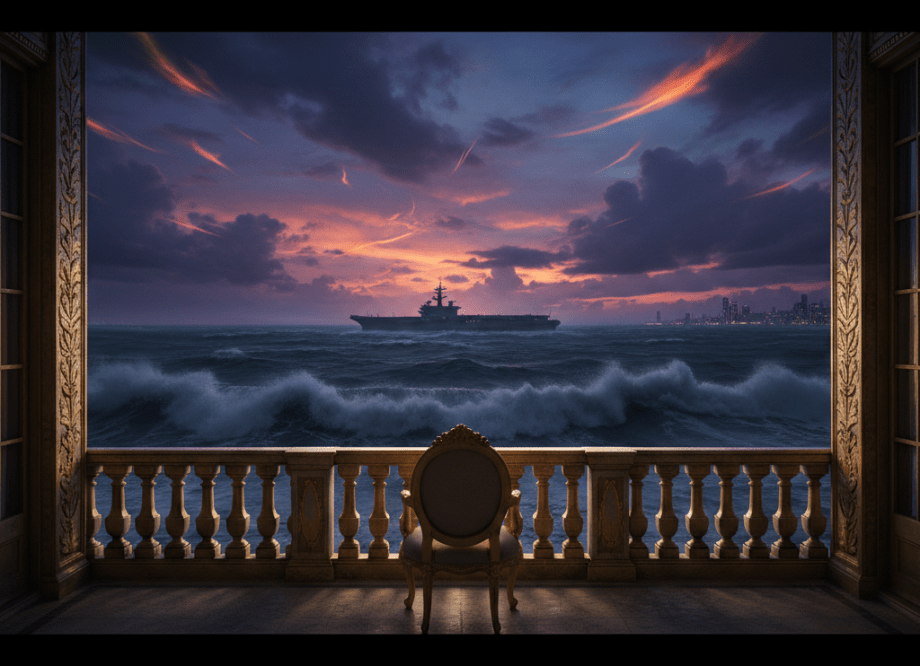
As the imperial twilight stretches from Mar-a-Lago’s colonnades to the bazaars of Isfahan, the world’s longest-running show is no longer a republic in crisis, but a B-grade reality TV series with a military budget: all briefing rooms, cliffhangers written in sanctions, and a gaudy, Liberace-bright “Hail to the Chief” endlessly modulating upward, key change after key change, like a desperate, frozen grin.
The applause is canned. The guests have already wandered off to other scandals. Yet the solitary showman keeps plugging away at the anthem, louder, brighter, faster, as if volume were policy and glitz was strategy, until the tune runs out of oxygen, stalls in mid-triumph, and collapses into a few lonely notes; thin, exposed, and suddenly audible for what they are: not fanfare, but fear.
Trump, the “Fool on the Hill” re-imagined as Sun King in power tie, lifts and dazzling dental veneers, has traded the shepherd’s crook for a gilded sabre. He rattles it senseless. One moment he is the noble liberator of an oppressed Caracas; the next, he is “making an offer” on Greenland, treating sovereign territory like a distressed asset in a Queens bankruptcy court. He hopes that if he bellows “Humanitarianism!” with enough force, the pallid, patrician ghosts of history will stop sniggering.
He is as historically illiterate as he is profoundly insincere; a volatile but unstoppable mix that produces high-octane entertainment and low-frequency statecraft. He loves his name on everything.
Only Trump could boast of a “Donroe Doctrine”, a pun so tawdry it would make a carnival barker wince, yet he wears it with the solemnity of any Caesar’s laurel. He speaks of “big ships”; the biggest anyone has ever seen, with five or six thousand sailors apiece. And their own post-codes.
Floating cities, he insists, as though displacement tonnage were a substitute for destiny. The USS Gerald R. Ford, a 13.3-billion-dollar flagship, weighs 100,000 tons and carries nearly as many contradictions. It probably costs more to heat its decks for a week than to maintain the entire Tongan navy for a decade, yet it steams toward irrelevance; an ark built for a flood that has already passed.
Full steam ahead: the Abraham Lincoln cuts through the Pacific towards the Levant flat-chat at thirty knots, as if velocity alone can outrun the physics of imperial decay. Be seen everywhere; strike fear in everyone as a mode of governance. But if one reads the fine print—and in this administration, the fine print is in the disappearing ink of a 3 am Truth Social post—the mathematics remain stubbornly uncooperative. The show never stops because inertia is the only fuel left in the tank.
The Abe Lincoln is slowed in the end by the epic failure of the US-Israeli plan to foment rebellion and insurrection in Iran. A whale of a plan goes belly-up when foreign agents find out, too late, that logging on to Starlink busts their cover. Starlink’s “handshake” provides the Islamic Revolutionary Guard Corps (IRGC) with the precise coordinates of the operative. Thousands are now in prison.
Worse. The IRGC’s ability to “bust the cover” of Starlink users means the underground digital currency network collapsed. $4.2 billion in shadow-liquidity meant to fund the civil disobedience is “stranded” in digital wallets that operatives are now too terrified to access for fear of instant geolocation.
Above all, Israel and the US have lost their “assets,” agents in Iran, so the attacks planned for—or “locked and loaded” in Trump-speak—are impossible. Trump has had to turn his sabre into a fluffer and praise the Ayatollah and his government for its restraint in not proceeding with the execution of traitors and subversives, at least drawing the line at 800.
Best of all, “Trump’s Help is on its way” may be chiselled on to his gravestone. It’s a massive and irrecoverable loss of credibility for the “fucking moron”, as his Svengali, Rupert Murdoch, has called Trump. Kudos finally to Trump for helping the IRGC by publicly declaring US interference, a move which helped the Iranian crackdown on dissent, took some of the heat off the regime, and boosted its support.
The Ice-Cream Emperor’s Arctic Pipe Dream
Consider the pièce de résistance of late 2025: the “Putin–Trump Tunnel”. This is a Pynchon-esque absurdity, a 113-kilometre concrete umbilical burrowed beneath the Bering Strait, ostensibly to “link free markets across hemispheres”. Its Russian boosters promise 40,000 jobs and the “reunification of the continents”. Trump says he’s interested in the idea; Russia is invested in the chump in Trump.
In reality, it is an underground bypass of reality itself, designed to tether two toxic autocrats in a sub-oceanic embrace. While Moscow eyes the 620-billion-dollar gas fields of Chukotka, U.S. strategists see only the map’s empty whiteness—a blank canvas upon which to project a final, desperate glory.
The project epitomises the “Armament-in-Width” fallacy: the delusion that imperial reach can compensate for internal incoherence. The American war machine attempts to be omnipresent; Venezuela today, Tehran tomorrow, Nuuk the day after, stretching its steel skin so thin that the light of the rising East shines through the pores.
The U.S. Navy deploys 292 combat ships across eleven carrier strike groups; China already fields 370, targeting 440 by 2030. The arithmetic is merciless. Cruel. Domination no longer scales. To claim Greenland “the hard way” while “locking and loading” for a Persian crusade is not grand strategy. It is a seizure. Or, perhaps, merely a tantrum.
The Shallow Pool: A Shortage of Spirits
The rot is not merely geopolitical; it is ontological. Staffing, or HR as we prefer in the Neoliberal magic of turning people into commodities, is America’s Achilles heel. While China produced 1.3 million engineers last year, the United States graduated a mere 230,000. Pilot pipelines are running dry. Air Force officer attrition stands at 28 per cent, roughly 350 per cent higher than the civilian management average. Since 2020, more fighter pilots have hung up their flight suits than have been fitted for them.
The Pentagon, now Department of War, sinks 160 billion dollars a year into personnel, yet the rosters remain ghost-ridden. Those who once flew F-35s now debug algorithms for Palantir or Codex Dynamics for triple the pay, less chance of death at work and zero moral hazard. America has curated an exquisite arsenal but is running out of the bright warrior-monks required to maintain the faith. Rome, in its final chapters, was not short of swords; it was short of Romans willing to wield them.
The Golden Age of Gilded Decay
Trump’s empire is a mirror of the man: gaudy, insecure, and eternally leveraged. In hock to its eyeballs. The original American Dream was defined by motion; an infinite frontier where failure was simply the prelude to reinvention. By that metric, Trump is the dream’s perfect, grotesque scion: the inept salesman of second chances who has never learned a single lesson from the first.
But the frontier is closed. There are no more vistas, only servers, bandwidth, and data corridors. The Bering Tunnel and the “Donroe Doctrine” are fantasies of momentum in a static world. They betray a culture terrified of stillness, willing to tunnel through permafrost rather than confront entropy. The last refuge of American exceptionalism is simple denial.
Economic supremacy, once forged in the foundry, now rests on financial illusion. In 1970, manufacturing comprised 25 per cent of U.S. GDP; today, it is barely 11 per cent. The nation runs a 1.2 trillion-dollar trade deficit while allocating 886 billion dollars to defence—more than the next six largest militaries combined. Every missile contract is a domestic stimulus; every aircraft carrier is a floating jobs programme.
The Empire of Diminishing Returns
Trump is not the pathogen; he is the fever. The “unipolar moment” of the 1990s lasted a mere twelve years; since 2008, the empire has engaged in eight wars and won none. The U.S. maintains over 750 foreign bases in 80 countries, yet struggles to maintain the power grid in Detroit. Power projection has become performance art.
Every election season is pitched as a reboot; every scandal, a sequel. The special effects improve even as the script disintegrates. In 2024, the cost of U.S. political advertising exceeded 17 billion dollars—a figure equal to the annual GDP of Papua New Guinea. The yield was not democracy, but “content”.
The Frost Beneath the Flame
Beneath the klieg lights, the machinery is seizing up. The Pentagon’s audit failures have reached a seven-year streak. The F-35 programme alone has swallowed 2 trillion dollars in life-cycle costs, nearly a tenth of annual GDP. Cyber-defence contractors visit GitHub to recycle open-source code while lobbyists recycle campaign slogans about “technological leadership”. The “Golden Dome” initiative, Trump’s attempt at resource autarky, is collapsing under the weight of its own contradictions. One cannot sever global supply chains without severing profitability.
Logistics is the new loyalty test. In 2025, 63 per cent of U.S. microchip imports originated in Southeast Asia, while rare-earth dependency on China remains at 74 per cent. A single embargo could ground the entire Air Force. The empire’s arteries are clogged not by enemies, but by Excel spreadsheets.
The Sun Also Sets on the Desert
The American Empire slouches toward its own Bethlehem. Its generals understand what the Emperor refuses to concede: that the United States possesses neither the resources nor the spirit to garrison an ancient desert like Iran. Empire is a muscle that eventually breaks its own bones.
Imagine a command tent outside Isfahan. A general studies a map, the ghosts of the Twelve-Day War flickering in his peripheral vision. “Fuel’s low,” an aide mutters. “The boys are tired.” The general nods, his voice like gravel in a tin cup. “We can hit them,” he says, “but we can’t stay. You can’t hold a desert with a drone and a prayer.” It is the only honest sentence spoken in two decades of briefings.
The Final Act: The January 21st Precipice
The cliff-edge is here. On 21 January 2026, the Supreme Court may finally pull the rug from beneath the Emperor’s feet. If it strikes down the use of the International Emergency Economic Powers Act for the 25 per cent “Iran tariffs”, the Treasury will owe 140 billion dollars in refunds; money that does not exist. With a federal debt of 36 trillion dollars and interest payments consuming 22 per cent of revenue, the “Golden Dome” will become a stranded asset.
The Emperor stands on his balcony, declaring peace while authorising provocateurs. He offers a “Crisis Response Fund” to Tehran with the same sincerity as a tip he never intends to pay. The performance persists. The curtain refuses to fall.
After the Ball: The Post-American Blues
There is a tragic symmetry to this decline. Each empire dies twice: first in illusion, then in stuff. Rome had its circuses; Britain its railways; America has Mar-a-Lago and the “influencer”. Its myths of virtue survive only as trademarks: Freedom™, Independence®, Liberty™; printed on munitions crates and red hats.
The United States still commands the oceans and the satellites, but it no longer commands faith. At some point, the screens will flicker, and the empire will discover it was the show all along. The audience, long since dispersed, will not even notice the credits rolling.
Trump, on the balcony of his Floridian Versailles, will proclaim another victory as the tide rises to meet the steps. The ships will gleam. The drones will hum. Cue digital applause. And somewhere beyond the gilded lawns, the ocean, the oldest superpower, will resume its indifferent work of reclaiming the shore.
 Urban Wronski Writes
One thought on “The Donroe Doctrine: Twilight of the American Century”
Comments are closed.