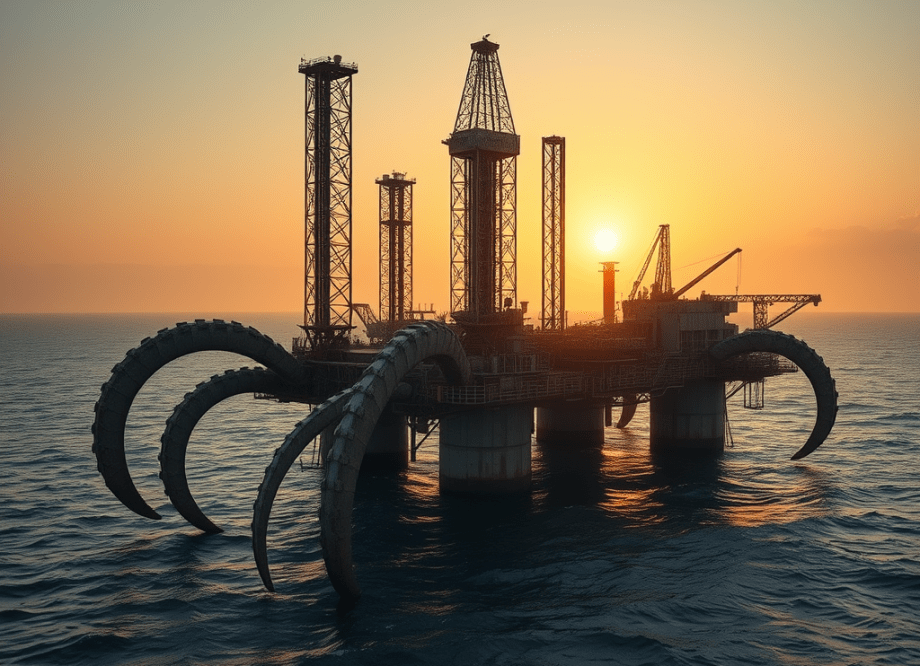
It’s not drill baby drill, after all. Picture a vast, rusting skeletal oil rig off Venezuela’s coast, derricks frozen mid-stroke like the limbs of some colossal fossil. If you’ve heeded Stenographers R Us, the mainstream international media franchise embedded with the rich the powerful and the fabulously ruthless, you’d think Washington’s frenzy over this country boils down to a simple heist. But you’d be wrong.
Put to one side Bull Dust Trump’s buccaneering fantasy, a daring smash and grab raid for the world’s largest proven oil reserves, a tanker-load of cut-price fuel so cheap that every man can run at least one Ram V8 or Ford F-Series truck. And one for the little woman. Above all, it’s the heist that pays for itself. You steal Venezuela’s oil. Take over their country. All free of charge; funded by the plundered oil.
Trump’s lying. Of course. Like his career as a deal-maker, turning Caracas into a McDonald’s hamburger franchise is a fantasy founded on a fiction based on a lie, pure and simple. Behind the headlines, see the levers of power post-Maduro’s Manhattan manacles, muffs and blindfold, the full, Gitmo rig, and a sharper, more sinister pattern swims into view. Not just touring the trophy in a van with the back door open. This isn’t about nicking the black gold. It’s all about the chokehold, a slow but sure squeeze to block off the oil, denying the flow not just to Venezuela, but to anyone who dares defy The Hulk.
The Chokehold Takes Shape
Cast your mind back to the early 2010s. US sanctions began to creep from diplomatic tiffs to industrial strength sabotage. PDVSA, Venezuela’s state oil mammoth, didn’t just falter; it was engineered into failure. Spare parts were embargoed, rigs starved of foreign cash, refineries left to rust in the tropical brine and the sulphur that makes the nation’s heavy, treacle-thick crude, notoriously hard to refine.
Output didn’t dip, it plummeted from three million barrels a day to under 800,000. The Intercept, and Democracy Now! map the blueprint: not haphazard penalties, but a calculated corrosion of the coronary arteries of the economy. And here’s the exquisite irony in the crude itself; that heavy, sour Venezuelan black isn’t some elixir of cheap bounty.
It demands bespoke refineries, the kind that gobble margins unless global prices pitch high, say at the $60-70 per barrel sweet spot for US shale outfits. By idling millions of barrels, Washington doesn’t just punish Caracas; it rigs scarcity, propping up prices for its own patch and Saudi bedfellows.
Why would the planet’s oil glutton sabotage a gusher? Follow the boardroom gaze across the trading floors: scarcity keeps the market taut, volumes crimped, returns plump for the anointed players. The Grayzone and The Real News call it engineered sabotage, with Chevron and Exxon not clamouring for a bargain-bin blowout, but biding time for PDVSA’s orderly dismemberment and disembowelling. It will be privatised, of course, to some asset-stripper, on terms dictated from Foggy Bottom.
The Empire’s Ledger: Workers Foot the Bill
Yet no imperial romp runs on fairy dust, and the tab for this buccaneering lands not in some mythical oil jackpot, but squarely on the brows of ordinary Americans. Imagine the bills: 80 billion dollars a year vanishing into overseas bases, the concrete teeth enforcing sanctions and glowering at rivals across 25 countries since 2001.
Tack on another 62 billion in fossil fuel subsidies; bargain priced pollution, tax loopholes ladled to a coterie of oil titans, as with our gas industry, and the mathematics unmasks itself. The truck driver filling up at dawn, the nurse tallying grocery receipts inflated by freight costs: they’re clobbered doubly, once by the pump’s regressive bite from jacked global crude, again by tax dollars greasing the imperial gears. No plunder’s bounty offsets it; this is a quiet expropriation from wage packets to corner suites.
Cuba’s Defiant Shadow: From Neon Bordello to Eternal Foe
Now widen the lens to Latin America, where the rogue elephant lumbers, trunk swinging. Step forward Marco Rubio, son of Cuban exiles, his irony bypass a marvel of surgical precision. There he is on ABC’s 7:30 Report, cool as a Miami breeze, labelling Havana a “huge problem” mired in “a lot of trouble” for cradling Maduro; ripe, he implied, for Uncle Sam’s rapture. Rubio has the gall to scorn Cuba’s “senile incompetents” while a demented Donald Trump cheers intervention and why stop with Venezuela?
Trump paints Colombia’s Petro a narco-overlord and Mexico’s Sheinbaum a cartel consort.
Cuba’s original sin harks to 1959, when Fidel Castro’s revolution swept away the neon bordello Washington had bankrolled. Havana wasn’t just a city then; it was an offshore playground for Mafia dons and sugar barons, gangsters and generals carousing amid the roulette wheels while peasants toiled in the cane fields. Paradise Lost. Be not afraid. Trump has the team to turn back the clock.
Socialism didn’t just nationalise assets; Cuba reclaimed dignity, dodging the fate of a permanent Americano brothel. The reprisal? The Bay of Pigs bloodbath, a six-decade embargo tighter than a drum, whispers of invasion perennially on the wind. Rubio’s ire isn’t bungled governance; it’s the gall of autonomy. Now Venezuela’s shell is broken, Havana may well be next; Latin America is no mere backyard, but a type of professional wrestling tournament where Trump shows off US muscle.
China’s Jolt: Crude Hijacked, Chains Rattled
Beijing, too, savours the aftershock. Picture the tankers rerouted: China guzzles 60-90% of Venezuela’s exports, some 470,000 barrels daily. That’s 4-7% of its total crude thirst, a sliver that balloons to strategic heft in a 30-35% import pool menaced by US writ (Iran in the crosshairs too).
Trump’s hijack doesn’t just nick barrels; it disrupts The Panda’s supply lines, spiking costs and forcing frantic diversification. Beijing’s Foreign Ministry thunders condemnation, pledging legal armour for billions in PDVSA loans, but the calculus shifts: no Taiwan gambit while Washington clutches the taps.
An economic setback morphs into geopolitical handcuffs.
 Urban Wronski Writes
2 thoughts on “Oil in Venezuela: Strangulation, Not a Steal”
Comments are closed.