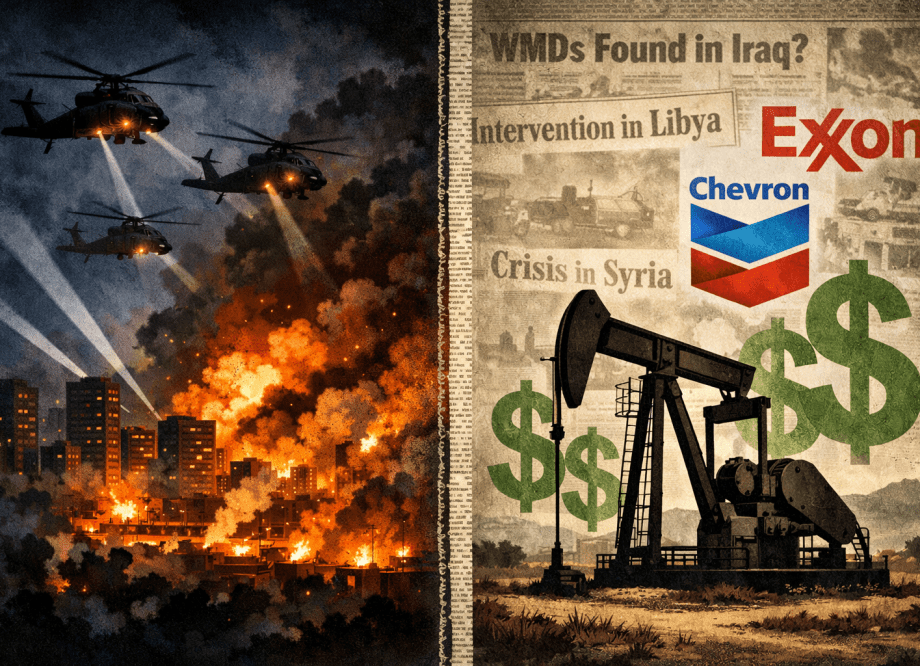
Part One: The Anatomy of an Imperial Project
“Venezuelan strongman Maduro seized in daring US operation.”
That’s how our ABC led its coverage when American forces stormed Caracas in January. Over at The Australian, it was “Narcoterrorist-in-chief finally brought to justice,” a newly-minted international crime, ingeniously linking two scourges, drugs and terror.
The Sydney Morning Herald went with the risible “Democracy’s long-delayed victory in Venezuela.”
Not one dare say that what we’d just witnessed was an illegal military invasion of a sovereign nation. Dear SMH, how is the invasion democratic? Not one asked why Australian media were suddenly experts on Venezuelan “narcoterrorism”, a freshly-pressed grape of wrath? Or brand-new imperial panic button.
And not a soul bothered to note that we’ve seen this movie before, frame for frame, lie for lie.
Welcome to the second level of contempt: not just the violence itself, in which we all through our membership of various organisations failed the people of Venezuela, but the propaganda about the propaganda, served up by our own trusted news sources.
It’s as if we’re too dim to remember Iraq’s WMDs or Libya’s “humanitarian intervention.” They’re counting on our goldfish memories, our inability to hold a pattern in our heads long enough to shout: “Hang about, haven’t we been down this path before?”
Narcoterrorism: The Empire’s Latest New Designer Label
Every imperial adventure needs its signature scare. Saddam had (invisible) WMDs that could strike London in 45 minutes. John Howard, hadn’t actually seen them but he was prepared to lie that proof existed. Gaddafi was about to massacre Benghazi. Assad gassed his own people (some of which was true, conveniently omitting our backing of jihadists fighting him). Now Maduro runs a “narcoterrorist state”, a portmanteau phrase that fuses two reliable panic buttons into one handy package.
If he could remember his earlier phrase, Trump would doubtless call Venezuela a shithole country.
But let’s be clear, we are being sold a smash and grab raid. Cool. Maduro had it coming. It’s Marketing 101 for illegal invasion. Drugs? Terrifying. Terrorism? Even worse. Mash them up and you’ve got a villain so vile that international law is just a mere technicality. Far-fetched? It’s a hoot. The United States; the world’s largest consumer of cocaine, its biggest market and architect of the catastrophic “War on Drugs”, now poses as global sheriff, with just a whiff of the crusader against narcotics? Hilarious.
But the crusader copy writes itself. And our media newshounds are selling it with a straight face.
It’s not the drugs. It’s the oil. Venezuela sits atop the world’s largest heavy sour crude oil reserves. Bigger than Saudi Arabia. Bigger than Iraq. And unlike those compliant petrostates, Venezuela has had the temerity to suggest that its oil might benefit Venezuelans rather than Exxon-Mobil shareholders.
That’s the real crime. The drugs are just the marketing.
Our media know this. They’re not stupid, just complicit. When The Australian quotes “Western intelligence sources” on Maduro’s drug empire, they’re parroting CIA talking points. When the ABC describes Venezuela as a “failed state,” they skip over how it got that way. And when they mention sanctions at all, it’s as a footnote, “pressure for reform”, not as the economic siege warfare it actually is.
But always check your oil. A reality check: Venezuela’s Orinoco Belt contains extra‑heavy, sulphur‑laden crude that’s expensive and technically finicky to extract and refine. CNN reports that gulf refineries in Texas and Louisiana are already tooled up for this dirty work—cheaper than retro-fitting to deal with local shale oil.
Despite Venezuela needing $58 billion for infrastructure upgrades, refining Venezuelan oil remains cheaper long-term due to low production costs and refinery optimisation. This could stabilise US diesel amid tight global supply, potentially dropping American refining costs 10-20% versus Saudi or Canadian alternatives.
Economic Strangulation as Prelude to Invasion
Since 2017, Washington has waged silent war on Venezuela, strangling its economy with a sadistic deliberation that would make any medieval besiegers green with envy. To be fair, corruption in Caracas and mismanagement helped. But billions in Venezuelan funds were frozen. Oil exports blocked. Access to global financial markets cut. Ships intercepted. Assets seized. The whole machinery of dollar dominance weaponised against a country whose real offence is daring to chart its own course.
The arithmetic of empire is written in bodies. Forty thousand preventable deaths from sanctions-induced medicine shortages by 2024, according to Physicians for Human Rights. Three hundred thousand Venezuelans with cancer, diabetes, HIV at risk of death because medical supplies can’t get through the blockade. Maternal mortality at 125 deaths per 100,000 live births. A population where 75% collectively lost an average of over 8 kilograms to hunger. Seven point six million people, nearly a quarter of the population, driven into exile, generating the largest displacement crisis in Latin American history.
UN human rights experts have condemned these sanctions as collective punishment, noting that unilateral coercive measures enforced through armed blockades violate international law. Human Rights Watch criticised the sanctions for lacking humanitarian exemptions. In 2025, UN rapporteurs called US actions “collective punishment,” violating international law by inducing suffering without UN Security Council approval. They are, in plain English, economic warfare against civilians.
Now Australian media perform their best trick: they report the humanitarian crisis while erasing its primary cause. Venezuela is “collapsing under Maduro’s mismanagement,” we’re told. True enough; the man couldn’t run a chook raffle. But the sanctions turbo-charged a crisis into a catastrophe, and that’s the bit that gets memory-holed. It’s like reporting on a bushfire while forgetting to mention the arsonist.
It’s America’s classic neocon playbook. Throttle the economy. Wait for the suffering to mount. Blame the government. Present military intervention as mercy. Rinse and repeat. We did this to Iraq. We did this to Libya. We did this to Syria. And now, with barely a change in script, we’re doing it to Venezuela while the ABC and its fellow travellers play their assigned role: cheerleaders for the latest passage in a very old US game play.
From Sanctions to Shock and Awe: The Long Con
The January military assault isn’t some sudden eruption. It is the logical endpoint of a strategy perfected over generations. The USA has been toppling Latin American governments since before most of us were born.
Guatemala’s Jacobo Árbenz in 1954, was overthrown for daring to redistribute land owned by United Fruit Company. Chile’s Allende was sent packing in 1973, because socialism and copper don’t mix (from Washington’s perspective). Panama’s Manuel Noriega in 1989.
Yes it’s the same narcotics pretext, when a former CIA asset outlived his usefulness. Nicaragua, Honduras, El Salvador, Haiti: the list reads like a greatest hits of manufactured regime change.
Each time, the script is identical. Step one: demonise the target government. (Check: Maduro’s been “dictator” and “strongman” in our papers for years, never mind that he’s been elected multiple times under international observation.) Step two: manufacture or exploit a crisis. (Check: sanctions created the crisis, now presented as evidence of governmental failure.) Step three: present military action as the only solution. (Check: “No choice but to act,” as the Pentagon spokesman put it, parroted faithfully by our lot.)
The “kidnapping” of Maduro; let’s call it what it is, not “arrest”, represents peak imperial theatre. A sitting president of a sovereign nation, indicted by a US court on charges of narcoterrorism and having guns and stuff, (the real charge sheet is preposterous), seized in a military raid that violated every principle of international law, paraded before cameras like a trophy buck.
Legal scholars and a UN Secretary-General have warned this sets a catastrophic precedent. Without Security Council authorisation, without credible self-defence claims, this is simply illegal. An act of war.
But watch how Australian media runs with it: as if it were a police procedural, not an invasion. “Wanted man captured.” “Fugitive seized.” The language of law enforcement, not the language of international aggression. This is propaganda by omission, the most insidious kind.
Australian Complicity: Our Shame
Australia isn’t some innocent bystander tutting from the sidelines. We’re up to our necks in this.
Check our UN voting record on Venezuela: lockstep with Washington, backing every condemnatory resolution, every sanctions package, every diplomatic manoeuvre designed to isolate Caracas. We’ve imposed our own sanctions; targeting oil, gold, and individual officials, all while the Australian press trumpet this as righteous punishment of corruption rather than a lethal punching-down in economic warfare.
Not spelled out: Through Five Eyes intelligence sharing, we’re part of the machinery that provided targeting data for the Caracas raid. Our Pine Gap facility, that polite lie of “joint defence,” played a role in communications and surveillance. We’re not just cheer-leading; we’re materially enabling the US.
And the media? They’re the propaganda arm of this operation, whether they admit it or not. When The Australian runs pieces about Venezuela’s “criminal regime” sourced entirely to the US State Department and the CIA-backed opposition, that’s just stenography, not journalism.
When the ABC describes Maduro as “widely regarded as illegitimate” without noting that “widely” means “by Western governments who want his oil,” that’s editorialising posing as fact.
Compare the coverage to Saudi Arabia, for example, a real autocracy that dismembers journalists, starves Yemen, and funds extremism globally. The press might tut occasionally, but there’s no drumbeat for regime change, no breathless coverage of Saudi “crimes against humanity,” no earnest panels discussing whether we have a “responsibility to protect” Yemeni children from starvation.
Why? Because the Saudis play ball with Western oil interests. Venezuela doesn’t. That’s the difference, and our media know it.
This is the second level of contempt I feel: they think we’re mugs. They think we won’t notice the pattern. They think we can’t hold two ideas together long enough to ask: “Hang on, didn’t they sell us this same pig in a poke before?”
The Oil They’re Not Talking About
Let’s cut through the smoke: this is about oil. Always has been, always will be.
Venezuela holds roughly 300 billion barrels of reserves; the largest in the world. After years of sanctions crippled Russian oil exports following Ukraine, and with OPEC playing hard to get on production increases, those reserves are irresistible to Washington. Add China’s deepening energy partnerships with Venezuela; Belt and Road investments, oil-for-loans deals, and you get the strategic picture.
Maduro’s great sin isn’t drugs or authoritarianism (Washington has backed far worse). It’s keeping Venezuela’s oil revenues at home instead of letting them flow north to Houston. It’s partnering with Beijing instead of bowing to the Monroe Doctrine. It’s being an example, however flawed, of resource nationalism in a region where the US prefers compliant client states.
The press mention the oil in passing, if at all. It’s treated as context, not cause. But follow the money, follow the barrels, and the whole “narcoterrorism” narrative reveals itself as window dressing for a very old-fashioned resource grab.
Chevron, notably, got a sanctions exemption in 2022 to restart Venezuelan operations. Funny how the “criminal narco-state” is fine for doing business with when it suits corporate interests, but requires military intervention when it doesn’t play ball politically.
The Human Cost: What They Won’t Count
And now, in the January strikes: at least 40 dead in the initial assault, Venezuelan and Cuban military personnel alongside civilians. An apartment block in Catia La Mar with its exterior wall blown off, one confirmed dead, others seriously injured. “Unspecified” casualties—that bureaucratic language that erases individual lives. The Venezuelan government is still counting bodies while the American press celebrates “liberation.”
Add to that the 115 people killed in the boat strikes from August through December 2025, fishermen and alleged traffickers alike, all part of the same operation. Governments and families of those killed say many were civilians, primarily fishers. The Pentagon insists they were all “narco-terrorists.” The bodies can’t argue back.
But this is developing information, casualties still being tallied. What we know for certain: Venezuelan Vice President Delcy Rodríguez confirmed deaths among both military and civilians. Trump confirmed two US soldiers injured. One US helicopter was hit but remained flyable. The 30-minute assault involved over 150 aircraft striking military bases, ports, communication facilities, and yes, civilian areas too.
Resistance: The Story They’re Burying
Here’s what should terrify the Pentagon but won’t make the ABC news: Venezuela isn’t collapsing in grateful relief. The Bolivarian militia, whether 1.6 million or government claims of eight million, represents a genuine popular defence force. Millions of Venezuelans, whatever they think of Maduro’s economic management, won’t thank the Americans for bombing their capital and kidnapping their president.
Across Latin America, governments from Mexico to Argentina have condemned the invasion. Not because they love Maduro; many don’t, but because they recognise the precedent: if Washington can do this to Venezuela, it can do it to anyone. Regional solidarity isn’t about personality; it’s about sovereignty.
China and Russia have issued sharp condemnations. They’ve got skin in the game: billions in loans and infrastructure investments that a US-installed puppet government might default on. This isn’t ideological—it’s the emerging reality of a multi-polar world where US military adventurism faces actual push-back.
And in the streets, from Caracas to Mexico City, from Barcelona to Sydney; protests are building. Not because protesters are Maduro fans, but because they’re sick of watching the same imperial playbook run again and again while their media gaslight them about “liberation” and “democracy promotion.”
The press is busting a gut to ignore or minimise this resistance.
Can’t have the narrative complicated by inconvenient facts like Latin American solidarity or popular opposition to invasion. Better to focus on the “drama” of Maduro’s capture, the “terrorism” charges, the grateful (CIA-vetted) Venezuelan exiles welcoming “freedom.”
Lest We Forget
What ought to enrage us: the utter contempt for our minds. They genuinely believe we won’t remember.
Colin Powell’s vial of “anthrax” at the UN, the aluminium tubes, the mobile weapons labs lies. Or Libya, where “protecting civilians” became regime change and now boasts open-air slave markets. Syria’s Assad was gassing his people (true) so we’d better arm the jihadists (catastrophic).
Won’t remember that every single time, the pattern is identical: demonisation, sanctions, crisis, intervention. And every single time, our media play their part in manufacturing consent.
The difference now? They’re not even trying that hard. The “narcoterrorism” frame is lazy; transparently so. But they’re banking on our scattered attention being too fragmented to notice. They’re counting on the dopamine hit of outrage at the “dictator” overwhelming any critical thought about whether invading a sovereign nation might be, you know, illegal and catastrophic.
This is what I mean by the second level of contempt. The violence itself is bad enough. But being propagandised about it by our own media, who know better but do it anyway? That’s the deepest cut.
What Comes Next
The US may have captured Maduro, but they haven’t captured Venezuela. Guerrilla resistance, regional backlash, and international condemnation are already brewing. This may not be the clean victory our media are selling. It could be messy, bloody, protracted; another forever war to add to the collection.
But then our media could “both-sides” Gaza. Australia is complicit. Our government will back it. Our media will sell it. And most of us will scroll past, troubled but not troubled enough to actually do anything.
Unless we start holding the pattern in our heads. Unless we start asking the questions our media won’t: Who benefits? What’s being omitted? Where have we seen this before?
The anatomy of an imperial project isn’t complicated. It’s the same operation, over and over. The only variable is whether we’re awake enough to recognise it.
Time to wake up.
[To be continued in Part Two: The Media’s Role in Manufacturing Consent]
 Urban Wronski Writes
3 thoughts on “The Venezuela Playbook: How Australian Media Sold Us Another War”
Comments are closed.