Bombs Over Caracas: The US Attack on Venezuela and the End of International Law
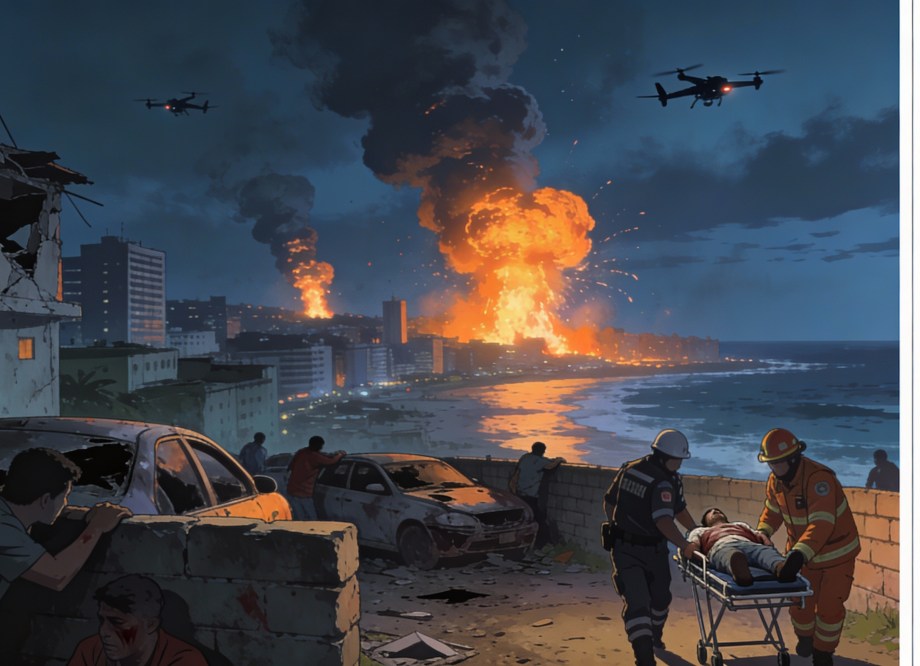
In the early hours of January 3, 2026, the United States bombed Venezuela. Seven explosions tore through Caracas and other major cities as American aircraft targeted military installations, a suspected cocaine refinery, and according to several reports, captured Nicolás Maduro himself.
By dawn, the world had changed, again. This report outlines the attack’s anatomy: the midnight chaos, the neoliberal machinery driving it, and the human tragedy from what looks disturbingly like the US-led invasion of Iraq’s neocon template transplanted to South America.
Just after 2 am Venezuelan time, at least seven explosions rocked Caracas and beyond. Eyewitnesses report flames at Fuerte Tiuna, Venezuela’s largest military base, while videos and images show panicked civilians running through smoke-clogged streets. Secondary blasts hit Maracaibo, where a suspected ELN-controlled cocaine facility was levelled, and other so-called “dual-use” complexes in Valencia and Barinas. The overnight attack brought American military power directly into the heart of a sovereign nation, flouting every international legal framework that governs such attacks.
Hours later, a jubilant Donald Trump confirmed the operation in a pre-dawn post on Truth Social. “Maduro is gone,” he wrote, promising a weekend press conference. The White House has offered no formal legal ratification, though Trump previously declared the United States in an “armed conflict” with “narco-terrorists,” a novel, self-coined designation that aims to sidestep congressional or UN authorisation.
The escalation follows a heavy American naval build-up around the Caribbean, the deployment of the USS Gerald R. Ford, and CIA covert operations green-lit in December. The FAA’s flight ban over Venezuelan airspace, citing “ongoing military activity,” signalled that something larger was coming.
The Trump administration’s talking point is narcotics: the Cartel of the Suns, ELN guerrillas, and a narrative of “narco-terrorism” designed for American audiences still primed for post-9/11 justifications. But the evidence is thin, the timing political, and the real stakes are unmistakable: oil. Venezuela holds the world’s largest reserves of oil at 303 billion barrels, and the Americans have been tightening a blockade that has helped strangle the Venezuelan economy. The parallels are unnerving. Like Iraq 2003, the moral cover of “democratisation” masks a deeper bid for illegal invasion, extraction, and dominance.
The pretext problem is deep. Thirty-five so-called boat strikes since September 2025 have already killed at least 115 people. Not one extra-judicial kill has been independently verified as a cartel target. Legal scholars warn these actions breach both American and international law, yet two attempts in the Senate to limit Trump’s powers have failed. Each escalation has occurred outside legislative oversight, textbook neoliberal militarism where executive power expands and accountability evaporates.
September 2025 saw American strikes on maritime “drug targets” that killed 115 or more. In October 2025, Trump declared his “armed conflict” with “narco-terrorists” without congressional approval. December 2025 brought CIA covert operations into play, followed by a Christmas Day strike on Maracaibo port. Then came January 3, the bombings in Caracas and the reported capture of Maduro. Each step built on the last, creating a fait accompli that Congress could only ratify or ignore.
Venezuela’s interim officials have declared a national emergency and appealed for UN protection. Colombian President Gustavo Petro condemned the attack as “bombing with missiles,” while Iran and Russia swiftly denounced it as Western imperialism. Cuba’s President Miguel Díaz-Canel called for urgent international action, describing the attack as “state terrorism.”
Across Latin America, however, silence prevails. Mexico and Bolivia are expected to condemn the strikes but Brazil remains cautious. The OAS may fracture over the legality of Maduro’s extraction, while the American Congress, still in recess, offers Trump a free hand.
Meanwhile, Western media coverage has split between cautious approval and outright theatre. Pentagon briefings describe “surgical precision,” but imagery from Caracas paints a scene of chaos and civilian panic. The laundering has already begun, the euphemisms deployed: “neutralise,” “eliminate,” “precision strike.” The same linguistic machinery that sanitised Iraq and Libya now polishes this latest adventure in regime change.
For Venezuelans, the bombs revived the trauma of economic collapse now layered with fear. Videos show blackouts, people fleeing burning buildings, and smashed vehicles near Fuerte Tiuna. Aid groups warn of mass displacement as yet more Venezuelans prepare to flee to Colombia and Brazil, potentially adding to the seven million refugees already abroad.
Trump’s bombing spree leaves three legacies: civilian terror in Caracas, refugee suffering across Latin America, and billions wasted on a war for oil, not justice.
For American citizens, the bill runs in the billions. The naval deployments and precision munitions are funded by diverted domestic budgets, another neoliberal hallmark: austerity at home, aggression abroad. The pattern repeats itself with numbing predictability. Cut healthcare, education, infrastructure, then pump those billions into foreign military adventures that enrich defence contractors while leaving ordinary Americans to pick up the tab in reduced services and crumbling communities.
Three scenarios now hover over the region. Full-scale invasion justified on “stabilisation” grounds if Venezuela retaliates or American hostages are alleged. Puppet governance installing a compliant regime, as in Iraq or Libya, to fast-track oil contracts and security agreements. Or withdrawal under pressure if global outrage forces Trump to declare victory and retreat, though blockades and sanctions would persist. The next seventy-two hours will reveal which script Washington is following and how much resistance Caracas, Moscow, and Tehran can muster.
But the deeper significance reaches beyond Venezuela. Sultan Barakat, professor of public policy at Hamad Bin Khalifa University in Qatar, told Al Jazeera that American actions in Venezuela signal an end to respect for international law and that they have also given international rivals an excuse to do the same thing:
“This is probably a nail in the coffin of any international agreement. The very principle of state sovereignty now has been taken apart,” Barakat said. “This is in line with some of the operations that Israel has undertaken in Lebanon and Iran jointly with the United States. They are now moving the bar much, much higher than what we are used to and very much against international norms and international law.“
On setting a precedent, Barakat said China could now point to American actions as justification for it to do the same with Taiwan, which China has long claimed. The implications cascade outward. If Washington can bomb Caracas over unverified narcotics allegations, what stops Beijing from citing separatism and launching strikes on Taipei? What stops Moscow from expanding operations in Ukraine or beyond under similar pretexts?
The rules-based international order, already fraying under Israeli attacks in Gaza and Lebanon, despite a supposed ceasefire, now lies in tatters.
This moment marks something more than another military adventure. It represents the final abandonment of the postwar consensus that sovereign nations, however imperfect their governments, retain the right to exist free from foreign bombardment absent Security Council authorisation or genuine self-defence. The Iraq invasion undermined that principle. The Libya intervention eroded it further.
Venezuela shows us the endgame: a world where the powerful do as they please and the weak suffer what they must, where international law is scorned and military might makes right.
The neoliberal project has always required violence to open markets and secure resources. From Chile 1973 to Iraq 2003, the pattern holds: overthrow inconvenient governments, install compliant replacements, privatise assets, extract profits. Venezuela’s oil reserves make it too valuable to ignore and too resistant to pressure for anything short of military intervention. The economic sanctions failed to topple Maduro. The diplomatic isolation failed. The recognition of Juan Guaidó as interim president failed. So the bombs fall, and another nation joins the list of those who learned that standing against American interests carries consequences measured in high explosives and shattered lives.
We stand now at a hinge point in history. Either the international community finds the will to resist this descent into lawlessness, or we accept a future where sovereignty means nothing and violence everything. The choice belongs to all of us, but the clock is ticking and the bombs keep falling.
 Urban Wronski Writes
Mention this strategy, more deflection from domestic issues, like Netanyahu and Putin….all aggressive, but too many Anglo faux anti-imperialist tankies of the left (or right?) follow US corporate supported gaslighters like Mearsheimer, Sachs et al., not genuine experts and ignore Putin….
Especially evidenced when tankies share (Kremlin) talking points with Trump, FoxNews, Breitbart, RT, Farage etc. vs Ukraine, but nobody notices?
LikeLike
Release the Epstein files. Attacking Venezuela will not distract us.
LikeLike