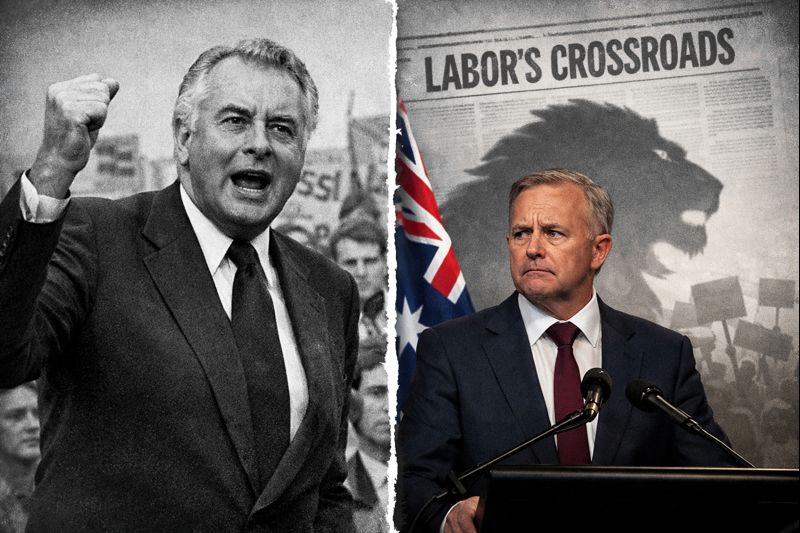
Anthony Albanese’s government is under siege; not just from the usual suspects, but from its own hesitation. While the Coalition lurches right and the Greens surge left, Labor risks irrelevance by mistaking caution for strategy. History offers a way out: Whitlam’s boldness, Keating’s fire, and the Greens’ grassroots power prove that survival isn’t about avoiding fights. It’s about picking the right ones.
Whitlam’s Lesson: Boldness Forces Your Enemies to Move
Gough Whitlam didn’t just govern; he expanded the meaning of government itself. In just three tumultuous years, and under a Senate blockade plus a Murdoch press intent on his destruction; he delivered Medibank, free university education, and the Racial Discrimination Act. Whitlam’s genius was not compromise but conviction. Boldness didn’t just inspire; it forced the opposition to move.
Albanese’s administration, by comparison, often blinks first. The Safeguard Mechanism could have been Labor’s defining climate legacy; a line in the sand marking Australia’s irreversible shift to renewables. Instead, concessions to fossil-fuel lobbyists turned principle into process. Whitlam would have flipped the script: forcing the Coalition to oppose progress, not courting the forces of delay.
Whitlam didn’t ask permission. He didn’t test the waters. He plunged in and made his enemies scramble to catch up.
A Whitlam moment for Albanese could mean three things: a national anti-corruption commission with teeth, including mandatory public hearings and authority over political donations; a wealth tax to rebuild social housing, daring the Coalition to defend the top end of town as rents soar; and a housing guarantee, funded by ending property-investment loopholes, that treats shelter as a right, not an asset class.
Each measure resets the narrative: forcing the Coalition to either fight popular reform or admit its ideological emptiness.
Keating’s Rhetorical Fire: Framing the Fight
Paul Keating didn’t just argue policy; he defined destiny and, with Don Watson’s brilliant help, re-introduced the art of the well-timed, superbly crafted phrase. His “recession we had to have” speech transformed necessity into nation-building. His invocations of “the light on the hill” revived Labor’s moral compass.
Paul Keating relied heavily on Don Watson as his chief speechwriter and adviser from 1992 to 1996, a period that included some of the most memorable and transformative speeches in Australian political history. Watson was not just a speechwriter but a senior adviser and confidant, shaping both the language and the ideas behind Keating’s public addresses.
By contrast, Albanese’s managerial instincts leave space for others to write the story. During the Bondi attack aftermath, NSW Premier Chris Minns; intrepid where Albanese was tepid, filled the void with clarity and conviction: calling for a royal commission, uniting communities, and demonstrating the leadership that presence creates. Albanese offered cooperation; appropriate but uninspiring.
Keating didn’t explain. He declared. He didn’t defend. He attacked. He didn’t fear the fight, he relished it.
Albanese needs his own defining moment; one that names the entrenched interests blocking change and reframes the coming election as a moral choice. Imagine a speech beginning:
Those who resist reform aren’t just my opponents; they’re the billionaires avoiding their taxes, the media moguls selling division, and the polluters burning our future for profit. They’re not fighting me. They’re fighting you.
That’s a sure way to turn policy into purpose.
The Greens’ Grassroots Pressure: Turning Weakness into Leverage
The Greens, with a fraction of Labor’s machinery, consistently shift the agenda by turning conviction into mobilisation. Their 2022 climate blitz forced stronger emissions caps and re-energised disillusioned voters. Labor’s compromises; the Safeguard’s offsets, new gas projects, timid rhetoric, handed them an open goal,
The Greens don’t wait for a seat at the table. They build their own. They don’t fear the headlines. They make them. They don’t play small-target. They go big; or go home.
Albanese could have co-opted that energy by ending fossil-fuel subsidies or announcing a green-jobs guarantee. That would’ve forced the Greens to support him or explain why they didn’t. To win back moral ground, Labor must “steal their thunder” with a 2025 climate reset: not tokenism, but renewed ambition.
The Minns Model: Leading from the Front
Chris Minns’ Bondi response proved leadership isn’t about risk-management. It’s about embodiment. He acted first, spoke plainly, and stood visibly with those affected. Albanese, deferring to process, appeared managerial and reactive, bound by convention and protocol rather than assertively taking charge. His absence from key funerals, after being effectively excluded by the Jewish community, and the boos he faced at public memorials underscored the depth of the rift and the cost of his perceived hesitation.
Albanese was “effectively denied the role of being the nation’s chief public mourner” by the Jewish community, and was “not invited to some” funerals.
- He was “notably absent from the funerals of those killed at Bondi” and was booed at memorial events, reflecting widespread anger over his government’s handling of antisemitism and the attack’s aftermath
- His opponents, including Opposition Leader Sussan Ley, attended funerals and memorials, further highlighting the contrast
The PM’s exclusion, may also point up Advance’s unbridled, unprincipled, naked opportunism and how it is a force, embedded in what commentators call The Jewish Community, a phrase which misrepresents the complexity of beliefs and diversity of political allegiances of around 50,000 people in Sydney.
The faith of the Sydney Jewish community is highly diverse and multifaceted, spanning the full spectrum of contemporary Jewish religious life, from Ultra-Orthodox (Haredi) to entirely secular.
How Albanese can adopt the Minns model:
- Show up early. Visibility shapes empathy.
- Frame first. Don’t let Murdoch or Ley define the moment.
- Unify through story. Tie Australia’s crises; housing, climate, integrity, into one narrative about fairness and national renewal.
The small-target strategy that worked in opposition now looks like inertia in government.
The Path Forward: Three Moves for 2025
To avoid political erosion by a thousand cuts, Labor must:
- Pick a battle it can win; housing, corruption, or climate, where the Coalition must defend the indefensible.
- Frame the election as a choice, not a verdict. Make it about who has the courage to lead, not who can manage decline.
- Mobilise the base through conviction, not polling. Inspire the same energy that delivered the 2022 majority; this time with clearer moral stakes.
Appendix: Leadership, Fear, and the Cost of Borrowed Frames
There is a difference between leadership and performance, and Australian politics has a long history of confusing the two.
In moments of national trauma, leaders are tempted to borrow the language of certainty. To sound firm. Look decisive. Close ranks. But history is unkind to those who mistake firmness for wisdom, or unity for silence.
Chris Minns was praised for acting quickly after Bondi. But speed is not the same as judgement. In accepting the lazy thesis that pro-Palestine protest existed in the same moral universe as an act of extremist violence, he did more than misread the moment. He legitimised a falsehood.
Peaceful protest did not cause the atrocity. Chanting did not produce the knife. Dissent did not summon the crime. To imply otherwise is not leadership. It is capitulation to fear, and fear is always politically promiscuous. It never stops where you ask it to.
Labor governments have made this mistake before. They have accepted conservative premises in the hope of neutralising them. Each time, the right has pocketed the concession and demanded more. Each time, Labor has looked surprised.
Paul Keating understood this. He knew that the real battle is never over policy detail. It is over who defines reality. He did not borrow his opponents’ language. He exposed it. He did not soothe anxieties manufactured by others. He named the manufacturers.
When a Labor leader allows protest to be recast as provocation, when they allow grief to be conscripted into political discipline, when they allow communities to be flattened into caricature for the sake of calm headlines, they are not holding the centre. They are abandoning it.
And when Labor abandons moral ground, someone else occupies it. Not gently. Not temporarily.
The next election will not turn on managerial competence. Australians have seen competent decline before. It will turn on whether Labor remembers what it is for.
Because parties that borrow the language of their opponents eventually inherit their fate. And history does not remember them kindly.
Next: Breaking the Murdoch Firewall
In Part Three, we’ll examine how Labor can bypass the Murdoch machine, and why the next election may hinge not on policy, but on who dominates the narrative battlefield.
 Urban Wronski Writes
albanese is losing the unlosable, he can cement Australia with bold decisions we all know should be addressed, tax/subsidies to mining..2 that are decades overdue. Sadly he’s gutless. He’ll do nothing to endanger the status quo, political careers depend on that.
LikeLike
Yes, ALP need to find their mongrel vs Murdoch led media and ageing voters; like the RW MSM audience many old Labor are skip and socially conservative.
ALP could follow the tactics of mob or mafia, Trump and Murdoch fixer Roy Cohn…
‘The strategy Cohn imparted on Trump was to “Deflect and distract, never give in, never admit fault, lie and attack, lie and attack, publicity no matter what, win no matter what, all underpinned by a deep, prove-me-wrong belief in the power of chaos and fear.”’
Part 3 on media is central to what’s wrong with Australia and Howard’s Anglosphere, following UK and led by the US….
LikeLike
It goes to show how spooked by the forces of the right is Labor. After what should have been a victory and great Taxation reform, in 2019. Its now softly softly slowly slowly. And drip feed any progress in case the Murdoch Press kick up a stink. And let their tame LNP make the noises. Albonese and I fight Tories is a bit of a misnomer. Since he became PM he lost that fight he had under Gillard to get things done. Its very true some people are not natural leaders and do better when doing things, and getting stuff done in the background.
LikeLike