“The price of metaphor is eternal vigilance,” wrote Flannery O’Connor.
She might have added that lazy metaphor, repeated by a complicit media, does not just mislead. It kills. And it feeds the slow strangulation of democracy by security theatre.
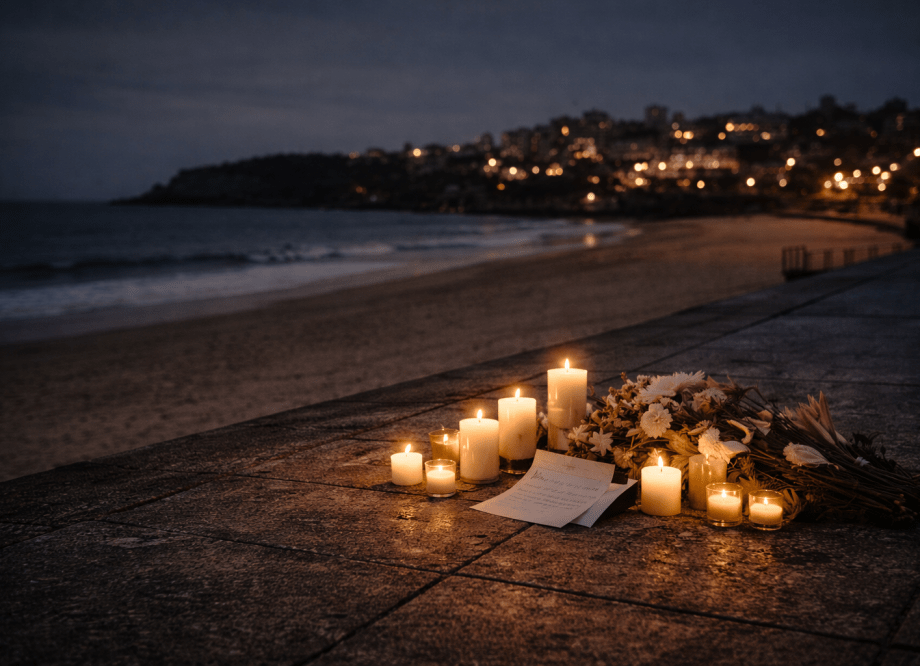
Fifteen people died at a Hanukkah celebration on Bondi Beach on December 14, 2025. Sajid Akram, 50, and his son Naveed, 24, carried out the massacre. The father was shot dead by police. The son survived, awoke from a coma, and now lies silent under guard in hospital.
Those are the facts. What followed in the first 72 hours was something else: a masterclass in how tragedy is used to bury state failure.
The Philippines Phantom
Within 24 hours, Australian media ran hard with the “terror training camp” narrative. The Akrams had travelled to the Philippines from November 1 to 28, 2025. Therefore, went the story, they must have received ISIS training in some jungle facility, returning as hardened jihadists ready to slaughter Jewish innocents on Australian sand at iconic Bondi Beach.
It was a neat story. It was also unsupported.
Philippine officials and hotel staff in Davao described a different picture: a budget hotel, long stretches inside a room, minimal movement, no visitors, no suspicious excursions, no signs of a training pipeline. Military experts have been blunt: meaningful firearms training, tactical preparation, or indoctrination is not conducted in hotel rooms. Whatever degraded remnants of ISIS-affiliated groups remain in the Philippines, they were not running finishing schools for foreign attackers.
But once the training camp myth hit saturation, it did what myths do. It became the lens through which everything else was interpreted. Foreign threat first. Domestic failure later, if ever.
The Bolt-On Bigotry
Before even basic timelines were checked, the usual chorus appeared on cue. Andrew Bolt framed the massacre as an argument against multiculturalism. Pauline Hanson reached for immigration panic. Opposition Leader Sussan Ley demanded “stronger border protections” and a “review of our immigration settings”, as if the Akrams had parachuted into Bondi rather than being Australian citizens, one born here, using weapons legally acquired from Australian gun shops under Australian licensing rules administered by Australian authorities.
This is the oldest trick in the culture-war playbook. If the perpetrators trained overseas, foreigners are the danger. If they radicalised here, multiculturalism is the failure. Heads we win, tails you lose.
The purpose is not to explain what happened. It is to shift blame away from the state systems that actually had the power, on paper, to reduce risk: licensing, intelligence sharing, and early intervention.
The Wicked Problem They Refuse to Name
There is another temptation in moments like this, and it is one the political class finds especially comfortable: the reflexive call to “get tougher on antisemitism”. Antisemitism is real. It is toxic. It must be confronted wherever it appears. But that truth is now being cynically instrumentalised.
In the wake of Bondi, scrutiny has been reframed as intolerance, criticism as hatred, and accountability as menace. The effect is not to protect Jewish Australians, but to shield power from examination. It conveniently deflects attention from two uncomfortable realities at once: the catastrophic failure of Australia’s domestic security systems, and the ongoing devastation in Gaza, including acts of violence carried out by Israeli settlers with state backing.
This is where the government’s managerial style becomes actively dangerous. Anthony Albanese governs by deferral and damage control. When his antisemitism envoy produced a plan that was amateurish, politically compromised and widely regarded as non-viable, the government neither defended it nor disowned it. They hoped the problem would fade. Instead, Bondi detonated it.
Into that vacuum rushed lobbyists, politicians and commentators, each competing to monetise grief. The result is not reassurance, but violation. A young Jewish woman whose family was directly impacted, tells Crikey’s Michael Bradley:
“It’s really fucked and quite violating, like we can’t even feel safe to grieve without someone trying to profit from our vulnerability.”
That is the measure of failure here. Not the absence of slogans or laws, but the collapse of trust at the exact moment it was most needed.
The re-emergence of political ambition amid this grief only compounds the damage. Josh Frydenberg’s attempt to attack the Prime Minister as a pathway back into politics smacks not of leadership, but of grotesque misjudgment of time and place. Grand-standing on grief is not courage. It is opportunism.
The Real Story They Buried
Here is what actually matters, stripped of melodrama and imported menace.
Naveed Akram came to ASIO’s attention in 2019 for extremist ties and connections to a pro-ISIS network. He was not placed on a watchlist. Sajid Akram had previously been rejected for a gun licence, then approved in 2023, and legally acquired six firearms. Those were the weapons used to murder 15 people.
Police reportedly found IEDs and ISIS flags in the vehicle. The Prime Minister called the attack “ISIS-inspired”. That description may be accurate. But ISIS-inspired is not ISIS-trained. The distinction matters because one narrative points outward, toward borders and surveillance. The other points inward, toward catastrophic domestic failures of judgement, coordination and oversight.
Police raids then raised the same question again and again: how did a man previously rejected for gun ownership, whose son was already on the intelligence radar, legally amass an arsenal?
The Intelligence Silo Con
When agencies fail, they reach for the same defence: silos. Information sat in compartments. Nobody joined the dots. Terribly sorry. More funding required.
Sometimes silos are real. But they are also convenient. As Hannah Arendt observed, the most frightening failures are not driven by monsters, but by systems filled with people who are “terribly and terrifyingly normal”. Modern bureaucracies rarely collapse because of malice. They collapse because of inertia, diffusion of responsibility, and an institutional habit of waiting until catastrophe forces action.
If ASIO noted Naveed in 2019, that note should have had consequences across relevant systems, including firearms licensing. If it did not, either the systems do not exist; the systems exist but are not used; or the systems exist and nobody is held accountable for ignoring them.
None of those failures are solved by granting broader surveillance powers to the same machinery that failed to act on the information it already possessed.
Cui Bono?
Who benefits from the Philippines training-camp myth welded to an immigration panic narrative?
The security apparatus benefits, through expanded budgets and reduced scrutiny. Mainstream media benefit, because terrorism spectacle plus culture-war outrage drives clicks and advertising. Politicians benefit, because blaming outsiders is easier than admitting the state licensed the weapons used in a massacre.
Who loses is obvious. The dead and their families. And all those wounded and those whose lives are irretrievably broken. Jewish Australians living with renewed fear. Muslim Australians facing intensified suspicion. Every citizen whose civil liberties erode with each new “emergency” fix.
As Upton Sinclair observed, “It is difficult to get a man to understand something when his salary depends on his not understanding it.” Substitute “business model” for “salary” and the logic still holds.
What Needs to Happen
First, a royal commission into intelligence and licensing failures, with subpoena powers, public hearings and real consequences. Why was Naveed Akram noted but not watchlisted? Who made that decision, under what criteria, and why?
Second, firearms licensing reform that genuinely links systems. Intelligence alerts should trigger mandatory review. Rejections should create durable flags. High-risk approvals should require multiple independent sign-offs and clear accountability.
Third, media accountability. Outlets that laundered the training-camp claim should publish corrections with equal prominence. Columnists who used the massacre to prosecute immigration panic should be forced to confront the inconvenient facts: the weapons were legally acquired here, the perpetrators were already here, and tighter borders would have prevented nothing.
The Deeper Rot
The Bondi massacre exposed more than extremist ideology. It exposed a democracy where media confuses speed with truth, where politicians weaponise grief, and where institutions that fail at basic coordination are rewarded with more power rather than hard scrutiny.
George Orwell wrote that in a time of deceit, telling the truth is a revolutionary act. The truth here is unglamorous and domestic: a licensing system that said yes when it should have said no, an intelligence system that noted risk but failed to act, and a narrative machine that blamed the world outside Australia for failures inside it.
The 15 dead deserve better than disinformation. Those wounded and the countless other family and community members who have been scarred for life; hurt in ways that words can never measure.
They deserve better.
They deserve a state that fixes what failed instead of selling fear to avoid accountability.
They deserve the truth. We all do.
When myth replaces scrutiny, failure becomes repeatable. The danger exposed at Bondi is not imported or ideological, but administrative: a state that mistook narrative control for prevention, and spectacle for safety. Until that changes, no amount of border theatre, moral posturing or emergency lawmaking will make Australians safer. It will only ensure that the next tragedy arrives already explained away.
Editor’s note:
In the immediate aftermath of the Bondi attack, I repeated claims, widely reported by many reputable media outlets and attributed to unnamed security sources, that the perpetrators had received training overseas. Subsequent reporting and on-the-ground accounts indicate that this claim was without foundation. I regret the repetition of that assertion and have corrected the analysis accordingly. The broader argument of this piece, that unverified narratives were allowed to displace scrutiny of domestic institutional failure, stands, and is reinforced by this correction.


Your writing is clear, lucid and, on the whole, accurate.
One small point – Akram per was not a citizen. He overstayed a Student visa in the 90s, had several Bridging visa which are meant to allow for non-disruptive/traumatic winding up of commitments then <U>timely departure</U>.
He then claimed marriage to obtain Return visa extensions with a view to obtaining Permissive residence – NOT citizenship.
LikeLike
An excellent piece of analysis that deserves wide circulation.
LikeLike