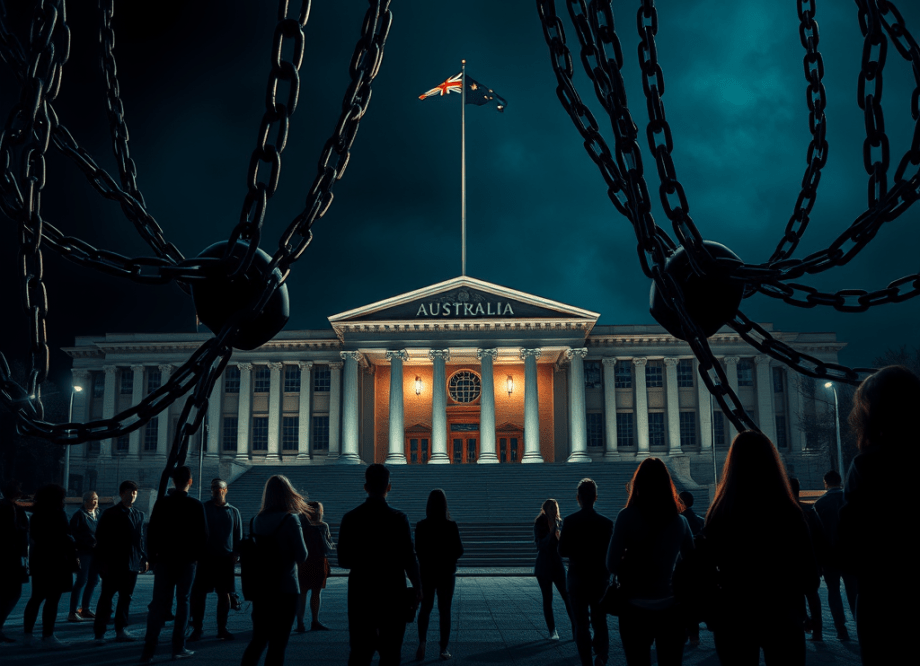
How Australia Capitulated to Digital Overlords (And Called It Safety)
SECTION I: THE MOMENT EVERYTHING CHANGED
Parliament passed the teen social media ban on 29 November 2024. Three days’ later, on 4 December, Meta closed the accounts of every teenager in Australia.
Not because parliament forced it. Nor because courts ruled it necessary. Certainly not because Canberra had any enforcement mechanism in place. Meta made a unilateral decision about when and how to implement the law that parliament had just passed. Then Meta’s public affairs team released statements praising their own “responsibility” and their commitment to “protecting young Australians.”
By the time Meta closed those accounts, they had already written the technical standards. They had already designed the age-verification systems. They had already built the compliance infrastructure. Canberra didn’t design how the law would work. Canberra ratified what Meta had already decided. The law wouldn’t take effect until December 2025, a full year away. Meta chose to enforce it immediately, on their terms, with their systems, according to their timeline. For reasons best known to itself.
That single moment, Meta implementing policy on its own schedule, using its own standards, then daring Canberra to object, is the shape of Australian sovereignty now.
SECTION II: WHAT THE BAN ACTUALLY DOES
The teen social media ban is sold as child protection. In practice, it crystallises platform power over basic infrastructure.
Here’s how it works:
Meta moves first, closes accounts, announces their own age-verification system. Snapchat follows, routes age checks through banks, making verification a payment verification process. TikTok waits to see if it will be banned entirely, then complies with platform-designed standards. YouTube implements their version. Each company’s compliance framework is slightly different, but the principle is identical: the platforms write the rules, and Canberra becomes the enforcement arm.
This isn’t regulating Big Tech. This is outsourcing regulation TO Big Tech.
A parent in Melbourne trying to help their 15-year-old verify age to stay connected with friends has to go through a system Meta designed, using verification methods Meta chose, with data flowing through systems Meta controls. If the verification fails, if Meta’s algorithm decides the ID is suspicious, there’s no appeal to an Australian regulator. There’s Meta’s customer service, which doesn’t exist. The account stays closed.
Safety, in this framework, is no longer a civic good. It’s a product that platforms sell and control. And Canberra has guaranteed they have a monopoly on it.
SECTION III: THE ABSURDITY THAT HAUNTS THE BAN
The disease becomes the cure:
The same companies that Australia claims are too dangerous for teenagers to use are being contracted to VERIFY that teenagers don’t use them. We’re saying: “You’re a security risk. Here’s a contract to build the security system.”
It’s like hiring an arsonist to install your fire alarm.
Snapchat’s age-verification system uses ConnectID, software linked to major Australian banks. ConnectID confirms a user’s age through their bank records but returns only a “yes or no” answer to Snapchat, not banking data or personal information. A platform previously restricted in countries for data privacy violations now has access to a system that connects teenagers’ identity to banking infrastructure. The banking system confirms age, the platform gets approval, and the infrastructure link remains.
TikTok, the platform that parliament claimed poses “national security risks”, will implement its own age verification and moderation systems to comply with the ban. Which means TikTok’s systems will be used to monitor Australian teenagers’ compliance with Australian law. If you think that’s an uncomfortable dynamic, you’re paying attention.
Meta will use age verification to improve its demographic profiling. An Australian parent who verifies their 12-year-old’s identity to protect them from social media has just handed Meta verified identity data linked to a household. That data becomes part of Meta’s advertising targeting database. “Parents concerned about teen safety” becomes a demographic profile.
Safety, it turns out, is monetisable. And we’ve written the platforms a contract.
SECTION IV: WHAT ACTUALLY GOT BANNED
The ban nominally applies to all platforms “equally.” In practice, it protects Meta while constraining competitors.
Meta can afford compliance infrastructure. The company maintains extensive in-house legal teams and pays billions annually to outside counsel. It has significant compliance operations, including major teams in California and Sydney. Meta will build an age-verification system that’s marginally functional and declare itself compliant.
A startup trying to build a better platform, something genuinely designed around teen wellbeing instead of engagement maximisation, can’t afford compliance. They can’t build age verification systems. They can’t hire lawyers to navigate the regulatory minefield. They fold or never launch.
The ban doesn’t eliminate Meta’s market power. It entrenches it. By making compliance expensive and technically complex, it ensures only the giants survive.
And here’s the bit that should make you furious: Canberra didn’t do this deliberately as a pro-Meta strategy. Canberra was played. Meta showed them a “problem” (teen safety), offered a “solution” (the ban), and knew that the compliance burden would eliminate any competitor who might threaten their market position.
Albanese’s government celebrated this as regulation. It was actually monopoly consolidation dressed as child protection.
SECTION V: THE SOVEREIGNTY PROBLEM (STATED PLAINLY)
Parliament passed the teen social media ban on 29 November 2024. Meta had already announced their implementation strategy. They began closing accounts on December 4, using their own age-verification systems to determine who should be removed. By the time Australian regulators could organise their enforcement apparatus, Meta had already written the rules and begun implementation. This is the shape of platform power: act first, lobby second, comply theatrically third.
When you can’t negotiate with a platform on your own time scale, when Meta sets the technical standards and you’re forced to comply or be called negligent, you’ve already lost procedural sovereignty.
Are we digital losers? Mugs? Australia is ranked 79th globally for broadband speed. We pay premium prices for digital services. Our universities outsource computing to foreign cloud providers. Our schools sign contracts giving Microsoft and Google access to children’s educational data, with no Australian oversight of what that data is used for.
We talk about digital sovereignty. We mean: “We’d like to keep some power over our own digital future.” The harsh reality is that we surrendered our autonomy years ago, and now we’re arguing about the terms of capitulation.
When parliament can’t say no to Meta without facing accusations of restricting “free speech,” when Canberra can’t mandate data residency without being told it’s “protectionist,” or when we can’t build public computing capacity without being lectured about “government inefficiency” by the same companies that run at a huge loss, we’re not negotiating anymore. We’re renting.
And the lease terms keep getting worse.
SECTION VI: THE PATTERN, HOW PLATFORMS WRITE POLICY
The teen social media ban was sold as an exception, a unique emergency measure to protect children. In practice, it sets the template for future policy: platforms define the problem, write the solution, and governments ratify it.
The mechanism is always the same. A social problem emerges. A platform offers a “solution.” Canberra ratifies it. The platform’s power expands. The next problem gets pre-solved by the same company, deeper into the system.
EXAMPLE ONE: Workplace Rights, The Gig Economy Model
The gig economy section now also explicitly demonstrates the policy capture pattern:
- Platforms moved first — wrote their own standards, operated in regulatory vacuum
- Government was behind the curve, The Fair Work Commission had to investigate and negotiate
- Platforms resisted transparency; wouldn’t explain how their algorithms worked
- Workers had to sue; courts had to examine the algorithms Canberra couldn’t access
- Platforms still control implementation; even after legislation, they determine how standards work
An Uber driver in Melbourne wakes up and opens the app to see what work is available. An algorithm decides when she’s “active” in the queue. An algorithm determines which rides she sees. Uber sets the rate, she has no negotiation. If she declines too many rides, the algorithm deprioritizes her. If the algorithm decides she’s “too risky,” she’s deactivated with no appeals process and no way to know why.
She has no workplace protections. No minimum wage. No sick leave. No collective bargaining. When work dries up, during COVID, during economic downturns, she has no safety net. She’s classified as an “independent contractor,” which means Canberra won’t regulate her because “she’s not an employee.”
This isn’t unique to Uber. Deliveroo (acquired by DoorDash in October 2025) workers face identical conditions, algorithm controls shifts, platform sets payment, no transparency about how the system works. Aged care workers use shift-booking apps that match them to casual shifts algorithmically, with the same mechanism: algorithm sets terms, workers accept or lose access to work.
The Fair Work Commission has inquired into gig worker conditions. They’ve found documented problems: precarity, wage theft, deactivation without due process. Canberra could regulate. They could mandate transparent algorithms. They could require minimum payment standards. They could protect workers’ right to collective organisation.
Instead, Canberra celebrates the “gig economy” as innovation and flexibility. The platforms own the distribution network, the only way to access work in these sectors, and they set the rules unilaterally. Workers have no leverage because there’s nowhere else to go. As with accessing social media, the platform call the shots.
EXAMPLE TWO: Election Integrity, Who Controls Political Information
Meta, Google, and TikTok determine which political stories get amplified during elections. Not through explicit censorship. Through algorithmic curation. Through moderation standards they set unilaterally. Through the decisions about which content reaches voters and how prominently it appears.
When a voter sees political news on Facebook, the algorithmic prominence of that story: whether it reaches 100 people or 100,000 people, is determined by Meta’s system, not by editorial judgment or democratic debate. During elections, this shapes which narratives dominate public conversation. Different voters see different political content based on what Meta’s algorithm decides is “engaging” to their demographic.
TikTok’s algorithm curated Gen Z voters’ understanding of the 2022 election. Australian campaigns couldn’t predict what content was being amplified to young voters because the algorithm is proprietary, opaque, and controlled by a foreign company. Young voters’ primary news source about Australian politics was determined by an algorithm designed to maximise engagement, not to inform democratic choice.
Canberra could require transparency. Mandate that platforms disclose how their algorithmic moderation works. Require appeals processes. Build public infrastructure for political information distribution, something owned by Australians, operated transparently, designed around democratic principles rather than engagement maximisation.
Instead, Canberra accepts platforms’ standards and celebrates their “responsibility” when they claim to suppress content. The distribution infrastructure for political information; the pipes through which election campaigns reach voters, is owned by foreign companies. Canberra has no ability to audit, contest, or shape how those pipes work.
THE PATTERN ACROSS ALL THREE:
- A social problem emerges (teen mental health, worker precarity, election manipulation)
- A platform offers a “solution” (age verification, algorithmic scheduling, moderation standards)
- The solution consolidates platform power (platforms control compliance, platforms control work access, platforms control political information distribution)
- Canberra ratifies it and calls it “innovation” or “safety” or “responsibility”
- The platform’s power expands deeper into the next system
The teen ban isn’t an outlier. It’s a proof of concept for how policy gets made now: not in parliament, but in corporate boardrooms, with government approval coming after the fact.
And the pattern will continue because Canberra has accepted the fundamental premise: that private platforms own the infrastructure through which essential human activities happen, and that regulation means negotiating with the platforms rather than building alternatives.
SECTION VII: WHAT WE’RE ACTUALLY PROTECTING
The ban is framed as protecting childhood. What it’s actually protecting is Meta’s business model, the attention extraction that depends on teenage data and engagement metrics.
Meta doesn’t make money from you. Meta makes money from advertisers. The product they’re selling to advertisers is you, your attention, your behaviour, your relationships, reduced to a dataset. Teenagers are the most valuable customers because their attention is still forming. Teenage attention is plastic. Teenage behaviour is legible to algorithms.
The ban doesn’t stop the extraction. It restructures it. Instead of teenagers on platforms, platforms now own the identity verification infrastructure teenagers need to participate in any online community. Instead of algorithmic exploitation, you’ve got compliance extraction. Instead of engagement time, you’ve got verified data.
A teenager in Melbourne who wants to video-call friends on Snapchat has to go through ConnectID, which connects to their bank account but returns only a ‘yes/no’ answer about age, the banking data itself stays with the bank. In theory. In reality, Australia’s banking data is under sustained attack.
At least 30,000 Australian banking passwords have been exposed between 2021 and 2025 after hackers infected devices with infostealer malware, though the actual number of compromised customer devices is likely substantially higher Information Age. These compromised credentials from major Australian banks (ANZ, NAB, Westpac, Commonwealth Bank) are being shared as free samples on the dark web.
A kid who wants to stay connected to classmates on TikTok has to go through a platform-controlled verification. The extraction just moved upstream.
If protection was the goal, Canberra would have:
- Built a public, privacy-preserving age-verification service owned by the government, with transparent code and public auditing. Teenagers could prove their age once, to one system, and that proof wouldn’t be monetised or sold.
- Mandated open, auditable moderation standards for any platform serving minors. Transparent logs of what got removed and why. Appeals to human reviewers, not algorithms. Platforms competing on how safe they are, not on how effectively they extract engagement.
- Created a digital public space for teenagers, a platform owned by the government, operated by educators and child psychologists, designed to keep kids connected without extracting data or maximising engagement. Not TikTok or Meta or Snapchat. Something that belongs to Australian teenagers, not to Wall Street.
- Protected civic speech explicitly. A teenager organising a climate protest needs a platform. A kid discussing mental health with friends needs privacy. Those should be enshrined in law, not left to Meta’s whims.
None of that happened. Instead, Canberra contracted the protection to the extractors. And called it regulation.
SECTION VIII: AUSTRALIA THE SERVER COLONY
This is what Australia has become: a server farm with a flag.
Our electricity powers computing we don’t control. Our data gets analysed otsiesn systems we don’t own. Our regulatory capacity gets out-sourced to companies we can’t hold accountable. Our teenagers’ identity becomes a tolled gateway, with Meta and Snapchat and TikTok collecting rent.
Are we digital patsies? We have broadband speeds that lag the developed world. We have public services starved of funding while cloud subscriptions eat institutional budgets. We have universities surrendering computing autonomy. We have schools signing data-sharing agreements with American companies. We have a government that can’t say no to Silicon Valley because Silicon Valley writes the standards.
So this is known as progress?
It’s not progress. It’s dependency. It’s what happens when you let others own the rails and then wonder why you can’t go anywhere they don’t want you to go.
SECTION IX: WHAT RECLAIMING ACTUALLY LOOKS LIKE
Australia could choose differently:
A public age-verification service built by the government, operated transparently, audited annually by parliament. Your kid proves their age once. The data doesn’t get sold to advertisers. It doesn’t feed algorithms. It just confirms age. The code is open source. Other democracies can use it.
Mandatory open standards for teen-serving platforms. Moderation logs are public. Algorithmic decisions can be appealed. Terms of service are in plain English, not corporate legalese. Platforms compete on actual safety, not on how effectively they hide their extraction mechanisms.
A procurement requirement for public institutions. Schools, libraries, universities: can contract with foreign cloud providers if, and only if, they agree to Australian data residency, Australian oversight, and transparent auditing. Or they build it locally and retain control.
A national broadband authority that builds fibre to every town and community. Not a duopoly of private carriers charging rent. Public infrastructure, like roads. Universal connectivity, like electricity.
Digital literacy and civic tech education in every school. Kids learn not just to use platforms but to understand how they work. They learn to code. They learn that technology can be designed differently, with consent instead of extraction, with transparency instead of opacity, with democracy instead of algorithmic governance.
A genuine conversation about what digital sovereignty means: not isolation, but the power to say no. Not autarky, but autonomy. The capacity to negotiate with global powers from a position of strength instead of capitulation.
None of this happens without a fight. The platforms will lobby. They’ll claim innovation will die. They’ll say Australian regulation is “protectionist.” They’ll threaten to leave. (They won’t. The Australian market is too valuable.)
But the hardest part isn’t the policy design. It’s the political will to say: “We built this digital world. We shouldn’t have to rent it back.”
SECTION X: THE PATTERN
Notice the pattern. It appears everywhere.
With gig workers: Platforms move first. They build systems that embed their control before regulation arrives. Government intervenes only after workers have already lost bargaining power. Even after legislation, platforms control implementation—workers still don’t know why the algorithm deactivated them.
With teenagers: Meta moves first. Closes accounts unilaterally. Announces its own age-verification system. Parliament votes after the fact. Snapchat implements ConnectID. TikTok waits to see if it will be banned. By the time regulation arrives, platform infrastructure is so entrenched that “compliance” means negotiating with the incumbent, not designing public standards.
The pattern is always the same: platforms define the problem in ways only they can solve. Government becomes the enforcement mechanism. Regulation becomes capture wearing a safety mask.
SECTION XI: THE FINAL RECKONING
We’re told the teen social media ban is about safety. And there is real concern; vulnerable teenagers are suffering, platforms are partly responsible, intervention is warranted.
But here’s what wasn’t debated: whether the solution should consolidate platform power or challenge it.
Canberra chose consolidation. They made Meta, Snapchat, and TikTok the arbiters of teen safety. They embedded platform-controlled systems deeper into the infrastructure of Australian life. They defined the problem in ways only the platforms could solve.
That’s not regulation. That’s regulatory capture dressed up as child protection.
And it’s happening across every domain. Gig work. Retail. Aged care. Digital advertising. Wherever there’s a platform and an algorithm, we see the same sequence: platforms move first, entrench their control, define what “compliance” means, and government arrives too late to do anything but ratify their terms.
This is what “The Silicon Leash” actually means. Not that technology is bad. (Isn’t all technology socially mediated, anyway?) But that we’ve surrendered the basic capacity to set our own terms. We regulate at the platform’s discretion. We protect children using their systems. We govern gig work after the algorithm has already captured it.
Australia didn’t lose this fight in November 2024. We lost it years ago when we decided that platforms didn’t need to be regulated like infrastructure; because we forgot that platforms are infrastructure now. They’re the pipes through which our economy, our democracy, and our teenagers’ social lives flow.
If we don’t own the pipes, we don’t own the future. And right now, we don’t own the pipes. We’re just paying the rent. We surrender our autonomy. We abandon our duty of care to our youngsters. But worst of all, we risk becoming silicon serfs; surrendering our rights and our prosperity at the bidding of the billionaire tech-bro oligarchy that already runs too much of the world for its own good. We’re not just renting our digital future. We’re mortgaging our children’s capacity to think freely, to organise politically, to live authentically in a world increasingly mediated by algorithms designed to extract value from their attention, their data, their very sense of who they are.
That’s not progress. That’s capitulation. And we’re calling it regulation.
END OF PART TWO
 Urban Wronski Writes
Politicians for the most part have a problem, they are reactive, not proactive and their reason is a lack of courage, they don’t want to lose their job,by upsetting the electorate. So they wait until the electorate gives them a sign, sadly by then the horse has bolted.
Since the likes of Whitlam, Hawke and Keating, we have had a situation where our politicians have been waiting for a sign from the people and the people have been waiting for a sign from the politicians, I think it’s called inertia.
LikeLike
Very angelic, Jon. You take the cake. Enjoy!
LikeLike