Debt, Democracy, and Digital Dependency
The AI Wars: How Australia Became a Server Farm with a Flag
Over two days, Urban Wronski examines the speculative bubble hollowing out democracy and the colonial logic reshaping Australia’s future. Day One exposes the global machinery: trillions in borrowed money chasing an unprofitable dream, while hospitals close and grids strain. Day Two turns the lens homeward: how Australian politicians capitulate to Silicon Valley overlords while pretending to protect children, and what sovereignty actually costs when you can’t say no to Meta. Together, these articles form a reckoning with empire, debt, and the price of digital dependency.
PART ONE:
THE VINE AND THE GUM TREE
How AI Infrastructure Spending is Eating the Future
SECTION I: THE MONEY PROBLEM
Thirty billion dollars. That’s what Meta will pour into AI infrastructure this year alone. Not over a decade. This year. Enough to build every hospital Australia needs for the next twenty years. Enough to solar-panel every school and library on the continent. Instead, it buys server farms that consume electricity like a city, mortgaging our climate for an unprofitable speculation.
Imagine being a nurse at a small but busy hospital in regional Victoria. Last month, you had to delay elective surgeries because the operating theatre’s HVAC system failed, and you’re waiting for funding. The theatre sits idle. Meanwhile, across the Pacific, Meta is building another server complex that will run at a loss for years because the math assumes AI will eventually be worth the debt.
Meta spends $30 billion on server racks while regional, Victorian hospitals delay surgeries because of a HVAC failure. In a state where 62,878 patients languish on elective surgery waitlists, the opportunity cost of debt-fuelled AI vanity projects is measured in human pain.
That’s not innovation. That’s triage in reverse.
SECTION II: THE VINE
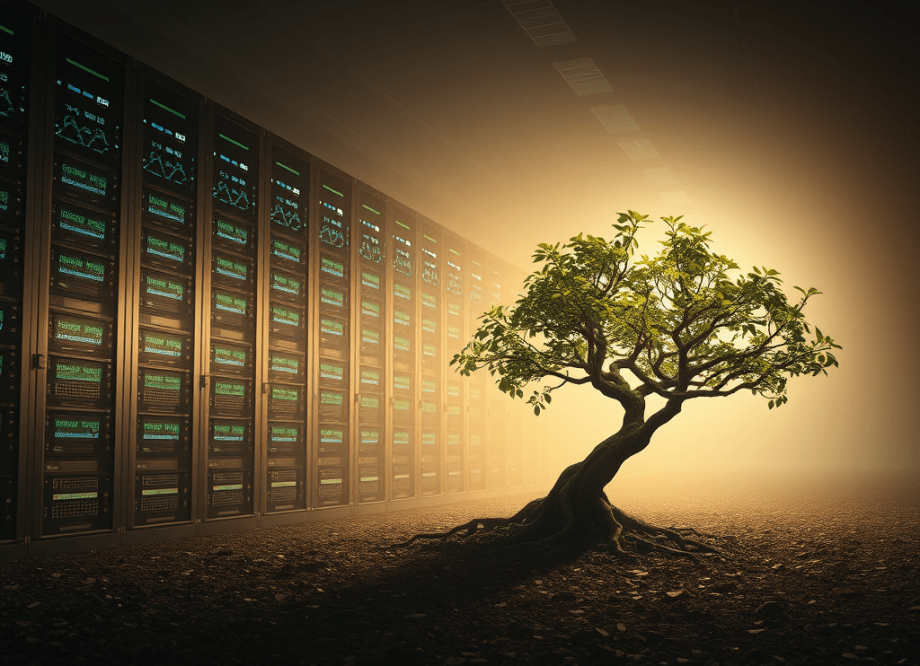
Picture a vine strangling a gum tree. The vine grows faster than the tree can shed it. Its roots don’t anchor to soil; they feed on the tree itself, piercing bark, girdling limbs, drawing nutrients meant for the tree’s own survival. As it swells, it creates the illusion of growth; the vine is massive, impressive, expanding. But what’s actually happening is a transfer: life from the tree to the parasite. The tree doesn’t get stronger. It gets slowly strangled.
That’s what’s happening to Australian public infrastructure right now.
Enterprise IT budgets are growing at 70% a year; that’s extraordinary growth. But it’s growth in the wrong place. This money isn’t new. It’s diverted. A hospital’s budget for surgical equipment gets redirected to cloud contracts. A university’s research computing gets leased from AWS instead of built in-house. A local council’s IT operations migrate from maintained servers to subscription services. The vine is growing. The tree is hollowing out.
Here’s the mechanism: boards face pressure to “modernise” and “compete globally.” They sign multi-year cloud contracts with foreign companies. The costs are buried in operational budgets, so they don’t look like capital spending; they look like inevitable utilities, like electricity or water. By the time anyone asks whether the original infrastructure could have been maintained or replaced locally for a fraction of the cost, the contracts are locked in and the institutional knowledge to operate local systems has been retired.
The vine is thickening. The gum tree’s branches are thinning.
Meta’s capital expenditure has doubled to over $30 billion in a year. Apple is building AI infrastructure. Amazon Web Services is expanding its data centre footprint. Google is retrofitting facilities for AI workloads. Not because they’re profitable. Bond markets are tightening. Investors are nervous. These companies are spending borrowed money, justifying it with promises of AI revenue that don’t yet exist, gambling that they can hold onto market dominance long enough for the bets to pay off.
If they’re wrong, and the debt markets suggest many of them might be; the bill gets paid by everyone else. Australian workers’ superannuation takes a hit.
SECTION III: WHAT $30 BILLION ACTUALLY BUYS
Meta’s annual AI spend could build:
- 600 regional hospitals at $50 million each, equipped with MRI machines, surgical suites, pathology labs. Regional Australia would have emergency capacity again.
- 1.5 million public housing units at $20,000 each. Australia’s homelessness crisis, solved. Rent stress, halved.
- Salaries for 300,000 teachers for a year. Every regional school overstaffed. Class sizes cut in half. Special needs support in every classroom.
- Solar installations for 2 million Australian households. A third of the nation is off-grid for electricity. Energy bills dropped. Grid resilience up.
- Universal fibre broadband to every town over 1,000 people. Australia no longer languishes at 79th globally for broadband speed.
Instead, it buys server racks humming in coal-powered sheds.
And here’s the hidden cost: when Meta (or Amazon, or Google) builds a data centre, it doesn’t pay for the electricity it consumes. The grid does. The cost is externalised to everyone else; to the household paying rising electricity bills because demand peaked during the data centre’s peak consumption. To the renewable energy project that can’t get grid connection because the data centre got priority. To the region where coal plants stay open longer than they should because the data centre contracts lock in capacity.
This is not a small economic adjustment. Australian data centres already consume roughly 3-4% of our national electricity. That’s projected to grow to 8-10% globally by 2030. We’re talking about millions of tonnes of CO2, billions of litres of cooling water diverted from agriculture and drinking supplies, mountains of e-waste exported to countries without environmental protections.
All to run AI systems that generate negative returns on investment.
SECTION IV: THE DEMOCRACY PROBLEM
But the money problem is actually smaller than the democracy problem.
These decisions; trillion-dollar bets on unprofitable infrastructure, reshaping grids, committing national electricity resources for decades, are made by unelected executives, rubber-stamped by shareholders (often pension funds managing your retirement), and never debated by parliament.
Hannah Arendt warned in the 1950s that technocracy would hollow out public life. She was writing about nuclear power. She’d recognize this exactly: decisions of civilisational scale made by technical elites, with democratic oversight reduced to signing contracts.
When Meta decides to build a server farm in Australia, Canberra doesn’t negotiate. It offers incentives. Tax breaks. Grid priority. Fast-tracked planning approval. We compete with other nations to host infrastructure we don’t own, that pays us minimal tax, that employs dozens where a hospital or a TAFE would employ hundreds.
When Amazon Web Services expands its Australian presence, universities don’t ask whether they should retain computing capacity in-house. They assume outsourcing is inevitable and negotiate the least-bad contract. Public research, funded by taxpayers, runs on systems owned and audited by a private American corporation.
When TikTok becomes “a national security threat” and parliament moves to ban it, Meta moves FIRST; closes teen accounts before parliament votes, defines the technical standards everyone must follow, and suddenly becomes the trusted partner implementing “safety.”
No parliamentary debate about whether age verification should be owned by platforms. No discussion of a public alternative. Just: Meta wrote the code, here are the compliance standards, implement or be fined.
This is technocracy. Democracy would mean: “Here’s what we need. You tell us how to do it. If you can’t, we’ll build it ourselves.”
SECTION V: THE ENVIRONMENTAL RECKONING
Australia has made a choice that no democratic parliament debated or approved: we are becoming a digital quarry for the global North.
Our coal-fired electricity, the dirtiest on Earth, powers server farms that run AI training algorithms for Silicon Valley companies. We pay the climate cost. They capture the value. Our grid operators have to manage demand spikes from data centres that consume more electricity than entire cities. Our water is diverted for cooling systems. Our rare earth minerals are extracted to manufacture the hardware. Our emissions budget is mortgaged.
This echoes the mining booms of old. Iron ore stripped landscapes. Coal scarred communities and killed miners. Now we’re strip-mining computation and data, concentrating wealth in a few coastal tech hubs while externalising the environmental harm to regions that bear the climate cost.
A coal-reliant region in Queensland or NSW doesn’t get to vote on whether a data centre is worth the pollution. A farmer in the Murray-Darling doesn’t get to vote on whether data centre cooling takes precedence over irrigation. A kid with asthma in a coal town doesn’t get to vote on whether keeping the coal plant open for another decade “to power AI progress” is acceptable.
That’s not a market. That’s extraction.
SECTION VI: WHAT AN ALTERNATIVE LOOKS LIKE
Australia could choose differently. Not easily, but genuinely.
A public cloud cooperative owned and operated by a consortium of universities, hospitals, and research institutions. Not profit-maximizing. Purpose-built for Australian public goods; health data analysis, climate modelling, agricultural optimization, education. Powered by renewable energy. Audited in public. Operated under Australian law, not American terms of service.
Mandated public stakes in megaprojects. Any data centre consuming more than 100 megawatts of Australian electricity is 30% government-owned. Profits flow to infrastructure. Policy is debated. Grid priority is negotiated, not granted.
A national digital commission with power to set standards, audit practices, reject proposals that don’t meet environmental or democratic thresholds. Not a rubber stamp. A genuine gatekeeper.
Reviving the public internet spirit. The internet was built on ARPANET; publicly funded, publicly controlled, designed to resist centralisation. Universities developed TCP/IP. Australia’s CSIRO co-invented WiFi and didn’t patent it. We could rebuild that logic: public investment in foundational computing capacity, with open standards that prevent monopoly capture.
None of this is as profitable as current arrangements. That’s the point. Profitability for Meta is unprofitability for everyone else.
SECTION VII: THE HARDEST TRUTH
We are the capital.
That’s what George Carlin was trying to say, and what the global North has understood for 50 years: ordinary people ARE the resource. Your data. Your attention. Your labour on gig platforms that avoid taxation. Your electricity bill that subsidises server farms. Your pension fund financing the debt.
Without a democratic fight to redirect this, we don’t become wealthier. We become tenants in a home we built but can barely afford to live in.
Meta will spend $30 billion this year on infrastructure that generates no revenue. The debt will be serviced somehow. The bill will arrive eventually. When it does, it will be paid by wage stagnation, service cuts, and climate damage borne by the poorest regions first.
The vine keeps strangling. The gum tree keeps hollowing. And we keep watching, as if this is inevitable.
It’s not. It’s a choice. And it can be changed.
 Urban Wronski Writes
A cashless, electronic, AI governed society, is all about control. Society living on small Universal Wage and no employment to occupy their time or stimulate their minds is powerless. Like cattle humanity will have just become feed stock.
LikeLike