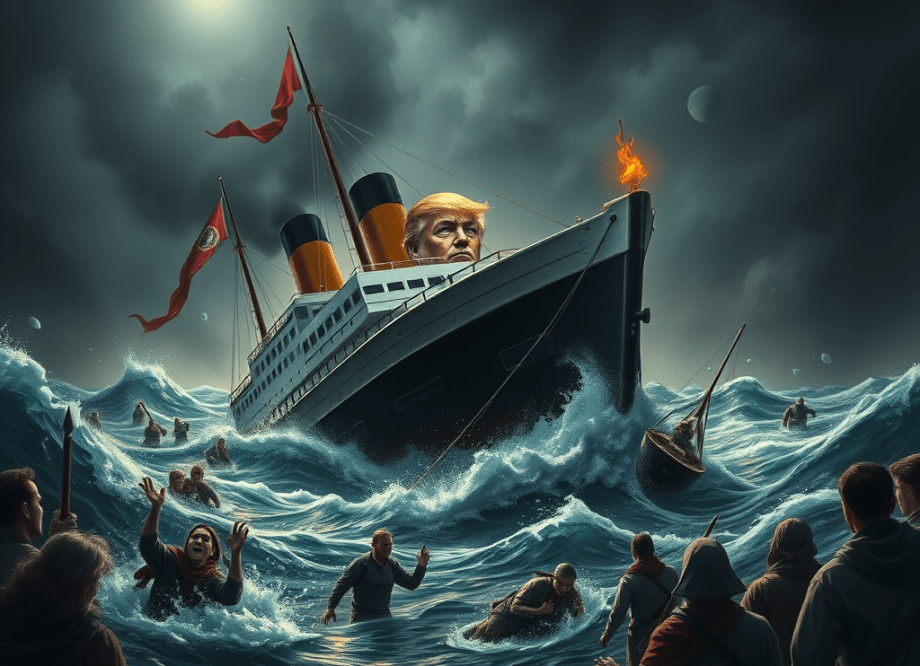
Ten months into his second term, Donald Trump isn’t just losing: he’s becoming a political contaminant so toxic even Republicans are holding their breath when he walks in the room. This isn’t a gentle electoral correction. This is political septicaemia. With too many co-morbidities to count.
The numbers don’t just tell a story: they draw blood. Trump’s approval has cratered to somewhere between 36% and 41%, depending on which pollster you trust. His disapproval? A septic 58-62%. But here’s where it gets really ugly: his net approval on handling the economy, the one metric he’d always brandished like a trophy, has now sunk below where Joe Biden ever went.
Let that particular indignity percolate for a moment. The self-anointed business genius, the dealmaker extraordinaire, the man who promised to make America rich again, is now less trusted on economic stewardship than Sleepy Joe. As Muhammad Ali once observed about a different kind of stumbling heavyweight, “He’s got a million dollar body and a ten cent brain.” Trump’s got the gilt tower, the golf and the private jet, but the political instincts of a drunk playing Russian roulette.
But the real story isn’t what Democrats think. Blind Freddy could’ve predicted that with a dartboard and wearing a blindfold in the dark. No, the carnage is happening inside the Republican tent. Approval among GOP voters of Trump’s handling of government has collapsed from 81% in March to 68% now. When your own tribe starts edging toward the exits, sniffing for fresh air and looking for the nearest lifeboat, you’re not just in trouble. You’re the Titanic, and the orchestra’s packing up early.
The Shutdown That Ate the GOP
The 43-day government shutdown, longest in American history, naturally, because Trump does everything bigly, just became the president’s self-inflicted gut wound. While 42 million Americans watched their SNAP benefits get slashed to 65% of normal, while air traffic controllers worked without pay and turned airports into chaos zones, while federal workers lined up at food banks in the richest country on Earth, Trump doubled down with the strategic genius of a man who’d never read Sun Tzu’s warning: “There is no instance of a country having benefited from prolonged warfare.”
“The radical left Democrats” would cave, he insisted. They’d blink first. They always did.
They didn’t.
Instead, they let Trump stew in his own juice while Republicans in swing districts fielded increasingly panicked calls from constituents wondering why Grandma’s food stamps had been cut and Dad’s VA benefits were delayed. The private sector data rolling in shows the economic carnage: beer sales dropped 6% in October. Auto sales fell 4%. When beer sales tank, mate, you know something’s got to be very crook in the consumer confidence wing of the economy. Yet, this is the USA. As George Carlin once put it, “When you’re born you get a ticket to the freak show. In America, you get a front row seat.” Trump just made sure everyone’s watching his particular sideshow disaster.
Then came November 4th. Election Day. The day US voters delivered Democrats a victory so whopping it would’ve sent every Republican strategist reaching for the hard stuff and updating their CVs.
Take Virginia: Democrat Abigail Spanberger won the governorship by 15 points, the strongest Democratic performance in the state’s recent history. New Jersey: Mikie Sherrill romped home by 13 points in a state Trump had been making inroads. New York City: voters turned out in numbers not seen since 1969 to elect democratic socialist Zohran Mamdani as mayor, rejecting former governor Andrew Cuomo so decisively it was cruel. California: voters approved redistricting that favours Democrats heading into the midterms, potentially handing them five more House seats.
This wasn’t a correction. This was a rejection. Voters taking a long, hard look at Trump’s second act and deciding they’d rather walk across broken glass than endure another four years of this buffoon.
The Economy, Stupid: Redux
Here’s the bit that must really sting: Trump’s famously tender ego: exit polls showed voters ranked the economy as their top issue in every single race (Virginia, New Jersey, New York, California) and backed Democrats overwhelmingly. Trump’s been flogging immigration as the great motivator, insisting Americans care more about his wall fantasies than their grocery bills. Turns out they don’t. Turns out when coffee prices spike and electricity bills jump 22% (hello, New Jersey), voters notice.
And they remember who’s been in charge.
Paul Keating once rebuffed John Hewson’s attack as “like being flogged with a warm lettuce.” Trump’s economic response has been to set fire to prices. He’s scrambling now, signing executive orders to roll back food tariffs on coffee, beef, and tropical fruit, a tacit admission his reciprocal tariff scheme has been hammering ordinary Americans while he prattled on about “winning.” Over 60% of Americans disapprove of his tariff handling. His much-vaunted China deal, announced with such fanfare after his Asia trip, is already looking threadbare as experts question whether Beijing will actually follow through on those soybean purchases and rare earth commitments.
Meanwhile, Trump’s floating trial balloons about invading Venezuela, 15,000 troops and over a dozen warships positioned for “Operation Southern Spear,” as if the solution to cratering domestic approval is to start another foreign adventure. “I sort of have made up my mind,” he told reporters aboard Air Force One, with all the reassuring certainty of a man ordering from a menu he can’t quite read in dim lighting.
Nothing says “I’ve got domestic politics under control” quite like threatening regime change in South America, right? As Dorothy Parker would agree, that way madness lies. Or at very least, political suicide.
The Epstein Albatross
Then there’s the Epstein files, the gift that keeps on giving if you’re a Democrat, and keeps on taking if you’re Trump. After House Democrats released emails showing convicted sex offender Jeffrey Epstein had ridiculed Trump during his first term as “fucking crazy,” “dangerous,” and possessing “not one decent cell in his body,” Trump’s response displayed his characteristic wit, grace and subtlety: order Attorney General Pam Bondi to investigate Bill Clinton’s ties to Epstein.
Nothing screams “I’m totally innocent and have nothing to hide” quite like weaponising federal law enforcement against your critics while simultaneously trying to block a House vote on releasing the complete Epstein files. Trump even hauled Rep. Lauren Boebert into the Situation Room for a desperate lobbying session, showing her select documents in a bid to get her to withdraw her signature from the discharge petition. It failed. The petition got its 218th signature anyway.
Even MAGA stalwarts like Marjorie Taylor Greene signed on. When you’ve lost MTG on a culture war fight, you’ve got problems. Conservative commentator Megyn Kelly summed up the political idiocy with surgical precision: “Why doesn’t he just release these? Now he’s in a position of being singled out as the only one.”
Why indeed. As Mark Twain observed, “If you tell the truth, you don’t have to remember anything.” Trump’s now juggling so many versions of events he needs a 3D spreadsheet.
The Reckoning
So is the tide turning? It’s not just turning: it’s become a riptide pulling Trump and his enablers out to sea while they flail about insisting the water’s lovely and everything’s fine. Safe as a Venezuelan tuna boat.
Trump himself offered rare insight into the November 4th electoral drubbing: “I don’t think it was good for Republicans. I’m not sure it was good for anybody.” Translation: I’ve got no bloody idea how to spin this disaster, so I’ll just spray some broad-spectrum pessimism around; hope it sticks to Democrats too.
The question now isn’t whether Democrats can capitalise on Trump’s freefall. They’re already doing it. The question is whether Republicans will find the spine to cut their losses before the 2026 midterms turn their narrow House and Senate majorities into a Democratic wave that drowns them entirely.
History suggests they won’t. Trump’s cult of personality has the GOP so thoroughly cowed that most Republicans would rather ride this sinking ship all the way to the bottom than risk his wrath by jumping overboard. It reminds one of that 1991, classic Clarke and Dawe sketch “The Front Fell Off”, about the oil tanker that got towed outside the environment: “That’s not very typical, I’d like to make that point.” Except in this case, it’s become entirely typical. The whole bloody show’s outside the environment now.
By the time Republicans realise the Emperor’s second-term wardrobe was always transparent, the water will already be over their heads. As Oscar Wilde put it, “Experience is the name everyone gives to their mistakes.” The GOP’s about to get a graduate degree’s worth.
The shutdown’s over, signed away in a late-night ceremony where Trump lambasted Democrats while signing their bill. But for Trump, the real shutdown, the one where American voters close the door on his political future, has only just begun. Turns out the Art of the Deal doesn’t cover foreclosure.
Watch this space. The next twelve months should be spectacular. Not enjoyable. Just spectacular.


“They didn’t.” Well, they did. But that’s history now I guess.
LikeLike
While I agree with you comments, none of this is really new, Trump is not America’s first incompetent President and based on the lack of action on the part of the American people he won’t be the last.
Their electoral and legal systems are flawed and based on all I’ve read, no one is prepared to acknowledge that fact, or offer suggestions as to how to correct it!!
My real concern is the fact that due to our close “friendship” with America they will drag us down with themselves.
LikeLike
Jonangel,
You’re right that Trump isn’t America’s first democratic disaster, and you’re certainly not wrong about the structural flaws in their system; the Electoral College is an 18th-century relic that makes our Senate look positively representative. But I’d gently push back on a couple of points.
First, the notion that “no one is prepared to acknowledge” these systemic flaws or offer solutions doesn’t quite square with reality. Americans have been arguing about electoral reform, gerrymandering, money in politics, and judicial appointments for decades. The problem isn’t lack of acknowledgment – it’s that their constitutional amendment process is deliberately designed to prevent change, requiring super-majorities that partisan polarization makes virtually impossible. That’s not ignorance; it’s gridlock by design.
Second, and here’s where I’d suggest you’re being a touch too fatalistic, Americans are taking action, just not always in ways that grab headlines. Look at the sustained mobilization of women’s groups post-Dobbs, the grassroots organizing in swing states, the local-level fights over voting rights, school boards, environmental regulations. The resistance isn’t always spectacular, but it’s there. Dismissing an entire nation as passive seems… well, a bit like the American habit of writing off entire continents.
But your real concern, that Australia gets “dragged down” by American dysfunction, that’s where I’d invite you to examine the premise more closely.
We’re not being dragged. We’re choosing to follow.
When Morrison parroted Trump’s climate denialism, that wasn’t America forcing our hand. When we joined the Iraq debacle, that was Howard’s decision. When Albanese approves forty-odd fossil fuel projects while claiming climate leadership, mimicking American doublespeak – that’s our government’s moral failure, not Washington’s ventriloquism.
The “dragged down” framing lets us off the hook. It treats Australian foreign policy as something that happens to us, rather than a series of deliberate choices made by Australian politicians who could, if they had the spine, chart a more independent course. We’re a middle power, not a vassal state. The difference matters.
China doesn’t “drag down” Singapore. The EU doesn’t “drag down” Ireland. These are countries that maintain strategic relationships with larger powers while preserving genuine independence on matters of national interest. We could do the same – if our political class had the courage to prioritize Australian interests over the comfortable certainties of the alliance.
The real risk isn’t that America’s dysfunction infects us by proximity. It’s that we use the alliance as an excuse for our own lack of imagination, our own failure to build the independent defense capability, the regional relationships, and the moral authority that would give us genuine strategic autonomy.
So by all means, worry about American decline. But worry more about Australian complicity in our own diminishment.
LikeLike
It seems you have an even lower opinion of our elected leaders than I do!!
But I think you are correct, it matters not who we elect, they suck up to our American “friends”.
LikeLike