Jimmy Kimmel’s voice trembled when he returned to air. Five days gone. Five billion dollars of Disney’s market value evaporated. Four hundred celebrities, two governors, a fistful of senators, and Ted bloody Cruz all screaming into the void.
“Thank you,” Kimmel said, “for reminding us what democracy sounds like.”
For a moment—just a moment—the scenery collapsed.
Here’s what happened. Here’s why it matters. Here’s why the whole charade might finally be falling apart.
The Throat-Clearing Nobody Asked For
Donald Trump won the 2024 election, with roughly one in three eligible American adults actively supporting him. Do the Maths. Sixty-four percent bothered voting. Trump took just under half. That’s 32% of everyone who could have voted, handing him the nuclear codes, his get out of jail free card, an historic White House he could partly demolish and the world’s biggest megaphone.
Two-thirds of America either voted against him or couldn’t be arsed. Trump’s disapproval sits above 50%. Nearly half the country actively despises him. Only a quarter strongly approve. His signature policies tank in polling. Immigration’s a shambles. The economy wobbles. Fifty-five percent reckon he’s making a hash of it.
So why are America’s CEOs performing synchronised genuflection? Why does a president with the democratic mandate of a suburban councillor have boardrooms sweating through their quarterly reports?
The answer arrived last month, gift-wrapped in five days of corporate panic that showed exactly how minority rule works in modern America.
And why, occasionally, it doesn’t.
Last Month: When the Lever Got Pulled
Kimmel stuffed up. Not catastrophically, not unforgivably, but enough. His late-night monologue touched on the assassination of conservative pundit Charlie Kirk, a tragedy that had the country reeling. Kimmel’s dark humour, poking at Kirk’s bombast while the nation was still in shock, read the room spectacularly badly.
The MAGA faithful wanted blood.
Brendan Carr, Trump’s man at the Federal Communications Commission, appeared on a podcast. Not a hearing. Not a formal complaint. A podcast. He suggested ABC’s broadcast licence might need “reviewing” for airing such “divisive” content. No due process. No paperwork. Just a casual billion-dollar threat lobbed into the public sphere like a grenade with the pin half-pulled.
Within hours, two broadcasters; Nexstar and Sinclair, both waiting on FCC approval for merger deals, suspended Kimmel’s show. Disney folded faster than Visy’s cardboard box cartel going before the ACCC.
The mechanism was simple: you don’t need majority support when you control the machinery that crushes dissent.
But they forgot something.
The Arithmetic That Actually Matters
Disney’s market value dropped five billion in a week. Not abstract finance. Real money, vaporizing like spit on a hotplate. #BringBackKimmel went global. Protests mobbed ABC studios. Disney+ cancellations surged. The open letters piled up. The governors condemned it. The senators condemned it. Ted Cruz—Ted Cruz—condemned it.
Five days later, Carr retreated into bureaucratic waffle. Disney issued a non-apology that admitted nothing while apologising for everything. Kimmel came back.
The supermajority had spoken. The 68% who didn’t vote for Trump turned out to have wallets. And votes. And the ability to make five billion dollars disappear faster than a minister’s promise on election eve.
Corporations fear Trump’s regulators. Fair enough. But Trump’s regulators should fear the 68%. That’s not a minority. That’s a supermajority that occasionally remembers it exists.
The Train and the Crops
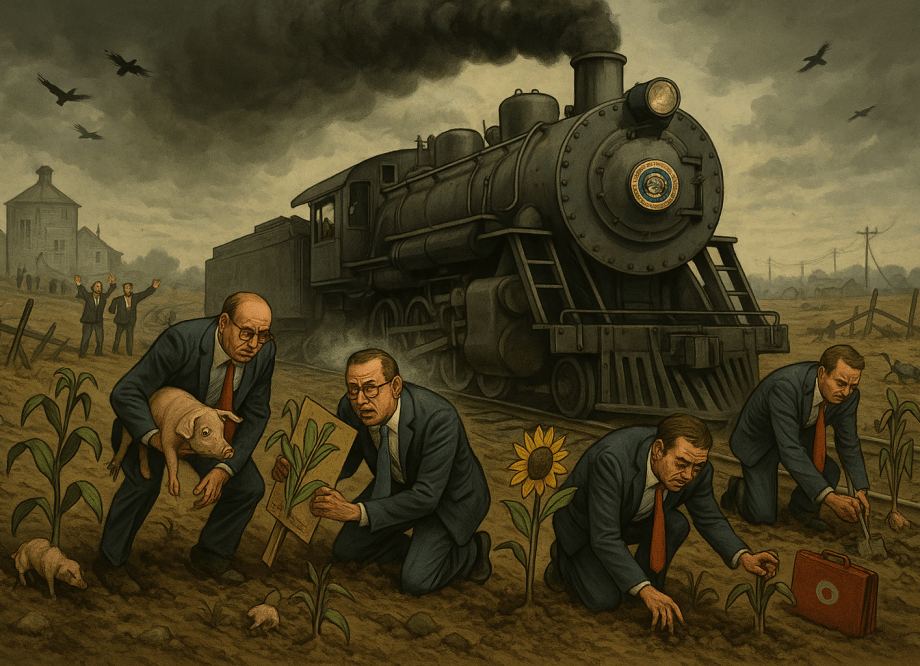
Mao’s Great Leap Forward had a parlour trick that’s rarely mentioned. Local officials would frantically replant the same crops along railway lines, moving them field to field ahead of the Chairman’s train. Same prize pigs making repeat appearances at different stations. Everyone knew it was theatre. Everyone also knew that pointing it out could get you killed.
We’re in a stranger situation now. The data’s public. The polling’s transparent. The arithmetic’s brutally clear. Trump’s 32% mandate is visible to anyone with a calculator and ten seconds.
But corporations keep bowing. Media keeps treating it as a genuine majority. Everyone keeps acting as if the harvest’s bountiful while the granaries stand empty.
It’s not ignorance. It’s strategic blindness. Better to wave at the train and praise the crops than mention the corpses in the ditches.
The Kimmel affair cracked that facade. Five billion vanished because millions refused to play pretend. They saw the empty fields and said so. Loudly.
How Leverage Trumps Love
Trump’s power doesn’t come from popularity. It comes from pressure points.
Corporate Australia understands this instinctively. One word from a regulator and your merger dies, your tax ruling evaporates, your licence goes under review. Americans call it “jawboning”—intimidation without legal process. A gun on the table that never needs firing.
Nexstar and Sinclair didn’t pull Kimmel because they hated his jokes. They did it because Carr’s signature could kill deals worth billions.
What they miscalculated, catastrophically, was thinking their customers were captive. A cancelled Disney+ subscription costs fifteen bucks. Multiply that by millions and you’ve got five billion of market cap evaporating before the ink dries on your appeasement memo.
The Kimmel affair created a public ledger: who folded, who fought. That tally doesn’t disappear when the news cycle moves on. Customers aren’t just revenue streams. They’re the jury.
The Dopamine Machine
There’s another engine driving this madness, and it’s humming in your pocket right now.
Trump’s base doesn’t need policy victories. They need the fight. Every Truth Social rant, every manufactured controversy delivers a hit. Fury as validation. Outrage as identity. A Skinner box where the pellet is rage and the lever’s always within reach.
His opponents are just as hooked, doom-scrolling through despair, feeding the same algorithm that profits from both sides. Healthcare rots. Housing crumbles. Democracy decays. But the timeline? The timeline never stops.
Aldous Huxley worried we’d be drugged into compliance. Instead we got wired into agitation. Democracy became a slot machine and we’re all pulling the lever, convinced the next spin will be different.
The Kimmel backlash cut the power, briefly. People looked up from their screens, saw the actual landscape, and decided they’d had enough.
The Australian Vaccine (and Its Limits)
From here, watching America feels like observing someone juggle chainsaws while drunk. We’ve got our own problems—Christ knows we do—but this particular pathology? We immunised against it in 1924.
Compulsory voting demands genuine majorities. When 95% of eligible voters turn up, you can’t win by revving up a third of the country while the rest stays home. You have to persuade the middle, not just mobilise the margins.
But the vaccine isn’t perfect. Scott Morrison proved that. He governed from a narrow base, weaponised culture wars, courted the Pentecostal margins while the secular centre shrugged. His 2019 “miracle” win came with 51.5% of the two-party vote—barely a mandate, sustained through strategic wedges and calculated outrages. He played Trump’s playbook with an Australian accent: keep your base furious, keep your opponents exhausted, govern for the 30% who love you while the rest doom-scroll through their resentment.
The difference? Morrison faced 95% turnout. Trump faces 64%. Morrison needed to at least gesture toward the middle. Trump can ignore it entirely. Our system raises the bar for minority rule. It doesn’t eliminate it. But it makes the performance significantly harder to sustain.
The 1975 Dismissal still haunts us. A governor-general sacking a prime minister remains our democratic nightmare, the ghost that keeps us honest. It cemented a system where participation trumps polarisation, where opting out carries consequences—even if leaders like Morrison test those limits by governing for their base while maintaining the barest mathematical majority.
America’s 32% presidency thrives on opt-outs. Our system makes staying home a lot harder. Not perfect. Not immune to manipulation. But structurally resistant to the pure charade unfolding across the Pacific.
When the Scenery Falls
The five billion and Kimmel’s return prove something crucial: when the 68% act, the illusion collapses. When they organise, cancel subscriptions, flood the streets, the whole bloody show evaporates.
Thirty-two percent isn’t a mandate. It’s a mirage sustained by fear and voluntary surrender.
Corporate America is discovering what happens when you try to have no enemies, try to appease everyone. Disney lost five billion in five days because the audience refused to applaud the performance anymore.
The facades are crumbling. The fields are bare. The mandate is hollow.
The train’s still running. The question is whether anyone’s still bothering to replant the crops ahead of it, or whether we’ve finally decided to let it pass through the actual landscape: devastated, honest, and real.
Keep pretending, and the train rolls on through empty fields.
Stop pretending and the harvest begins.
The choice, as always, belongs to the majority who forgot they were one.
 Urban Wronski Writes