Labor’s Eco Renaissance: Destroying the Joint, Sensitively
As federal parliament resumes its familiar variety show of “Consensus or Catastrophe”, the Labor government unveils another environmental revolution; provided it doesn’t trouble its donors in hi-vis or hard hats. Gina Rinehart’s chequebook, Woodside’s lobbyists, and the captains of the mining industry; Mike Henry (BHP), Simon Trott (Rio Tinto), Dino Atranto (Fortescue Metals), Stuart Tonkin (Northern Star Resources), Chris Ellison (Mineral Resources), and Dale Henderson (Pilbara Minerals), remain ringside, observing reforms with more interest than concern¹. Noddy Albanese is off showcasing Australia’s green credentials abroad while environmentalism’s Mr Plod, Murray Watt, revs up his red-tape chainsaw for another round of ecosystem-saving legislation, cleverly designed not to disturb the hands that feed.
A Softly Softly Apocalypse
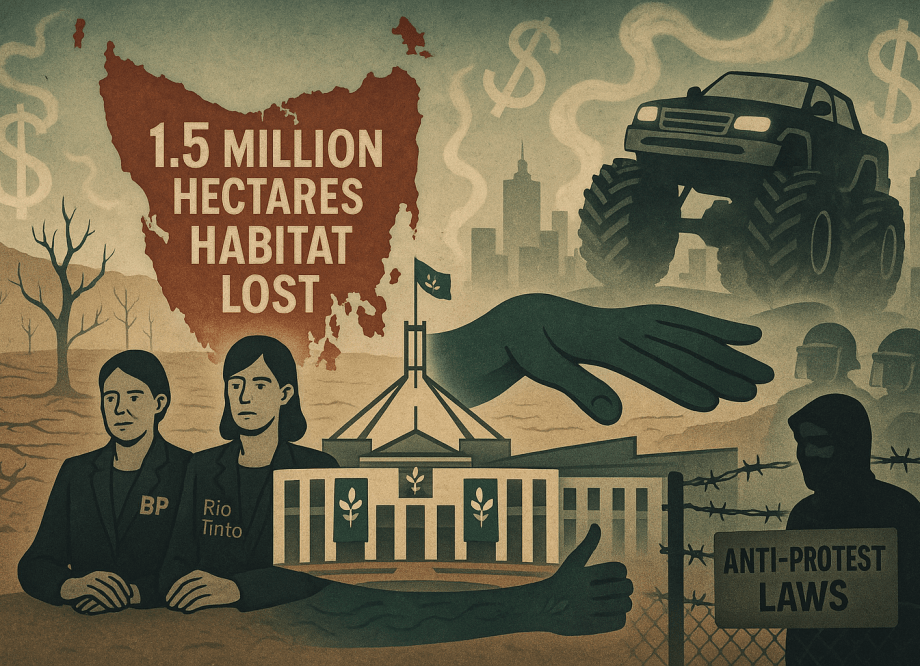
The reworking of the EPBC Act returns for yet another encore, after four reviews, three re-announcements, and five missed reform deadlines. Ken Henry calls it, “intergenerational bastardry”. Graeme Samuel’s 2020 review describes the Act as “a framework designed by industry for industry”². Five years later, the law has yet to sprout a single tooth. Business loves it. During that ‘consultation’ period, over 250 species have joined the threatened list, and 1.5 million hectares of Australian habitat, an area half the size of Tasmania, have quietly disappeared³.
Watt’s $7 billion business-saving headline comes with the promise to shrink assessment times from 70 to 50 days. Because nothing screams caution like greater speed. Quicker decisions mean less scrutiny; fitting with the 7.7 million hectares already lost since 2000, 93 per cent of it bulldozed without a federal environmental check⁴. No climate trigger either: ten failed bills, a cold shoulder to the UN, an ignored ICJ, while Australia’s mammal extinction rate leads the OECD pack, threefold above average. Only 19 per cent of our land is properly protected; trailing the OECD’s 28 per cent⁵.
Good Old Aussie Carbon Boondoggles
Successive governments have ploughed billions into soil carbon and tree-planting schemes since 2010, mostly yielding glossy brochures and a forest of consultancy invoices. The Clean Energy Regulator says nearly a third of carbon credits are for reductions that never occurred⁶; 78 per cent were issued to already-profitable projects (many run by mining companies above), as big polluters offset new gas fields while armies of monster chain saws hum. Our offset purchases top the OECD, though actual biodiversity spending is less than half the average⁷. Richard Denniss rightly notes, “Australia excels at spending public money for private reassurance”; a carbon market ministry of make-believe⁸.
Lobbyists in the Canopy
If the climate trigger is invisible, vested influence couldn’t be more obvious. According to the AEC Transparency Register, fossil fuel, mining, and energy companies gave $13 million to major parties in 2023-24; including direct and indirect contributions disclosed from BHP, Rio Tinto, Woodside, and their industry associations⁹. Donations surge with every major environmental announcement and reform milestone.
Lobbying, meanwhile, ramps up in lock-step: over 100 fossil fuel contracts were active with federal agencies last year, with 1,500 meetings for ministers and officials¹⁰. InfluenceMap’s 2025 Election Briefing and Senate inquiries trace twelve coal and gas project approvals directly to concentrated bursts in lobbying and donations. Corporate memos from the Minerals Council, BHP, and Rio Tinto are mirrored, almost verbatim, in the final Future Gas Strategy and climate offset rules¹¹.
Australia Institute reports and Senate inquiries call it what it is: “policy capture”¹². Resource sector money now dictates both the timing and the shape of change, funnelling funds via fronts like Cormack Foundation and John Curtin House, obscuring the full flow in ‘associated entities’ and event patronage.
The False Dichotomy: Big Tobacco’s Gift to Big Mining
Australia’s environmental paralysis is no accident. The narrative, that we must choose between prosperity or green reform, is psychological jiu-jitsu, copied straight from Big Tobacco and perfected by fossil fuel, mining, and gambling interests¹³. This “either jobs or the environment” wedge is not economics; it’s myth, manufactured to keep regulatory hands off the cash register. Big Tobacco pioneered the method: framing health policy as an assault on livelihoods, sowing doubts, funding contrarian science, and using front groups to amplify division¹⁴. The world has never recovered.
Big Mining and Gas, with help from PR firms and local consultants, run the same campaign: “jobs at risk,” industry-funded experts, manufactured balance, and “Aussie lifestyle” defenses¹⁵. Even gambling corporations now deploy these tactics with “grassroots” sport campaigns opposing regulatory reform¹⁶.
Policy after policy is kneecapped by this manufactured drama, while governments; especially Coalition, tiptoe around “economic Armageddon” lines scripted by donor lobbyists. Clean energy, healthy cities, and strict biodiversity laws are dismissed as “elitist” or “anti-jobs.” Only CEOs, lobbyists, and consultants win; the environment and ordinary Australians wait in forlorn hope for a backbone to reappear.
Monster Truck Madness
The obsession with monster four-wheel drives and super-sized utes in Australia isn’t just a North American contagion: it’s entrenched, growing, and deeply damaging. Vehicle sales data show that, since 2010, SUVs and “light commercial vehicles” have grown from 36% to near 60% of total sales¹⁷, with the Ford Ranger, Toyota Hilux, and RAM 1500 topping sales year after year¹⁸. Australian cities now mirror US suburbs, with ever-larger vehicles squeezing out small cars, crowding streets and parking spaces, and, crucially, ramping up aggregate fuel use and emissions.
Successive governments have utterly failed to rein in the auto sector or its advertising excesses. Australia remains one of the few OECD countries without mandatory fuel efficiency standards for new vehicles, and lobbying by the Federal Chamber of Automotive Industries, car importers and mining supply chains help block reform yearly¹⁹. New vehicles sold here emit nearly double the CO₂ per kilometre compared to EU or Japanese models²⁰.
The result? Higher emissions, pedestrian deaths, more roadkill, worsening urban air quality; and a culture war where “Aussie lifestyles” trump public health, shoring up the same false prosperity-versus-green dichotomy as the fossil lobby.
Choking Protest: The Assault on Dissent
While politicians fiddle with reform promises, governments are ramping up laws aimed squarely at silencing public dissent. Victoria and New South Wales in 2025 have passed sweeping anti-protest laws banning face coverings at demonstrations, outlawing “dangerous attachment devices” used in civil disobedience, and criminalising protests “in or near” places of worship, subjecting peaceful assemblies to hefty fines and even prison sentences²¹. These laws provide police broad powers to disperse crowds and confiscate equipment, chilling decades of Australia’s proud activist traditions and deterring protests over mining, environment, social justice, and indigenous rights²².
Recent rulings by the NSW Supreme Court declared such laws unconstitutional for burdening political communication, yet governments persist, redrafting and enforcing versions that suppress demonstrators—particularly those opposing government-backed conflicts or large resource projects²³. The anti-protest offensive is a vital vector in the broader strategy where corporate-backed governments throttle the voices challenging extractive industries and climate inaction²⁴.
Victoria’s premier Jacinta Allan and police describe these laws as public safety measures, blaming a “small minority” seeking to incite violence²⁵. Yet human rights advocates warn they inequitably target marginalised groups and lawful dissent, replacing democracy with police powers. The expansion of “safe access” zones around religious buildings further restricts protest space²⁶, stoking fears civil liberties will yield to political convenience.
This crackdown dovetails with policy capture and environmental rollback, a potent cocktail ensuring governments defend extractive interests on the floor of parliament and on the streets.
Don’t Rock the Boathouse
Two thousand plus species threatened, half endangered or critically endangered. Three invertebrates lost every two weeks. Only $12 million a year for extinction prevention; just 0.08 per cent of the $15.6 billion needed, making Australia the OECD’s lowest spender²¹. While New Zealand and Canada approve projects (with climate triggers) inside six months, our process averages eighteen²².
As for environmental protection—the “Greg Hunt group hug” moment (“Our work is done”) remains the truest piece of parliamentary theatre. If the comedians, economists, and activists can see the farce, it’s time we demanded what’s missing: a real, non-spineless Parliamentary Backbone. For now, look under “Parliamentary Backbone (Non-spineless variety)”. Last sighted 2007. Presumed extinct.
Yet, beyond the rhetoric of careful balance and slow reform lies a deeper reckoning. Australia stands at a crossroads; where the fossilised squirrel grip of corporate power and political expedience threatens to smother any real chance of environmental salvation. The erosion of habitat and democracy is accelerating, not abating, carried forward by vested interests who profit from paralysis. If Labor’s eco- renaissance is to transcend lip service, it must summon the political courage to break these cycles: to deny the false dichotomy pitched by Big Tobacco’s heirs; to champion not just market-friendly offsets but genuine ecological restoration; to protect the right to protest as fiercely as it protects corporate profits. Without this, we risk consigning future generations to a landscape and society hollowed out by opportunism, quieted dissent, and the abdication of responsibility. The time for soft revolutions is over; only bold, unapologetic stewardship can do justice to the land and people of this continent.
Citations and Footnote URLs
Footnotes
¹ Mining CEOs: https://miningdigital.com/top10/top-10-mining-leaders-in-australia
² Samuel review: https://www.dcceew.gov.au/environment/epbc/review
³ SLATS habitat loss https://www.acf.org.au/news/deforestation-in-australia-why-its-happening-and-how-to-stop-it
⁴ Fossil Fuel Subsidies: https://australiainstitute.org.au/report/fossil-fuel-subsidies-in-australia-2024/
⁵ OECD biodiversity: https://www.oecd-ilibrary.org/environment
⁶ ERF Project Register: https://www.cleanenergyregulator.gov.au/ERF/Data-and-reporting/project-register
⁷ InfluenceMap: https://influencemap.org/briefing/2025-Australia-Election-Briefing-32075
⁸ Greenwashing criticism: https://australiainstitute.org.au/report/greenwashing-growth-industry/
⁹ AEC Register: https://transparency.aec.gov.au
¹⁰ Lobbyist Register/InfluenceMap: https://lobbyists.pmc.gov.au/; https://influencemap.org/briefing/2025-Australia-Election-Briefing-32075
¹¹ Senate Inquiry: https://www.aph.gov.au/Parliamentary_Business/Committees/Senate/Environment_and_Communications/SafeguardMechanism/Report
¹² Policy capture: https://australiainstitute.org.au/report/policy-capture-mining-money-political-process/
¹³ Big Tobacco’s playbook: https://blog.ucs.org/anita-desikan/how-tobacco-companies-created-the-disinformation-playbook/; https://pmc.ncbi.nlm.nih.gov/articles/PMC11533144/
¹⁴ Tobacco tactics: https://www.tobaccoinaustralia.org.au/chapter-10-tobacco-industry/indepth-10a-strategies-for-influence/10a-7-the-mechanisms-of-influence-political-lobbyi
¹⁵ Climate sceptics playbook: https://theconversation.com/climate-sceptics-steal-the-big-tobacco-playbook-create-doubt-cause-delay-1854; Big Oil PR: https://www.ciel.org/news/oil-tobacco-denial-playbook/
¹⁶ Gambling lobby copy: https://theconversation.com/how-gambling-companies-are-copying-the-big-tobacco-playbook-in-australian-sport-266998
¹⁷ Car sales https://www.fcai.com.au/sales
¹⁸ Best-selling vehicles: https://www.carsales.com.au/editorial/details/australias-top-selling-cars-2025-139429/
¹⁹ Car emissions reform: https://www.theguardian.com/australia-news/2024/mar/04/australias-car-emissions-explainer
²⁰ ICCT emissions: https://theicct.org/publication/australia-new-vehicle-emissions-policies/
²¹ Human Rights Law Centre, Victoria anti-protest laws: https://www.hrlc.org.au/explainers/human-rights-briefing-vic-anti-protest-laws/
²² WSWS, Australian court anti-protest laws: https://www.wsws.org/en/articles/2025/10/18/wlvq-o18.html
²³ Reddit Australia, NSW Supreme Court protest law: https://www.reddit.com/r/australia/comments/1o7rd07/nsw_supreme_court_finds_protest_law_amendments/
²⁴ Australian Democracy Network, protest threat: https://australiandemocracy.org.au/australian-democracy-network/posts/media-release-right-to-protest-severely-under-threat-in-nsw
²⁵ ABC News, police and protests: https://www.abc.net.au/religion/melbourne-right-protest-police-need-common-sense-safety-measures/105924270
²⁶ Australian Democracy Network, protest space: https://australiandemocracy.org.au/vic-protest-laws-0125
²⁷ Federal budget extinction prevention: https://www.dcceew.gov.au/budget
²⁸ Canadian and NZ approval stats: https://www.canada.ca/en/environmental-assessment-agency/services/impact-assessment-process/statistics.html***
Sources
[1] Labor is close to a deal on environmental law reforms. … https://theconversation.com/labor-is-close-to-a-deal-on-environmental-law-reforms-there-are-troubling-signs-these-will-fall-short-267102
[2] Australian Government Climate Change commitments, … https://www.aofm.gov.au/media/1076
[3] Australian climate policy via ideas, interests, and institutions https://www.tandfonline.com/doi/full/10.1080/10361146.2025.2566678
[4] Reform of Australia’s national environmental law https://www.aph.gov.au/About_Parliament/Parliamentary_departments/Parliamentary_Library/Research/Briefing_Book/47th_Parliament/ReformAustraliasEnvironmentalLaw
[5] Reimagining climate change research and policy from the … https://www.sciencedirect.com/science/article/abs/pii/S1462901123000229
[6] Environmental law reform needed to manage trade of … https://www.nature.com/articles/s44183-024-00085-3
[7] Lessons for Australia’s Climate Change Policy Impasse https://socialsciences.org.au/wp-content/uploads/2021/12/Principles-of-Effective-Policy-Reform-Final.pdf
[8] Australian policies on water management and climate change https://pmc.ncbi.nlm.nih.gov/articles/PMC6918614/
[9] Nature law reform: key asks https://envirojustice.org.au/nature-law-reform-key-asks/
 Urban Wronski Writes
One thought on “Australia’s Environmental Policy Crisis: A Closer Look”
Comments are closed.