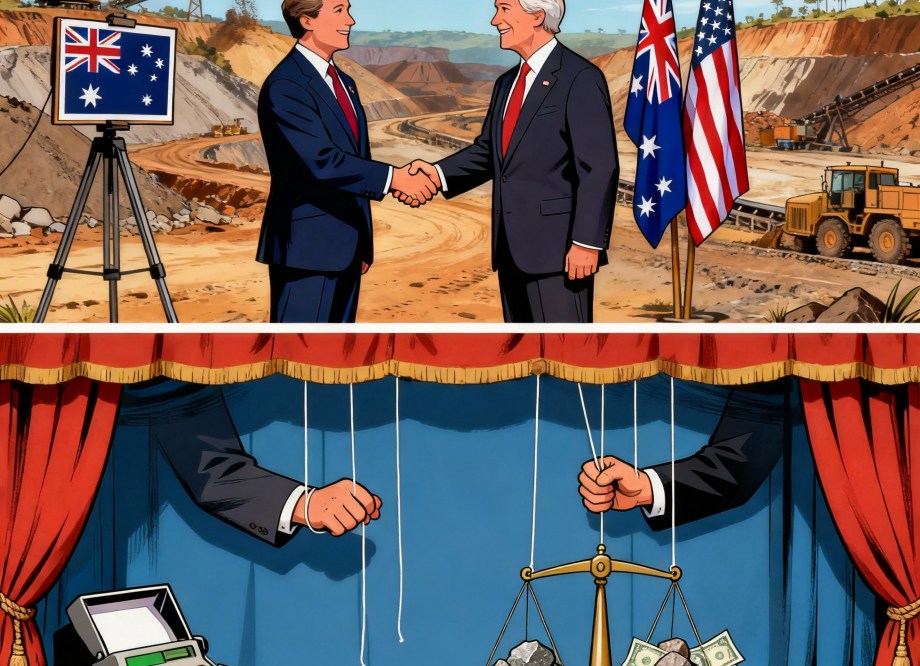
Australia’s Critical Minerals Deal: Access Without Control
By David Tyler (Urban Wronski)
October 21, 2025
Reading Options:
📄 Short version below (600 words, 3-minute read)
📖 Deeper full-cut analysis directly below Quick Take. (4,400 words, 18-minute read)
- Quick Take~600 words
Anthony Albanese flew to Washington to “secure” supply chains and “de-risk” Australia from Beijing. He landed back in Canberra having signed away control of both.
The optics were perfect; if you enjoy watching Australian prime ministers audition for grateful supplicant. There sat Albanese across the Cabinet Room table when Sky’s Andrew Clennell asks about Ambassador Kevin Rudd’s past criticisms of Trump. The president, moments after calling Albanese “a great friend”, turns to Rudd sitting directly opposite: “I don’t like you either, and I probably never will.” The Australian delegation laughs. Nervously. All very matey. Who sets the terms? Murdoch+Team Trump. Subtlety of a sledgehammer. Picture an anti-tank missile destroying a flimsy Venezuelan fishing boat in a few seconds.
Then they signed the documents.
The headlines glowed: $8.5 billion project pipeline, $3 billion in joint investment, price floors to counter China, Pentagon-backed gallium refinery. Malcolm Fraser once observed that Australia was “a willing partner in our own subordination.” He’d recognise this deal instantly.
Drill into the fine print and you find Letters of Interest; not cheques, not commitments, worth $2.2 billion. Not worth the cream wove they are printed on. You find a price floor mechanism wrapped in diplomatic puff that “will work to protect” markets through “standards-based systems” with “price floors or similar measures.” That’s aspiration dressed as policy, with all the binding force of a New Year’s resolution.
Context matters. China spent 2025 systematically weaponising critical minerals; export controls on gallium, germanium, graphite, antimony, and by October, twelve of seventeen rare earth elements. Chinese companies control 90 percent of global rare earths processing. Beijing’s October controls extend to foreign firms exporting products containing even 0.1 percent Chinese-origin materials.
Building non-China capacity is rational. But if we underwrite the ore while someone else underwrites policy and price, guess who captures the leverage? Hint: not the country with the holes in the ground.
The gallium refinery, the marquee project, could be operated through a joint venture between US and Australian governments, Japan, and Alcoa. Pending feasibility studies. (LOL) Proposed capacity: 100 metric tons annually, nearly five times US consumption. Australia supplies the bauxite and the site. America controls the distribution. What could possibly go wrong?
The AUKUS rust-buckets got ritual reaffirmation: “full support,” talk of clarifying ambiguity, Trump saying they’re “going full steam ahead.” Except they’re not. US shipyards produce 1.2 submarines yearly when they need 2.33 to meet their own requirements and deliver to Australia by 2032. The UK’s BAE Systems has a documented history of massive delays. Loves a bit of pie in the (briny) sky, though. UK plans to build reactor cores have been called “unachievable” by Britain’s major projects agency.
So. Australia just punted $2 billion to US shipyards with zero guarantee those boats will ever arrive. Whatever floats your boat. Strategic symbolism is cheap. Submarines cost $368 billion over thirty years.
If we wanted real sovereignty, we’d have written different terms. Domestic processing mandates; not aspirations. Australia captures 11 percent of the value chain for our critical minerals. Processing could increase this to 30-40 percent, adding $4.3 billion annually to GDP and creating 6.5 jobs per million dollars versus 3.2 in extraction. Golden-share vetoes ensuring we control offtake (a right to purchase products at an agreed price) destinations. Public royalty floors indexed to benchmarks so mates’ rates can’t bury value.
None of that exists in Monday’s framework. Instead, we got access to the Cabinet Room and a minerals communiqué. They got priority offtake, price-setting power, and $2 billion toward their submarine bottleneck.
If that’s your idea of sovereignty, the Kool-Aid’s on the bar. If not, if you think Australian resources should build Australian capacity, start writing those conditions into law before the next framework gets signed.
The till’s been handed over. We’re paying already. But will we notice before the account’s empty?
2. Deeper, full-cut analysis.
Handing Over the Till, Paying the Tab
Inside the Australia-US Critical Minerals Framework: How We Bought a Seat at Our Own Table
By David Tyler (Urban Wronski)
October 21, 2025 | Full Analysis
~4,400 words
Anthony Albanese flew to Washington to “secure” supply chains and “de-risk” Australia from Beijing. He landed back in Canberra having signed away control of both.
The optics were perfect; if you enjoy watching Australian prime ministers audition for the role of grateful supplicant. There sat Albanese across the Cabinet Room table from Trump, flanked by the entire Australian delegation. When Sky hack, Andrew Clennell kicks off for Team Murdoch and gotcha journalism, by asking about Ambassador Kevin Rudd’s past criticisms of the president. Murdoch’s creation, Donald Trump, who’d just finished telling Albanese “it’s a great honour to have you as my friend”, turns to Rudd sitting directly opposite and delivers the diplomatic equivalent of a pub king-hit:
“I don’t like you either, and I probably never will.”
The Australian delegation laughs. Nervously. Rudd apologises. Trump waves it away. All very matey. All very controlled. Not a shadow of a doubt about who sets the terms in this relationship.
Then they sign the documents.
The headlines glowed the way headlines do when governments need them to: an $8.5 billion project pipeline, $3 billion in joint investment over six months, price floors to counter Chinese market manipulation, and a Pentagon-backed gallium refinery in Western Australia with capacity to produce 100 metric tons annually; nearly five times current US consumption. Malcolm Fraser, who knew a thing or two about American alliances, once observed that Australia was
“a willing partner in our own subordination.” Mal would recognise this deal in a heartbeat.
Drill into the fine print, always drill into the bedrock, and you find bum-fluff. Letters of Interest from the US Export-Import Bank totalling $2.2 billion. Not cheques. Not commitments. Letters of Interest, which in the world of international finance rank somewhere between a handshake and a wink. You find a price floor mechanism to counter Chinese undercutting that’s wrapped in so much diplomatic hedging it could line a cricket ground. And you find an offtake-first architecture that keeps Australia in its customary role: dig, ship, smile. America polishes the value chain and writes the rules. We get to feel strategic.
The Mechanics of Dependency
Set aside the flag-waving; it only obscures what’s actually on the table. The framework commits both countries to “work to protect their respective domestic critical minerals and rare earths markets from non-market policies and unfair trade practices, including through the adoption of standards-based systems in which those who adopt the standards can trade freely and within a pricing framework including price floors or similar measures.”
Read that twice. Then read it again. “Will work to protect” is not protection. “Including price floors or similar measures” is not a price floor. This is the language of aspiration. Wishful thinking? More like strategic evasion. It’s dressed up as policy but has all the binding force of a New Year’s resolution.
Price floors might stabilise investment. But only if they survive beyond a news cycle. Only if they don’t get shredded the moment lawyers, lobbyists, or a new administration decide the politics have changed. Policy analysts, the ones not on anyone’s payroll, are blunt: Washington wants floors “across various industries” to meet a national security brief. Translation: we’ll set the dials; allies, please align. Richard Denniss would call this the “neoliberal two-step”; wrap corporate control in the language of mutual benefit, then act surprised when the benefits only flow one way.
Context matters here, and the context is brutal. China has spent 2025 systematically weaponising its control over critical minerals. Gallium and germanium restrictions began in July 2023. Graphite controls in October 2023. Antimony in August 2024. By October 2025, two weeks before this deal was signed, Beijing imposed licensing requirements on twelve of seventeen rare earth elements, plus the equipment and know-how for processing them. Chinese companies control more than 90 percent of global rare earths processing capacity. Beijing’s October controls extend to foreign firms exporting products containing even 0.1 percent Chinese-origin rare earths.
So yes, building non-China capacity is rational. Necessary, even. But rational isn’t the same as sovereign. Not remotely. If we underwrite the ore while someone else underwrites the policy and the price, guess who captures the leverage? Hint: it’s not the country with the holes in the ground.
Theatre of Power
The Kevin Rudd drive-by sniping wasn’t an accident. Trump knew exactly what he was doing when he asked, “Where is he? Is he still working for you?” while Rudd sat three feet away, like some pantomime villain. “He’s over there! No. Over there. This was ham acting; a public reminder of the power imbalance staged for both delegations to absorb. When Rudd tried to smooth things over; “It was prior to this position, Mr. President”; Trump didn’t budge. “I don’t like you either, and I probably never will.”
Foreign Minister Penny Wong calls Australia’s ritual humiliation “tongue in cheek.” Current Opposition Leader Sussan Ley calls Rudd “the elephant in the room.” Both miss the point. This wasn’t Rudd’s past tweets. It was about demonstrating; in front of cameras, in front of officials, in front of the entire Australian media contingent; that when you’re the supplicant supplier, you budget for insults. You laugh at the jokes. You apologise when told to apologise. And you call it a successful meeting because the alternative is admitting you flew halfway around the world to be publicly diminished.
“In deals between unequal partners, the weaker party always mistakes access for influence.” — Robert Reich
We’ve just paid $3 billion for the privilege of being in the room while someone else eats our lunch.
What We Actually Signed
The US secured what it came for: control levers. Seven Letters of Interest worth $2.2 billion in potential financing. Priority access to Australia’s gallium production; a metal suddenly critical for semiconductors, radar systems, and advanced weapons platforms. The Alcoa project, the centrepiece of the deal, involves a joint venture between US and Australian governments, Japan, and Alcoa itself. Once feasibility work is complete. If feasibility work is complete. The verb tense matters: “will invest” is not the same as “has invested.” “Intends to support” is not the same as “supports.”
Australia funds the extraction and fast-tracks the approvals. America arbitrates the price, controls the financing, and locks in the offtake. (Let’s just call it price-fixing.) That’s not treachery. Nor duplicity. That’s not even particularly unusual. It’s just statecraft; theirs, not ours. The Venezuelan option.
The AUKUS nuclear submarine deal got its ritual reaffirmation: “full support,” warm words about working to “improve the original framework” and “clarify some of the ambiguity.” Stop sniggering.
Trump dismisses concerns as “just minor details” and says they are “going full steam ahead, building.” Except they’re not building. US shipyards are stuck producing Virginia-class submarines at 1.2 boats per year when they need 2.33 to meet their own requirements and deliver to Australia by 2032. The UK’s BAE Systems; which will build the SSN-AUKUS boats; has a documented history of massive delays and cost overruns. Its Hunter-class frigates are a decade behind schedule. Its Astute-class submarines have been plagued by problems. UK plans to build reactor cores for SSN-AUKUS have been called “unachievable” by Britain’s major projects agency. What could possibly go wrong?
The US submarine sector needs to add 100,000 to 130,000 new skilled workers over the next decade just to build existing programs. That figure doesn’t include AUKUS. Mug punter, Australia has committed $2 billion to US shipyards with zero guarantee those boats will ever arrive. Strategic symbolism is cheap. Submarines cost about $4 billion each.
The Sovereignty We’re Not Building
If we truly wanted sovereignty; genuine strategic independence, not the theatrical kind, we’d have written different terms.
First: Domestic processing mandates. Not aspirations. Not targets. Mandates. Australia currently captures about 11 percent of the potential value chain for its critical minerals. Everything else; the refining, the processing, the manufacturing, happens offshore. Domestic processing could increase this to 30-40 percent, adding approximately $4.3 billion annually to GDP. More significantly, downstream processing creates 6.5 jobs per million dollars of output compared to 3.2 jobs in extraction. That’s not abstract economics. That’s the difference between mining towns and manufacturing centres, between royalty cheques and industrial capacity.
The government talks up onshore refining. Resources Minister Madeleine King acknowledged in September 2025 that “In Australia we’ve been mining them, but we haven’t moved along that processing path.” True enough. But acknowledgment without enforcement is just sophisticated evasion. The US-Australia framework says the countries “intend to capitalise on their respective existing domestic mining and processing operations.” Intend. Not require. Not mandate. Intend.
Second: Equity structures with golden-share vetoes. If Australian taxpayers are underwriting these projects—and we are—then Australian governments should retain controlling stakes with explicit veto rights over offtake destinations. Call it a national security interest. Call it strategic autonomy. Call it whatever the focus groups prefer. But build it into the corporate architecture so it can’t be stripped out when commodity prices spike and someone decides the Chinese market looks attractive again.
Third: Public royalty floors indexed to international benchmarks. Transparent. Published. Inflation-adjusted. So mates’ rates can’t bury billions in the footnotes while mining executives testify to Senate committees about the challenging operating environment. Australia has a proud history of giving away our resources for pathetically low royalties while foreign corporations book the profits through Singapore. We’re so good at it we’ve made it a structural feature of the economy.
None of these conditions appear in Monday’s framework. None of them were even discussed in the public briefings. Instead, we got what we always get: access to America’s table and a promise that the maître d’ will sometimes seat us near the kitchen. As Rudd himself wrote; back when he was a private citizen free to speak plainly; Murdoch’s media empire keeps Australia “restricted in terms of its economic structure to a few big farms and a lot of holes in the ground.” The American framework doesn’t challenge that structure. It entrenches it.
The Opposition That Isn’t
The irony, of course, is that Opposition Leader Sussan Ley; representing a Coalition that got washed out in the last election, called this meeting “vital to Australian interests” and spent her media appearances fretting about Kevin Rudd’s job security rather than interrogating the deal’s substance. The real opposition in Australia, as Rudd correctly identified, isn’t sitting in Parliament House. It’s sitting in the Murdoch editorial suites, working overtime to ensure Australian governments keep digging holes, shipping ore, and calling it economic strategy.
The heavy artillery of commercial media has already declared this deal a triumph. They would. It changes nothing about the corporate power structures they exist to protect. A few big farms and a lot of holes in the ground, skewed to rewarding foreign corporations and paying almost nothing back; that’s not a bug in Australia’s economic system, it’s a feature. And Monday’s deal just uploaded the latest patch.
The Price Floor Fiction
Australia announced a floor price scheme for critical minerals in August 2025, generating significant industry attention. But Minister King admitted “it may be some time” before final details are established. Some time. That’s bureaucrat-speak for “don’t hold your breath.” Price floors are good for project finance if they’re statutory, multi-year, and backed by appropriations. Otherwise they’re just vibes.
The US-Australia framework mentions price floors six times. Not once does it specify mechanisms, funding sources, duration, or enforcement. The commitment is to “work with international partners to develop a future global framework to deal with associated international pricing challenges.” Future. Framework. Work with. This is the language of permanent deferral dressed up as policy coordination.
Meanwhile, China’s export controls on gallium, germanium, antimony, and graphite led to price spikes of 20-60 percent within six months of implementation. Beijing doesn’t work toward future frameworks. It acts, and the market adjusts. That’s what control looks like.
Letters of Interest
The seven Export-Import Bank Letters of Interest totaling $2.2 billion could unlock up to $5 billion in total investment, according to the White House fact sheet. Could. Might. Potentially. These are not commitments. They’re not even pre-commitments. They’re expressions of possible future interest contingent on feasibility studies, environmental approvals, market conditions, and the political priorities of an administration that might not exist in eighteen months.
Anyone who’s worked in project finance knows what Letters of Interest are worth: exactly nothing until they convert to term sheets, and term sheets are worth exactly nothing until they convert to signed agreements with money in escrow. Build your domestic instruments to match or get stranded mid-capex. But Australia doesn’t have domestic instruments to match. We’ve spent forty years dismantling industrial policy capacity while calling it “efficient allocation of capital.” Now we’re financing American strategic priorities with Australian taxpayer guarantees and hoping the Letters of Interest mature into actual cheques.
Oscar Wilde derided those who know the price of everything and the value of nothing. We’ve inverted it: we know the value of critical minerals and we’re giving them away for promotional consideration.
What Sovereignty Actually Costs
China’s October 2025 rare earths controls extend beyond physical exports to regulate knowledge transfer, processing equipment, and foreign-made products using Chinese inputs. Beijing now requires overseas firms to obtain export licenses from the Chinese Ministry of Commerce before re-exporting products containing even trace amounts of Chinese-origin materials. That’s jurisdiction following molecules across borders. That’s control as legal architecture, not just market power.
Australia’s response? A framework document that “intends to” protect markets through “standards-based systems” with “price floors or similar measures.” We’re bringing regulatory aspirations to a supply chain war. China rewrites the rules of global mineral trade and we counter with a joint communiqué about future cooperation.
By October 2025, China’s export controls covered not just rare earths but gallium, germanium, antimony, tungsten, indium, bismuth, tellurium, molybdenum, high-purity silicon, advanced battery technologies, and the equipment required to process all of them. Beijing built a comprehensive architecture of control, legal, technical, commercial, then deployed it systematically as geopolitical leverage. That’s what strategic sovereignty looks like from the other side.
We announce Letters of Interest and call it de-risking.
The Gallium Gambit
The gallium refinery, the deal’s marquee project, would be operated by Alcoa through a special purpose vehicle jointly owned by US and Australian governments plus Alcoa itself, pending feasibility studies. Pending. That word’s doing a lot of work. The proposed capacity is 100 metric tons per year, which sounds impressive until you realise the US consumed 21 tons in 2024 and currently imports 100 percent of its gallium. So the plant, if built, would produce nearly five times US consumption, leaving 79 tons annually for… what, exactly? Export? Stockpiling? Re-export through US-controlled supply chains?
The framework doesn’t say. But the offtake structure makes it clear: Australia supplies the bauxite and the refinery site, America controls the distribution. As a CSIS analyst noted, “the challenge in diversifying gallium supply lies in its scarcity; it occurs at less than 0.003 percent in bauxite.” Building domestic processing capacity makes strategic sense. Handing control of that capacity to another country’s defence department makes someone else’s strategic sense. We do get a lot of waste to ourselves.
Gallium is critical for semiconductors, advanced radar, and weapons systems. A US Geological Survey report estimated that a total Chinese gallium export ban could cost the US economy $3.4 billion in GDP. That’s why the Pentagon’s investing in an Australian refinery. Not to build Australian industrial capacity. To secure American supply chains. We’re the site, not the sovereign.
The Submarines That Aren’t
The Virginia-class promise, three boats by 2032, possibly five, runs into an inconvenient collision with industrial reality. US shipyards are producing 1.2-1.3 submarines per year. They’ve been stuck at that rate for years. Supply chain disruptions, workforce shortages, and the sheer complexity of nuclear propulsion mean there’s no spare capacity. None. The US Navy is already two boats short of its target force.
General Dynamics Electric Boat is borrowing personnel from the Virginia-class program to keep the Columbia-class ballistic missile submarine program on track. The Government Accountability Office warned the Navy lacks essential schedule insight and hasn’t conducted statistical schedule risk analysis. Translation: they don’t know when, or if, they can deliver existing commitments, let alone new ones.
Australia has committed $2 billion to US shipyards to help expand capacity. That’s $2 billion in Australian taxpayer money to subsidise American submarine production with zero guarantee those boats will ever sail under the Australian flag. The UK situation is no better. BAE Systems’ track record includes massive delays on the Hunter-class frigates and chronic problems with the Astute-class submarines. UK plans to build one SSN-AUKUS boat every 18 months have been called “unachievable” by defence analysts and “optimistic” by officials who actually work on submarine construction.
Some analysts suggest Australia won’t see an AUKUS submarine before 2050. By which time our grandchildren will be making the maintenance payments.
But Albanese, Trump’s chump, got his photo op with Trump, who said they were “going full steam ahead.” Strategic symbolism, as noted, is cheap. The submarines cost about $368 billion over thirty years. We’re paying in advance for boats that might not exist, are obsolete already, subsidising shipyards that can’t meet current orders, and calling it a security partnership.
The Client State Aesthetic
There’s a particular aesthetic to these deals; a choreography of subordination dressed up as partnership. The smaller country’s leader flies to the larger country’s capital. Wait times are publicised: ten months since Trump took office, four phone calls, one brief UN reception, finally the meeting. The smaller country emphasises its value: critical minerals, strategic location, reliable ally. The larger country emphasises its benevolence: market access, security guarantees, technology sharing.
Documents are signed. Handshakes are exchanged. Press releases use identical language about “shared values” and “mutual benefit.” Everyone pretends the power differential doesn’t exist, even as every element of the staging; the location, the timing, the public insult to the ambassador; reinforces exactly that differential.
Trump tells Albanese “it’s a great honour to have you as my friend” moments before telling Australia’s ambassador “I don’t like you either, and I probably never will.” That’s not contradiction. That’s clarity. The PM is useful. The ambassador? Dispensable. The relationship continues because Australia has resources America wants and strategic geography China wants to contest. Friendship doesn’t enter into it.
Zelenskyy got publicly humiliated; meetings cut short, requests denied, aid withheld, because Ukraine had already exhausted its leverage. Australia got the polite version because we still have leverage to trade away. We’re doing it incrementally, deal by deal, framework by framework, Letter of Interest by Letter of Interest. The destination’s the same. The journey just involves better catering.
What Gets Lost
Australia holds vast reserves of lithium, rare earths, cobalt, tungsten, and other critical minerals. The government’s Critical Minerals Strategy aims to move from extraction to refining, processing, and manufacturing—backed by a $4 billion Critical Minerals Facility and a ten percent production tax credit for onshore refining. That’s the policy architecture. Implementation’s another question.
Minister King acknowledged Australia is “a couple of decades behind” in processing capability. Two decades. That’s not a gap; that’s a canyon. You don’t close a twenty-year capability gap with tax credits and Letters of Interest. You close it with industrial strategy: directed investment, protected markets, patient capital, trained workforces, and the willingness to tell foreign corporations they can’t just dig it up and ship it out.
But we don’t do industrial strategy in Australia. We do frameworks and incentives and coordination mechanisms. We do public-private partnerships where the public pays and the private profits. We do consultation processes that take three years to reach conclusions everyone knew at the start. And then we wonder why we capture 11 percent of the value chain while other countries capture 89 percent.
The US-Australia deal doesn’t challenge this structure. It ratifies it. America needs secure supplies of critical minerals outside Chinese control. Australia has the minerals. So we’ll dig them up, ship them out, and call it strategic partnership because the alternative; building our own processing capacity, controlling our own supply chains, capturing the value ourselves; would require industrial policy. And industrial policy, we’ve been told for forty years, is what unsuccessful countries do.
Successful countries let markets decide. Even when the market is Beijing flooding supply to kill competitors. Even when the market is Washington writing frameworks that lock in subordinate positions. Even when the market is a few big farms and a lot of holes in the ground while processing jobs go elsewhere and the national accounts show mining profits booked through Singapore.
Practicalities & Near-Term Risks
- Price floors: Australia announced a floor price scheme in August 2025, but Minister King admitted “it may be some time” before final details emerge. Good for project finance if they’re statutory and multi-year. Otherwise they’re aspirational window-dressing. If floors are US-administered, we’re price takers in our own sector.
- EXIM/DFC financing: Seven Letters of Interest totaling $2.2 billion could unlock $5 billion in investment. Could. Letters of Interest are signals, not commitments. Great for headlines, zero certainty. Build domestic instruments to match or get stranded mid-capex.
- Permitting deregulation: Faster approvals work until the first tailings spill. You’ll wear the local politics; Washington keeps the offtake.
- Predatory pricing: If Beijing floods markets to kill non-China rivals (as with nickel), you need border measures or watch projects bleed out. The framework mentions working with partners on a “future global framework” but provides no immediate enforcement.
- AUKUS linkages: No new hull timelines despite assurances. US shipyards need 100,000-130,000 additional workers over the next decade for existing programs; not including AUKUS. Australia committed $2 billion to US yards with no delivery guarantee. Still a promissory note.
- Gallium project: Strategically smart, but feasibility, offtake terms, and purity specs will determine whether we capture margin or ship atoms cheaply. The plant would be operated by Alcoa through a special purpose vehicle jointly owned by governments plus Alcoa.
- Geopolitical reality: Critical minerals are sanctions-adjacent. China’s October 2025 controls extend to foreign firms exporting products with even 0.1% Chinese-origin rare earths. Expect licensing, end-use policing, and blowback from whichever superpower you disappoint.
The Tab Arrives
Here’s what sovereignty actually requires:
Capital. Not loans, not Letters of Interest, not tax incentives that depend on projects reaching production. Actual public investment in processing infrastructure, skills development, and technology acquisition. The kind of money that makes accountants nervous and economists write concerned op-eds about crowding out private investment. Except private investment hasn’t materialised in twenty years, so perhaps the crowding-out concern is less urgent than the strategic exposure.
Control. Golden shares, export licenses, domestic supply requirements, and the regulatory backbone to enforce all of them against corporate lawyers who specialise in finding loopholes. If Rio Tinto wants to sell Australian lithium to China after we’ve subsidised the mine development, the answer should be “no, and here’s the legislation explaining why.” Currently the answer is “please consider our voluntary compliance framework.”
Patience. Building industrial capacity takes time. Decades, not quarters. It requires governments that can think beyond electoral cycles and populations that don’t panic when the first three projects run over budget. Every successful industrial power built capacity through protected markets, directed investment, and state coordination. We pretend this history doesn’t exist because acknowledging it would mean admitting the last forty years of policy has been structural sabotage dressed up as efficiency.
Courage. The political kind. The willingness to tell the Americans we’re not signing frameworks that give them price-setting authority over our resources. The willingness to tell the mining companies they don’t get taxpayer subsidies without domestic processing requirements. The willingness to tell the Murdoch press that we’re done with the “few big farms and a lot of holes in the ground” model because it’s produced exactly the strategic vulnerability we’re now trying to fix with Letters of Interest and aspirational price floors.
None of that happened Monday. What happened Monday was theatre—the theatre of alliance management, the theatre of strategic reassurance, the theatre of a client state receiving validation from its patron. We got access to the Cabinet Room and a minerals framework. They got priority offtake, price-setting authority, and $2 billion toward their submarine production bottleneck.
VERDICT
We weren’t humiliated like Kyiv. We were serenaded; into a structure where Australia pays the subsidy and wears the politics while America sets the dials.
If that’s your idea of sovereignty, the Kool-Aid’s on the table. Pour yourself another glass.
If not, if you think Australian resources should build Australian capacity, that taxpayer investment should generate domestic jobs, that strategic minerals require strategic control, then start writing those conditions into law before the next framework gets signed and the tab gets bigger.
The till’s been handed over. We’re paying already. But will we notice before the account’s empty.
About the Author: David Tyler writes as Urban Wronski, bringing informed analysis and sardonic observation to Australian politics, economics, and strategic policy. His work examines the gap between official narratives and structural reality.
Publication Date: October 21, 2025
Reading Times: Short version (~3 minutes) | Full analysis (~18 minutes)
 Urban Wronski Writes
Fuckity fuckity fuck fuck fuck – just an inarticulate chorus for your stiletto work.
LikeLiked by 1 person
A family member reported that Alexander Downer was of exactly the same opinion. The young woman was working for VSA at the time. Quite taken aback when the then Minister For Foreign Affairs, burst into the VSA Office. All five F’s and not one “bugger”. (Which would be an intolerable pun in light of what he did to E Timor’s cabinet.)
LikeLiked by 1 person
When will we realise that AUKUS was the final gasp brain fart of ScoMo as he exited stage right from the political scene. Boris Johnson was equally on-the-nose with the British public, so was happy to be roped in (Sunak was PM by the time the deal was signed). Biden probably thought it was a good idea.
And what did Morrison get? A job after politics. Simple. Better paid than the evangelical after-dinner speaking circuit. He would have thanked his lucky stars (and the Lord Almighty) that Albo was so determined to be a manager as PM, rather than a leader.
LikeLike
Mercurial. You’ve nailed the theatrical absurdity of it all. AUKUS, that trilateral submarine sonata, felt less like strategic foresight and more like ScoMo’s final curtain call—an exit-stage-right flourish wrapped in geopolitical cosplay. A legacy play, not a defence policy. The kind of deal you sign when you’re already halfway out the door, hoping the ink will outlast your relevance.
Boris, ever the showman, was happy to play wingman in the pantomime. Sunak inherited the paperwork, Biden the optics. And Morrison? He got the golden handshake, the post-politics parachute, and perhaps a few quiet hallelujahs for Albo’s managerial restraint. No grand ideological rebuttal, just a nod and a file transfer. The kind of leadership that prefers spreadsheets to speeches.
But here’s the rub: when spectacle replaces scrutiny, and legacy-building trumps legacy-worthiness, we’re left with submarines that won’t surface until the 2040s and a strategic alliance that feels more like a ghost tour of former PMs. The real question isn’t when we’ll realise; it’s whether we’ll remember who signed what, and why, when the bill finally arrives.
LikeLike