On “Swift Action,” Systemic Failure, and Bureaucratic Evasion
The stench hit first.
Not metaphorically; though God knows there’s metaphor aplenty in the administrative bowels of the Australian Federal Police. This was the actual, physical redolence of panic meeting inadequacy; the acrid tang of budget meetings, the sickly-sweet perfume of PowerPoint presentations, the metallic taste of desperation fermenting in air-conditioned conference rooms.
You can see it in their faces. The slackness that settles around the eyes when someone knows a prepared statement is about to become ammunition. The slightly too-firm grip on the microphone. The AFP spokesperson who delivers the “swift action” line has mastered the thousand-yard stare; that distant focus saying: I am not actually here, I am not actually responsible.
It had been mere minutes since the PM’s personal phone number; along with those of Opposition leaders, former PMs, and assorted bigwigs whose privacy was apparently as robust as a house built entirely from browser cookies, got published on a US-based website. An artificial intelligence scraper did the heavy lifting, wielding all the ethical scruples of a Murdoch News of the World phone-tapper.
Faces of the politicians appeared on screens, alongside their phone numbers and professional details. Albanese’s official portrait photo. Sussan Ley’s image, positioned directly beneath his. All of them rendered in pixels and data points. All of them, suddenly, exposed. The visual was jarring precisely because it was so artless; a simple list, a spreadsheet rendered in human form. This is what happens when national leaders, the nation’s revered elite, fall victim to a dastardly, data-scraper.
And what did the AFP say?
“The AFP will take swift action against individuals who breach the law.”
There it was. Swift action. As if the mere utterance of these terms, strung together like prayer beads by a spokesperson with the communicative vigour of a departmental memo, could somehow retroactively inoculate the organisation against decades of documented systemic failure. Two words do a lot of heavy lifting: at impossible odds, they are intended to resurrect the ghost of competence. Or are they?
Here’s the thing about institutional incompetence: it doesn’t announce itself. It whispers through carefully constructed language, through phrases that sound like commitment whilst committing to nothing. The AFP knows this. They’ve had decades to perfect it.
The Track Record
To understand the comedy lurking in that promise, you need to know the facts.
An AFP review from 2023, conducted by retired assistant commissioner Frank Prendergast, found the organisation had been “compromised for years by systemic failures, outdated technology and inadequate security.” Undercover operatives; men and women who’d infiltrated some of the world’s most dangerous crime networks; discovered their covers potentially blown, then were abandoned with what the Australian Federal Police Association calls “no exit strategy.” Just: you’re exposed, now figure it out yourselves. Suckers.
The union’s assessment was particularly elegant: the AFP was “not a mature enough organisation to run such a high risk endeavour.”
The AFP, Australia’s principal federal law enforcement agency is responsible for national security, investigating crime, protecting Commonwealth interests; tasked with protecting the nation from terrorism, organised crime, corruption, cybercrime. Yet it’s an organisation that couldn’t manage basic competence if competence came gift-wrapped with instructions. They stand tall in their uniforms. They project authority. But they communicate nothing but evasion. A giant moral weasel, dressed in blue, reading prepared statements about swift action the outfit will not take.
Unless it’s a raid. In 2017, the AFP raided the Australian Workers’ Union offices on decade-old allegations of vague financial impropriety. Just in time to damage then-opposition leader Bill Shorten. By January 2019, no charges. Two years later, June 2019, they raid News Corp journalist Annika Smethurst over a story about government surveillance plans. On a roll, the very next day, the AFP raids the ABC’s offices. Two media organisations embarrassing the government. Two raids. Both within 24 hours.
But watch what the AFP investigates with less enthusiasm. Cases that might prove inconvenient to certain power centres. Investigations that might embarrass sitting members of parliament. Those somehow never quite get the same resources, the same attention, the same media presence.
Then there’s the corruption. Bribery. AFP officer Benjamin Hampton received $7,000 in cash as a reward for releasing confidential information from secure AFP databases to someone associated with a criminal syndicate. He was sentenced to 22 months imprisonment, serving 11 months. One officer. One prosecuted case. How many unprosecuted cases exist? Nobody dare ask.
Self-Policing Illusion
The Commonwealth Ombudsman released its 2023–24 Annual Report on the AFP’s complaint handling in July 2025. The report identifies “recurring issues” that have persisted for years: inappropriate use of discretionary powers, inadequate investigations, systemic communication failures. The Ombudsman notes that the AFP is “not taking appropriate action” on many complaints. Which is bureaucratic language for: they’re not investigating misconduct. They’re not following up. They’re not doing the job.
Out of 620 conduct issues assessed, only three resulted in identification of practices issues. Three. Out of six hundred and twenty.
What does this pattern suggest? Not incompetence. Incompetence is what you get when you’re trying and failing. This is institutional disinterest. This is an organisation that has prioritised protecting itself over investigating itself.
The Ben Roberts-Smith scandal is instructive. An investigation into Roberts-Smith was compromised when former AFP chief Mick Keelty passed secret details to Roberts-Smith himself. That’s not just failure; that’s failure so comprehensive it loops back into comedy. The AFP then abandoned two subsequent criminal investigations due to “potentially inadmissible evidence.”
The official response? “The AFP has acted in good faith and professionally at all times during some of the most complex investigations the AFP has ever undertaken.” Translation: Everything’s fine. Trust us.
It’s not just corruption. The AFP can’t even manage basic workplace safety. Officers have been exposed to accidental gunshots, exploding ammunition, electric shocks, hazardous fires. They’ve worked in police cells that were unusable, buildings contaminated with lead dust and asbestos fibres. Ammunition literally exploded at Majura in Canberra whilst officers were preparing for operations. And firearms at the Prime Minister’s residence weren’t being returned after shifts. Someone had to establish a formal register and supervisor checking system to make sure officers handed back their guns.
The Sensory Reality
Watching this parody of probity is a kick in the guts. Almost a slap in the face. And more.
There’s the tension in the jaw when you read “swift action” and know, you actually know—what it means. The metallic taste that comes from biting back the obvious response: “No, you won’t.”
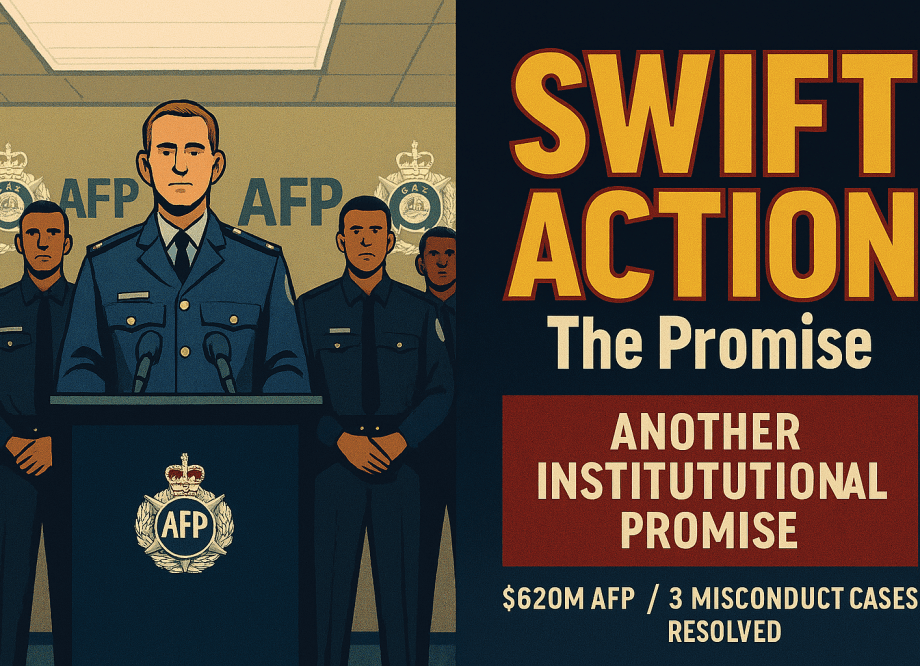
There’s the visual: a press conference room, fluorescent-lit and soul-crushing in its ordinariness. Beige walls. A lectern with the AFP logo. Attention! A spokesperson stands rigidly behind it, face arranged in an expression of professional concern that barely reaches the surface of their skin. Behind them, a semi-circular of officers, each wearing their dress uniform like it’s armour against accountability. Camera lights burnish polished buttons. The blue of their shirts; a cool, iron-blue that crisply dismisses intimacy. And then the words come: “swift action.” The gap between what you’re seeing and what you’re being told is so vast you could drive a loaded Christmas shopping trolley through it.
How does it feel to watch institutions protect themselves? Anger? Or frustration? It’s not quite anger; but a close neighbour; exhaustion mixed with contempt. You’ve seen this movie before. You know how it ends. No prosecution. No accountability. Another promise. Another non-commitment. Weasel-words.
Douglas Adams wrote about a drink engineered to taste like every flavour whilst being no flavour at all. That’s what institutional language has become. It’s Nutrimatic language. It quenches nothing. It merely fills the space where action should be.
The Pattern That Persists
Here’s the thing: the AFP’s incompetence doesn’t matter to anyone with power.
The organisation has been caught failing repeatedly. It persists. It’s been caught raiding media organisations to embarrass political opponents. It persists. It’s been caught conducting investigations that damage sitting members of parliament whilst ignoring investigations that might prove inconvenient. It persists.
Next year there will be another privacy breach or another investigation bungled or another occasion on which the AFP spectacularly fails at its fundamental mission. Another spokesperson will stand before another microphone and promise another version of swift action. You’ll see the same blue uniforms. The same lectern. The same careful expression of professional concern that never quite reaches the eyes.
The Prime Minister’s phone number sits on a US website. So do the phone numbers of other politicians, journalists, media figures. Faces alongside digits. Names become data points. The machinery of Australian law enforcement grinds with the ease and grace of a shopping trolley with one broken wheel. It goes round. It goes in circles. It eventually gets somewhere, but not anywhere you wanted to go.
And the smell? The smell lingers.
It’s the scent of institutional decay; familiar, metallic, and unchanging. The choreography of failure performed in full view: a kabuki of bureaucracy, theatre in drag as governance. Power, reflexive and unaccountable, cloaks itself in passive voice, the institutional opacity, euphemism and indirection of press briefings; vapid statements about swift action delivered with the grace of a flat-footed foxtrot. It’s the ponderous, unanswerable arrogance of office: presence without accountability, motion without consequence, a ritual of concealment rehearsed to the music of time. And a type of antiphony.
“In Australia, it is an offence to use a carriage service to menace, harass or cause offence. The AFP will take swift action against individuals who breach the law.”
That’s the real joke. Not the promise itself. The fact that we all know exactly what it means, and the AFP knows that we know, and they say it anyway. They stand there in their uniforms, behind their lecterns, under their fluorescent lights, and they say it anyway. Pull another swiftie. The gap between the image they project and the competence they possess is so enormous you could see it from space.
They say the truth is stranger than fiction. But it’s rarely as funny.
 Urban Wronski Writes