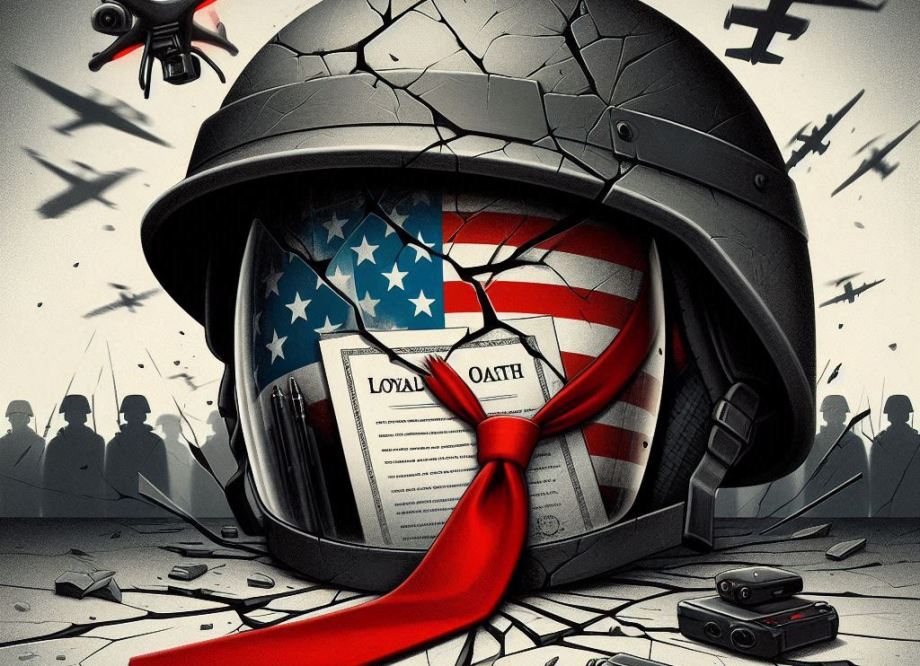
Part I: Machismo in Camouflage – Trump’s Fantasy Military
Quantico, Virginia. It’s not the respectful hush of a formal ceremony, but a silence that crackles with unease. Nearly 800 generals and admirals stand warily. Summoned from every corner of the globe with barely a week’s notice? Is that even a thing with top brass? Shoulder to shoulder, they sulk inside a cavernous hangar at Marine Corps Base Quantico. Is it jet lag, apprehension or disapproval?
Some fly in from active war zones: Iraq, Syria, the Sahel, the Taiwan Strait. Others leave strategic posts in NATO’s eastern flank; Poland, Romania, the Baltics; where U.S. forces “deter Russian aggression”. Still more arrive from domestic deployments in cities like Portland, Los Angeles, and Washington D.C., where National Guard units now suppress protests and enforce immigration raids in Trump’s Brave New World.
The air is heavy with the scent of jet fuel, brass polish and tension. Old Glory, looms over a stage, flanked by the banners of at least six military branches. Don’t forget Space Force. A black-eyed phalanx of Secret Service agents, in trademark dark glasses, earpieces glinting under hangar lights, encircle the perimeter.
Each operative packs a 9mm Glock. Behind dark lenses, his gaze fixes somewhere between the crowd and the horizon; locked into that uncanny middle distance from which all hell can break. It’s the Zapruder stare: blank, unreadable, and always watching, as if history might unfold in the next frame.
It’s a stare trained to register movement, not emotion; to read posture, not intent. The glasses conceal the eyes, but not the vigilance. A Secret Service man doesn’t look at you. He looks through you. The FBI Academy is shut down for the day. Even the base elementary school is closed. Quantico is on lockdown.
Then Trump waddles in, a much fleshier version of himself than in the official Quantico Base portrait.
“I’ve never walked into a room so silent before,” he says, half-joking. But he soon cuts to the chase:
“If you want to applaud, you applaud. If you don’t like what I’m saying, you can leave the room. Of course, there goes your rank, there goes your future.”
The laughter is nervous. The threat is not.
Trump launches into a 72-minute voyage around his obsessions that veers from the surreal to the authoritarian. He praises tariffs. He muses about renaming the Gulf of Mexico. He brags about sending nuclear submarines to Russia. But his big message is crisp, clear and chill. The US is “under invasion from within,” and the military must prepare to fight not foreign enemies, but domestic ones.
“We should use some of these dangerous cities as training grounds for our military,” he says. “Because we’re going into Chicago very soon. That’s a big city with an incompetent governor.”
The man in the bad fake tan calls for a “quick reaction force” to quell civil disturbances. He compares American cities to war zones. He tells the generals that the enemy is harder to fight because “they don’t wear uniforms.” He repeats a line that he knows will echo far beyond the hangar: “They spit. We hit.”
Right on cue, “sneaky” Pete Hegseth leaps to his feet. Pete’s one of Trump’s more controversial picks. He does his best to look like a man with everything to prove. A whistle-blower report and other documents suggest that, like Trump, Pete he has A Past. So the new Head of War had to leave previous leadership roles for financial mismanagement, sexist behavior, and being repeatedly intoxicated on the job?
Pete has the manic, kinetic energy of a man who’s never at ease. He may lack charisma, warmth, or charm, but he radiates a restless, combative edge. He’s like a talk-show host auditioning for a war cabinet. A bucket of chum in a tank of sharks, his presence doesn’t command the room; it churns it.
A former Fox News host, The Secretary of War power-walks the stage like a man auditioning for a role in a war film. But he’s all Fox once he opens his mouth. Hegseth rails against “woke garbage,” “fat generals,” and “dudes in dresses.” He announces ten new directives: mandatory fitness tests, grooming standards, the end of DEI programs, and a return to “the highest male standard” for combat roles.
“If the words I’m speaking today are making your heart sink,” he says, “you should do the honourable thing and resign.”
The generals remain silent. Especially, the seventy to ninety odd female generals and admirals.
Some shift uncomfortably. Others stare straight ahead; trained to be apolitical, to serve the Constitution, not a man. But the message is unmistakable: loyalty is no longer to the republic. It is to the president.
Outside the hangar, the world watches. Critics compare the gathering to Hitler’s 1934 oath of loyalty from the Wehrmacht. Legal scholars warn that Trump’s plans violate the Posse Comitatus Act. Governors threaten lawsuits. Civil rights groups call it a rehearsal for martial law.
Inside, the generals say nothing.
And that silence may be the most dangerous sound of all.
Pete Hegseth is like a preacher at a revival. He doesn’t offer strategy. He offers ultimatums. “If your heart sinks,” he repeats, “resign.” Trump led with his own gospel: loyalty above all, fitness tests for all, and a Pentagon reborn as the “War Department.” And war on Main Street.
“We’re under invasion from within. No different than a foreign enemy but more difficult in many ways because they don’t wear uniforms.”
This is not reform. It’s cosplay with consequences.
Hegseth sells a fantasy; one part Rambo, one part Fox News fever dream. He invokes Patton and MacArthur, but what he really wants is a military unshackled from law, nuance, and independent thought. “No more fat generals,” he declares. “No more beardos.” Drill sergeants are to instil “healthy fear.” Rules of engagement are to be stripped away. Ruthlessness becomes a virtue. Lethality becomes a brand.
It’s the military equivalent of a teenage boy’s video game logic, dressed up in the costume of machismo: Traditional Masculine Virtue™.
But the real commanders; Patton, Schwarzkopf, Eisenhower; aren’t icons because they were macho. They’re icons because they were brilliant. Patton mastered logistics. Schwarzkopf built coalitions. Eisenhower balanced politics and strategy with surgical precision. MacArthur, for all his flaws, understood theatre-level warfare; and his media crew were brilliant. He knew how to stage a landing, frame a photograph, and turn a battlefield into a broadcast. But behind the theatrics was strategic depth. What Trump and Hegseth offer is all theatre, no strategy.
Hegseth doesn’t understand this. He mistakes swagger for strength. He thinks unleashing troops is a strategy. It isn’t. It’s chaos.
And chaos is exactly what Trump wants. His Pentagon isn’t built to win wars. It’s built to win loyalty. Generals are told to comply or leave. Intelligence officers are screened for ideological purity. Diplomats are recalled for “less-than-positive analysis.” The message is clear: agree with everything or get out.
This is not how you build a military. It’s how you build a palace guard.
Carl von Clausewitz warned against this. “We must have trust in our lieutenants,” he wrote. “Choose men on whom we can rely and put aside all other considerations.” Trump and Hegseth invert this. They choose men for loyalty, then demand trust because they were chosen.
It’s circular logic. And it leads to circular failure.
In this new Pentagon, truth is dangerous. Dissent is treason. Strategy is replaced with slogans. And when reality intrudes, there’s no one left with the courage to say so.
Blind Freddy can see where this ends: a military that looks tough on Fox but folds under pressure. A command structure built on fear, not competence. A war machine run by yes-men.
This is not strength. It’s weakness in battle-dress camouflage.
Part II: Lawless Warfare – The Death of Military Honour
The Geneva Conventions are the hard-earned rules of war, forged in the aftermath of humanity’s worst atrocities. They exist to protect the innocent, the captured, and the soul of the soldier. Pete Hegseth treats them like a type of red-tape, invented by bureaucratic spoil sports. He’s no lone voice. War criminal, BRS, would agree. Rupert Murdoch’s family firm has made a fortune out of war-mongering.
During his confirmation hearing, Hegseth dodges direct questions about torture. He calls the Conventions “burdensome,” says they exist “above reality,” and draws a “tactical distinction” between international law and battlefield conduct. It’s not ambiguity. It’s contempt.
This is not just dangerous. It’s a moral collapse.
The War Dept, under Trump and Hegseth, begins to drift from legality into lawlessness. Trump installs his personal lawyer, Timothy Parlatore, as a Navy Judge Advocate General; not to uphold the law, but to bend it. Parlatore’s mission: encourage military lawyers to approve aggressive tactics and go soft on war crimes.
This is not unleashing warriors. It’s licensing atrocities.
And when those atrocities happen; as history guarantees; what’s left of America’s moral authority after VietNam, Iraq and Afghanistan, for example, will vanish. US alliances will dissolve. America’s enemies will feast on the propaganda. The cost won’t be measured in headlines. It will be measured in blood.
Senator John McCain, who knew war and torture intimately, once said: “The use of torture compromises that which most distinguishes us from our enemies.” Trump and Hegseth erase that distinction. They don’t just blur the line between us and our adversaries—they bulldoze it.
This isn’t theoretical. Hegseth has publicly defended war criminals, lobbied for pardons, and praised contractors who killed civilians “for fun.” He doesn’t see these acts as failures. He sees them as freedom.
But freedom without restraint is just brutality.
The laws of war aren’t liberal niceties, nor are they consistently honoured; one need only look at Gaza, Yemen, or any modern conflict to see how often they’re violated. But they’re the difference between war crimes that still carry consequences and war crimes as official doctrine. They’re the fragile agreement that even in chaos, some lines exist. When America formally abandons them, it won’t become stronger. Does it simply announce that US troops, when captured, deserve whatever horrors their captors can devise; because they’ve declared the rules void. That’s not being “realistic.” It’s being suicidal.
Trump’s Pentagon discards this. It replaces honour with aggression, legality with loyalty, and ethics with expedience. It’s not just a shift in policy. It’s a shift in identity; from professional military to armed mob, from soldiers to enforcers, from warriors to war criminals in waiting. Strip away the Geneva Conventions and what remains isn’t strength. It’s barbarism dressed in uniform.
Sun Tzu warned: “A leader leads by example, not by force.” Bone Spurs Trump hopes to lead by force alone. He has to. Bone Spurs has no example worth following.
And when the fog of war descends, when chaos reigns, when the world watches how America fights; what will they see?
They’ll see a military that no longer knows the difference between strength and savagery.
Part III: The Silence Before the Storm – How Armies Fail
The American military doesn’t collapse overnight. It erodes; quietly, steadily, from the inside out.
Trump and Hegseth aren’t just reshaping the Pentagon. They’re gutting it. Competence is replaced with loyalty. Strategy is replaced with slogans. Independent thought is punished. Dissent is career suicide.
Generals watch colleagues purged for speaking truth. Intelligence officers are screened for ideological purity. Diplomats are recalled for inconvenient analysis. The message is clear: silence is survival.
And so they stay silent.
But silence isn’t safety. It’s complicity. And when the catastrophe comes; when the poorly planned operation fails, when the “unleashed” warriors spark an international crisis, when the enemy refuses to play by cable news rules; those who stayed quiet won’t be spared. They’ll be blamed.
This is how republics die: not with a bang, but with the silence of good people who choose their careers over their oaths.
Strategic collapse doesn’t begin on the battlefield. It begins in the briefing room, when no one dares say the plan won’t work. It begins in the personnel office, when loyalty trumps expertise. It begins when the generals stop thinking and start nodding.
Clausewitz warned that military leaders need “the courage to follow the faint light of truth.” Trump demands they follow him instead.
And so the Pentagon becomes a theatre of obedience. The generals become actors in a loyalty pageant. The war plans become scripts written for applause, not victory.
Meanwhile, adversaries watch. China sees a military distracted by culture war cosplay. Russia sees a command structure built on fear. Iran sees an opportunity. They don’t fear Hegseth’s “warrior ethos.” They fear strategic clarity. They fear adaptability. They fear officers who can think.
Trump is dismantling all of that.
The American military’s strength has never been its uniforms or its slogans. It’s been its ability to absorb complexity, adapt under pressure, and even speak truth to power. That strength is now under siege.
And when the crisis comes; and it will come; America may discover that the greatest threat to national security isn’t foreign. It’s internal. It’s the slow, deliberate degradation of competence in favour of loyalty. It’s the silence of the generals. It’s the fantasy of strength replacing the reality of strategy.
The USA can still choose a different path. But the window is closing. And history is watching.
 Urban Wronski Writes
The historical act that prohibits the use of federal troops for domestic law enforcement is the Posse Comitatus Act of 1878. This law was enacted in the aftermath of the Reconstruction era to limit the powers of the federal government in utilizing military forces for civilian law enforcement purposes. While there are exceptions in certain circumstances, the act establishes a clear boundary between military and civilian authorities, aiming to protect civil liberties and maintain order.
LikeLike