Month: November 2014

G20 show exposes Abbott government as completely and utterly bereft of credibility.

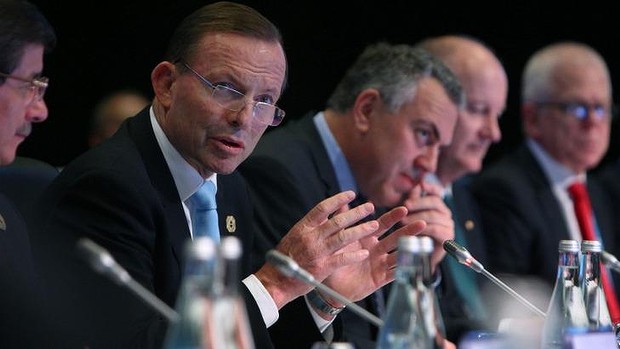
Tony Abbott at G20

Hats off to ABC TV News 24 for their fearless, recklessly endless live coverage of the death of the G20 today. Hats off also for generously including footage of the death throes of any last thread of credibility the Abbott government could pretend to. Stoic seekers of truth, the dutiful, the elderly and infirm, the perpetually confused and others who found themselves inexplicably close to a TV during Tony Abbott’s opening of the G20 show gasped as they were treated to some of the most compelling television ever made. In an excoriating, unhurried-to-the-point of-languorous expose, the ABC revealed the emperor has no clothes.

Under siege itself for preferring the truth over what politicians choose to tell them, our ABC, a publicly under-funded broadcaster mustered the courage today to make TV without fear or favour. It showed its public the shocking truth. True, there was some gesture towards timewasting twaddle, such as forms the substance of commercial TV, when drift-sock anchor Tony Eastley padded things out with his sonorous grain-fed beef basso profondo.  We were spell-bound as much by his tone as his capacity to extemporise. And improvise. And keep talking. And talk some more.

Impressively long on the waffle Eastley even ventured into boosting the event with his speculation that just getting together was an end itself for G20 leaders.  Nothing like lowering all expectations. Nothing like conveying the truth that the even the anchor is bored witless. Finally having the PM’s parliamentary secretary Joshua Anthony Frydenberg on screen was a master stroke. No doubt, Mr Frydenberg was volunteered by the Abbott machine just to keep the commentary on the rails. Having Frydenberg of Kooyong on camera to bounce ideas off proved a master stroke. Every unctuous comment Eastley made appeared objective by contrast to his master’s voice, Frydenberg.

Yet, despite the show’s all at sea anchor, and perhaps because of him, it was shockingly real, live coverage. Expect reprisals. Heads, no doubt, will roll on Monday. The ABC’s inept coverage illuminated Abbott’s idle posturing perfectly, set the stage for his government’s inevitable collapse and gave the coup de grace to the G20 itself. On this day, the ailing G20 died and was reborn, stripped naked of any pretension to substance, revealed as a bone-crushing, hand-shaking, personal space-invading almost nipple rubbing photo opportunity come TV game show. International guests had to come on down as Tony Abbott centre stage came too close, held hands too long and grimaced shamelessly at the camera. This was the point of the whole shebang. Tony the media tart pressing flesh, pulling unwary unwilling world leaders into his chest, holding that handshake for the camera.

It cannot have been easy TV to make. Evidently Aunty had to economise on adequately briefing journalists covering the event and it did lack that handy extra camera to show us the faces of international leaders hanging on every Abbottism. Or, on the other hand if anyone present was paying any attention whatsoever least of all making the risky attempt to follow along.

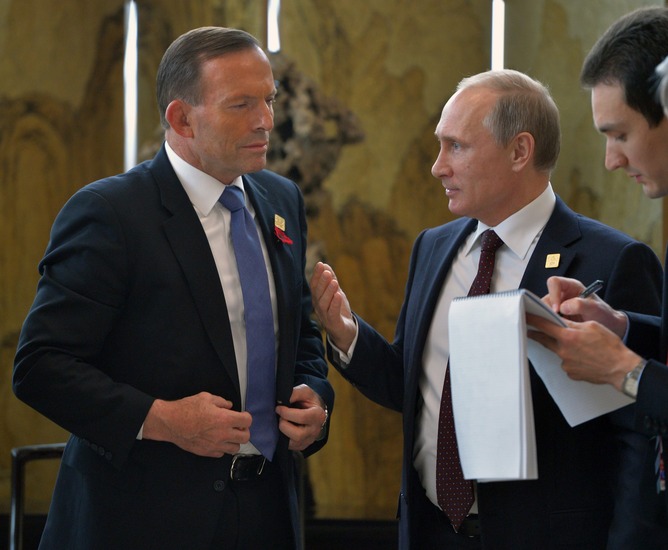
A random, accidental shot of Putin showed him to be completely disengaged, while appearing to occupy himself with what may have been navy ballistics calculations on a notepad. The overall effect was strangely heightened as the PM’s halting opening domestic piffle appeared to be delivered into a vacuum or a stony indifference. But then to get your guests to listen, you need first to have something to say. And the means to say it. Eastley’s smooth flowing basso profondo effortlessly utterly upstaged Abbott’s halting staccato strine baritone. And shredded any final hint of credibility.

First, as anticipated, the Prime Minister was completely unprepared. When he warned earlier that it would be no talkfest, we did not expect him to lead by example. Instead of any inspiring words, any meretricious rhetoric or, heaven forbid, any vision statement, Abbott insulted world leaders with a platitudinous and hypocritical injunction to be honest with each other followed by an insufferably irrelevant and tedious rehash of his own deceitful, stale election slogans. To cap it off, Abbott’s tone was apologetic. World leaders were treated to his frustrations as he shared his inability to impose a $7 fee on GP visits. Not all was sharing. He blamed voters who love free government programs for supporting wasteful spending. In brief, he whinged to the world how hard it was to be Prime Minister. Inspiring stuff.

Second, the ABC coverage reinforced the superficiality of proceedings. Whilst we were assured that the hard work had gone on beforehand, nowhere was that in evidence, except perhaps by the absence of physical conflict. After the Prime Minister’s ponderous wasting of everyone’s time with a recap of the highlights of his trivial and unsuccessful domestic policy over the last fourteen months, there may have been a few observers who either fell asleep or were generously prepared to give his government the benefit of the doubt. Later shots spliced into the commentary revealed that this indeed was the case. When Joe Hockey faced the cameras to smarm his way through another flatulent barrage of platitudinous hokum purporting to be the consensus of the finance ministers, the intellectual and moral poverty of the Abbott government was as they say, firmly locked in.

Abbott government crisis: G20 Show undergoes urgent revamp.

CHINA APEC SUMMIT

Public derision from any quarter is confronting to anyone. But members of political elites are especially susceptible. When one is derided by 6 billion people, it may well hurt just that little bit more. Even case-hardened psychopaths can prove sensitive, as the contemporary case of Tony ‘Shirtfront’ Abbott superbly demonstrates. Having made a complete international laughing stock of himself with Vladimir Putin and his moronic, mindlessly self-destructive yet sycophantic atavistic ranting about coal and humanity, a pale and visibly shaken Australian PM, Abbott has been forced to ‘rush through’ a total revamp of the G20 show in BrisVegas tomorrow.

Entitled ‘Operation Panic Button’, the remodelled show is supercharged with adrenaline, testosterone and sheer terror. Upstaged from the start by his own complete inexperience, Abbott is galvanised by a terrifying reality – being relegated into perpetual irrelevance and obscurity by a series of real world events, including Ebola, ISIS, Russia’s resolute determination to annex Ukraine and the recent announcement of a deal on carbon emissions between China and the United States.

Clearly angered at being blindsided by the shock announcement from US president Barack Obama and Chinese premier Xi Jinping of new national climate change goals and the way it has trashed his own G20 agenda, Abbott appears to be struggling to maintain any semblance of forward momentum, let alone any show of composure, especially now he has the added distraction of bits of the Russian navy up his clacker.

Having successfully made a personal lifelong enemy of Putin, the world’s most powerful and dangerous psychopath, Abbott is believed to be anxiously receiving regular special naval briefings on the accuracy and range of Russian missiles, nuclear weapons and other sea-borne armaments. Advertisements for auditions for the role of Abbott body double have appeared on all social media, in the press and on selected supermarket community noticeboards in all major capital cities. A food taster has been engaged for all official banquets and refreshment stations. Abbott in the meantime, has issued a statement which has only served to further alarm mental health experts and others who remark the disunity his cabinet demonstrates under pressure.

Spin doctors have been performing emergency triage on the Abbott government. Yet the patient’s vital signs continue to provide cause for concern. Media comments by a politically phlegmatic Julie Bishop and others have provided little but unintended comic relief. When the going gets tough, the Abbott government gets spinning. Avoid the truth at all costs: ‘Of course, the Russian Navy is always doing this sort of thing. It is only to be expected. They are in international waters. We have been monitoring them for some time.’ Hardy ha ha ha!

Australians are left scratching their heads trying to recall the last time a small fleet of Russian vessels was off the coast of Queensland during any international gathering. For those who still don’t get it, Russia has personalised Putin’s gun barrel diplomacy by pointedly claiming, tongue in cheek, that a purpose of their naval voyage is to seek information about climate change.

The government has been skittled. Abbott government unity, as distinct from Peta Credlin’s iron fist, is chimerical. Liberal unity is a contradiction in germs, given its lack of any coherent ideology and the peculiar circumstances of its origin. It is called Liberal because Menzies did not want the electoral handicap of the appropriate word ‘Conservative’. Certainly, on this occasion, it was all over the shop or, giving another dimension to the term, as it is fondly and blasphemously whitewashed, a broad church.

Anti-environment Minister and work experience student, Greg Hunt hollowly applauded the US-China deal in a Monty Python moment of magnanimity and irrationality. Like the Black Knight, his own imminent mortality was not in contention. Yet again, no one paid any attention.  Smart-arse, Julie Bishop claimed she was not surprised. She knew, ‘already, she said.’ The accommodating, avuncular and ponderously inept Joe Hockey deemed it an ‘acceptable item for discussion’ within a larger topic, the world economy, typically missing the point that global warming is the larger topic.

Abbott, finally, took off like a startled hare, bolting along on yet another tack, ‘We are talking about the practical. We are talking about the real. We are not talking about what may hypothetically happen in fifteen, twenty, twenty-five, thirty years down the track. We are talking about what … what we will do and are doing right now, and that is what the Australian people expect of us. I’m focusing not on what might happen in sixteen years’ time. I’m focusing on what we’re doing now, and we’re not talking, we’re acting.’ Sheer spin, fantastically out of control from a febrile leader who is neither talking nor acting but denying. Someone needs to take his temperature.

Abbott’s dizzy spell to one side, boffins are working feverishly around the clock to pull the fat from the fire. Joe Hockey’s original Headland PowerPoint: ‘Who has the key to a bigger GDP? Is now a snappy: ‘Catch the Rats who won’t pay Tax,’ and has been creatively re-crafted into a sultry torch song come bump n grind dance bracket format entitled: ‘Screw you over, give you the bill’: Australia – open wide for business.  

Sharing centre stage, but Miss Piggy style hogging the limelight, Foreign Affairs Minister, the incomparable Julie Bishop will perform her own lap (band) dance whilst belting out a fetching rendition of ‘Hey, Big Spender, while Smoking Joe steps through a specially choreographed IMF routine assisted by ‘The Hendersons will all be there’, an IPA giant dancing puppet troupe and led by a special Australian armed forces massed brass band supported by the Jacqui Lambie backing singers.

A second provisional number, ‘I will survive’ is a less certain Hockey offering, although it is rumoured that the Foreign Affairs Minister has expressed keen interest in putting her own stamp on this classic.

Global warming is back on the agenda. Once opposed as an agenda item (and indeed as anything of significance) by the same man who could not refuse Putin’s attendance because the G20 runs on consensus, will now be fully and energetically embraced in a late night team building and bonding workshop at the Viper Room, a world-class adult entertainment centre in Brisbane’s red light district. Featuring a complimentary international smorgasbord of divertissements, refreshments will include Scots whisky, Cuban cigars, Kiwi green, Cabramatta hydro and Bendigo ice. IMF and World Bank Paramedics will be on standby with wads of money to revive the fortunes of those who may become indisposed, in return for sovereign rights to that country’s economy in perpetuity.


The shirt front that roared.

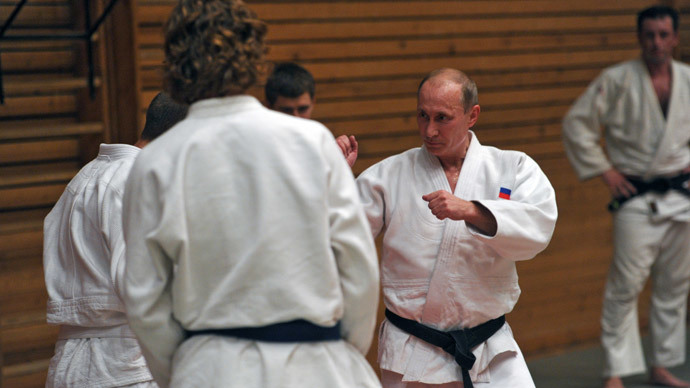
putin judo

When Tony Abbott threatened to ‘shirt front’ Putin, he put a lot on the line. He told journalists that he was going to shirt front the Russian president on the sidelines of G20 summit over the tragedy of the Malaysian airliner crash in the Donetsk Region of Ukraine in July.

What was he thinking? What did he hope to achieve? Who knows with Abbott? What is certain is that the gesture got him a lot of media interest. A bit of this was benign and non-intrusive. Some media types even looked up the term and explained thoughtfully on TV that it was an expression from Aussie Rules football. It was hopeful but did not really explain or excuse anything. The net effect, moreover, was to hang an albatross around Abbott’s neck.

Perhaps the shirt front was calculated to appeal to the alpha male. Perhaps it did win Abbott a flicker of attention if not admiration from macho types who believe that assertiveness equals being ready with your fists. Ironically, however, the same types would be irrevocably alienated by the lack of action. You can’t make a threat you are not prepared to carry out. Whatever modest gain in attention, the challenge is likely to have cost him further credibility. And the rest of us have probably had enough machismo to last a lifetime. Or Abbott’s political lifetime.

The shirtfront venue was first set for Brisbane at the G20 which Abbott is pretending to chair. Yet even Abbott subsequently realised that a shirt front was an unnecessary complication at a meeting which would require every ounce of his energy, just to appear to be in control. The distraction of an impending punch up out the back could be a tad distracting. Accordingly it was brought forward to APEC. (Entrepreneurs are probably hard at work as we speak creating an iPad  shirtfront booking app for that.) And there Abbott would be happy to let the matter lie. But some matters will not just lie down and die.

The shirt front is irresistible on many fronts. It conjures up an attractively incongruous image. Its inappropriateness appeals, especially given Abbott’s aspirations on the international stage. And the media would not leave it alone. Even as he stepped on to the carpet at his APEC meeting, there was a man or two chasing the PM with a microphone asking if ‘the shirt front was on’ at APEC. (APEC, by the way, is the meeting John Howard liked to talk up. APEC is the one where they all get dressed up in funny shirts for a photo opportunity. It is uncertain what else it achieves.)

In the event, there was no shirt front. Tony toned it down almost immediately. By the next day he was telling reporters that he was absolutely determined to have a very robust conversation with the Russian president.” Instead, he appears to have had a quick private whinge to Putin. No doubt he got on to the Russian leader’s complicity in the death of innocents in the shooting down of MH17. No doubt also Putin could have raised Australia’s appalling human rights record on asylum seekers and its recent indictment by the UN committee on torture.

It does not seem to have gone all that well. His promised great remonstration with the Russian leader is said to have lasted a whole fifteen minutes. He claims to have raised the issue of compensation by offering an indirect analogy. The US offered compensation when they accidentally shot down a passenger jet. Putin’s response is not known but can safely be guessed at it.

Ты меня достал! (You piss me off.)

The shirt front was more than an embarrassing gaffe. It will haunt Abbott for some time to come. It has got him the sort of attention that he would rather have done without. Naff. Limited. Testosteronic. Not flattering. Not useful. But enduring. And it even attracted the attention of the Minister for Foreign Affairs. You know you are in trouble when Julie Bishop goes into bat for you.

Putting, as usual, an impossible spin on it, Bishop claimed this week that the term has now entered the diplomatic vernacular. It’s not a gaffe but a nifty new term for a diplomatic confrontation. Abbott did not lose control after all. On the contrary we should all be grateful for his talent as a wordsmith. Quite the Shakespeare of the world stage.

If you swallow that you are in deep trouble. Next you will be believing that Tony Abbott is capable of leading the G20 through the next meeting. Or that he has prepared for the task. Or that he has the capacity to follow the discussion, let alone make a useful contribution.

What is more likely is that this lapse will prove a defining moment. When the world leaders look up at him at the podium on 16 November in Brisbane, it is likely to be through the lens of the shirtfront. They will wonder how a man who has trouble being in charge of his lip could ever be in charge of anything bigger, even if the chairmanship of the G20 will last only a year. They will not be happy with his almost complete lack of preparation; his ideological bent towards letting the market sort things out for itself when many of them have put in the hard yards intervening to prevent financial meltdown. They will see a man with anger management issues, a man who has trouble keeping his temper. They will see a parochial primitive predisposed towards a reductive approach to conflict resolution, a sort of spaghetti western hero who will invite adversaries out the back where we can settle this with our bare fists, man to man. And they will be antagonised, if not downright angry. Who knows, one of them might offer to take him out the back and sort out his attitude for him.

Abbott’s kiss of death to G20 Brisbane.

abbott and hockey blind lead the blind

What leadership? Abbott and Hockey in tense G20 discussion.

The good ship G20 is adrift, rudderless, on the turbulent high seas of international finance. It has been for some years. The G20 is widely held to be ‘in serious transition‘ according to Canadian academic Professor Andrew F. Cooper. Whilst it won praise for being a unique forum for global economic cooperation in the GFC, it has failed to deliver on a series of pressing international issues. Climate change, growing inequality, growing unemployment, the global decline in the value of wages to GDP are but a few of its many pressing challenges. Whilst it would be unkind to say that the G20 has achieved little so far,clearly there is much work to be done. Is it up to the job? Is Australia up to the job of providing desperately needed leadership? Are we serious? Or are we putting lipstick on a pig? The evidence so far is damning.

The G20’s role during the GFC has been embellished. No record of decisive action or intervention exists to support its glowing reputation in some quarters. Apart from a few fans who talk it up, the balance of opinion is yet to be convinced. Expert observers and analysts differ on how useful it was even as a forum.

Action by the US Federal Reserve and Treasury, together with a G20 commitment not to raise trade barriers; fiscal expansion and agreement for tripling IMF ‘firefighting’ capacity, made a vital contribution to changing expectations to arrest a potential global economic free-fall. This is a popular view. Yet others remain to be convinced.

Chris Berg dismisses as ‘a fantasy’ the idea that the G20 played any significant role in the GFC.  Certainly, he argues, it played no coordinating role; nations more or less acted on their own, with more or less success.

Yet the G20 has good intentions. Its aim of a GDP increase of 2% is a step in the right direction. But there is no action plan; no clear case that 2% is enough and no plan on how this might be achieved. No real leadership has been shown by the chairman, Tony Abbott. Indeed, so little has Abbott contributed so far that Australia’s turn to play host at a time of mounting international crises could well spell the kiss of death for the G20.

So far, Tony Abbott has conducted one brief photo opportunity and made the statement that this is the most important meeting in Australia’s history, ever. If this is the extent of his contribution, he risks appearing to treat the G20 with cavalier contempt. Cynics would reply that he needs to do less telling how important it is and do something to show that he himself recognises it. Optimists point out that there is still one week to go and we might yet see his grasp tighten.

Ironically, Abbott’s statement of the meeting’s importance echoes Tania Plibersek’s words when she expressed dismay in June that whilst visiting the USA, Abbott cancelled key meeting with the world’s top financial officials. It was as if he could not grasp the G20’s status let alone his role in it. Now he’s making a point of telling us he knows it is important.

Whatever its importance, without any leadership, without any concrete plan to match its lofty rhetoric, the G20 is like the Cheshire cat, in danger of vanishing, leaving nothing behind but its smile. Or is it a case of kiss me and wave me goodbye; the kiss of death? Tony Abbott may well have concluded that the G20 is moribund and perhaps he has resolved to hasten its demise by cynically accepting the public kudos of chairmanship without any of the responsibility.

Real leadership is critical to the G20’s continuance. Australia has a privileged opportunity to lead, a responsibility to lead and expectations to meet. Wayne Swan writes:

Leading the premier group of economies for international economic cooperation and decision making is a rare privilege. It is a coveted global leadership role. Australia needs to fully utilise it if we are to live up to our reputation as a nation that punches above its weight. It is also an opportunity to deliver on a number of reforms we have long advocated through the G20, reforms that have domestic and international upsides.

Will the G20 sail itself? It has such a motely crew that it demands a captain. Of course, the G20 has its technocrats to do the real work and Abbott’s light touch at the wheel will not have deterred G20 boffins from working on what Joe Hockey described in June as a ‘back to basics approach’.

What this means precisely is unclear but given the publicity from the prior gathering, the 16 November meeting will focus on economic growth. This is a worthy topic. Unemployment, poverty and inequality are increasing world-wide. Sustained long-term growth is vital to meet these challenges. But whilst Joe Hockey wants to set course towards 2% growth, this is not enough to fix the pressing problems. Nor is his government’s dry economic agenda likely to prove anything but a hindrance.  A fixation with ‘fiscal consolidation’ and a narrow view of infrastructure spending, his government’s signature, will not fix growing unemployment.

The Abbott government has a die-hard laissez-faire attitude to promoting economic growth. Nothing original here. And there is  plenty of evidence that it will not, cannot work. Leaving the market to create growth all by itself does not match the G20 experience in the GFC. Nor does it match today’s G20 rhetoric. It suggests a lazy retreat into ideology and the ignoring of the lessons of experience.

Abbott talks of lowering wages. He uses the weasel-word ‘flexibility’ to signify paying workers less. He talks of imported workers from China and India. It is understood that this is a cost reduction exercise. Bosses hire workers at lower wages. Reducing wages costs will make them employ more people. Yet it remains a theory.

Not only is it without evidence, it is also out of date: current developments in economic policy support raising minimum wages as a way of increasing demand for goods and services. In turn employment across the industries grows to meet the increased demand, domestically and globally. Businesses make more money. This parallels stimulus packages used during the global financial crisis to promote economic growth.

There are many other ways in which the Abbott government is totally at odds with G20 thinking. Out of touch with what leaders know has worked in the GFC. Its privatization perspective on infrastructure is but one example. Overall it is so totally at odds with current G20 thought and practice that it is difficult to see the Prime Minister as being equipped to even contribute to discussion, let alone lead the G20 on 16 November. Even if he was properly prepared. Even if he had a plan.

Blood on Scott Morrison’s hands.

funeral of bahari

Funeral of Reza Barati.


On 17 February 2014, men armed with guns, machetes, knives, pipes, sticks and rocks, systematically and brutally attacked asylum seekers detained on Manus Island. Reinforced by PNG Police and the PNG ‘mobile squad’, who pushed down a fence to join the fray, the assailants carried out acts of violent retribution to asylum seekers who had been protesting for three months, demanding that their claims be processed.

Reza Barati, a 23-year-old Faili Kurd from Iran was murdered in the attack. At least 62 other asylum seekers were injured. One man lost his right eye, another was shot in the buttocks and another was slashed across the throat.

The attack needs to be kept in sharp focus as the Abbott government, despite many protests and appeals from the local and international community, seeks to consolidate its high handed arbitrary approach while priding itself on the efficacy of its practices.

Changes to the Migration Act currently before the house, extend Maritime Law, redefine Australia’s responsibility to refugees and effectively give unprecedented powers to Minister of Immigration, Scott Morrison. Also slated is a plan to create a new super Ministry of Homeland Security with Scott Morrison at its head.

The legal changes proposed by the Immigration Minister would re-introduce temporary protection visas to be applied to about 30,000 asylum seekers still living in Australia. Asylum seekers found to be refugees would get a three-year visa allowing them to work, but they would ultimately have to return to their country of origin. Maritime powers would be expanded, covering people detained at sea, and allow Australian law to significantly limit the country’s responsibilities under international human rights laws.

Especially draconian is the intent to raise the risk threshold for sending arrivals in Australia back to another country. Currently, people will not be returned to the country they came from if there’s a 10 per cent chance they will suffer significant harm there. The Government will now raise that risk threshold to greater than 50 per cent. Mr Morrison says the higher threshold is the Government’s interpretation of its international obligations. Greens Senator Hanson-Young says the bill will result in more asylum seekers lives being put at risk. “This is a mean, dangerous law from the Government,” she said. “If this was not so serious, if it was not about life or death, it would actually be a joke.”

Whilst Morrison’s colleagues hold him to be one of his government’s ‘top performers’ for stopping the boats, this is no commendation. Indeed, their high regard is an indictment on the rest of the cabinet. It also reflects poorly on both sides of Australian government and, indirectly, on the Australian public who have allowed themselves to accept their country’s hard-line approach.

Morrison is not the man to promote. Not remotely. Outside of the government’s joy in turning back the boats, few Australians would approve of his self-abrogating approach or his performance in his portfolio. Most of us feel a deep sense of anger and shame. Many eminent Australians in many walks of life have called for the Minister to resign.

Julian Burnside added to the calls with his public claim this week that the Minister of Immigration bribed witnesses to Reza Barati’s death to retract their testimony in return for transfer to Australia.

Burnside’s claim is, sadly no bolt out of the blue. It comes at the end of a long series of sordid reports of cover up and whitewash by the Abbott Government.

It is, nevertheless, a typically courageous challenge by a highly regarded champion of human rights and deserves to be heeded as a timely reminder of the alarming track record of this government’s cruelly punitive approach to asylum seekers. Sadly it was rejected with typical hostility by Morrison who launched a libellous attack on Burnside for his opposition, malice and lack of evidence.

“This is a false and offensive suggestion made without any basis or substantiation by advocates with proven form of political malice and opposition to the Government’s successful border protection policies. The government once again rejects these claims,” Mr Morrison said. Yet there is independent evidence that Burnside’s account is correct.

An asylum seeker at the Manus Island detention centre has alleged 3 November that he and another detainee were tortured, physically assaulted, threatened with rape and forced to sign papers withdrawing their witness accounts about the night Iranian asylum seeker Reza Barati died.

The man, aged in his 20s, has spoken publicly for the first time about what he said Wilson Security guards and Transfield staff did to him in a secret compound called Chauka. The asylum seeker making the claims said he was too scared to be named.

Ben Pynt, director of Human Rights Advocacy at Humanitarian Research Partners, a non-profit human rights and humanitarian research organization is clear that the witnesses are speaking the truth.

“The specificity of their claims is such that you couldn’t make it up. Dates, times, places, people and then the documents corroborate all of those things,” he said.

“It really makes me think there’s no doubt.

“Quite frankly, I don’t believe the Minister and neither should the Australian public. The Minister’s denial has no factual basis.

“He hasn’t responded to any of the individual claims and he hasn’t asked an independent person to find out what happened.

He has been in regular contact with the two asylum seekers and raised their allegations of mistreatment with the Australian Federal Police (AFP) and the office of United Nations High Commissioner for Human Rights (UNHCR).

What caused the violence in February on Manus Island? It was not the suppression of a riot. The savage attack was the authorities’ response to a protest. More an armed attack than a ‘response’, the action was utterly unjustified, totally inappropriate and, in Reza Barati’s case, ultimately fatal. Detention Centre personnel were not attempting to quell any riotous assembly at the detention centre despite Immigration Minister’s version of events. Indeed, it seems, at the time of the incident, things had settled.

The previous day, 35 protestors had escaped. Yet by the day of the attack, only one individual remained protesting. The brutal, violent assault has been widely misreported as a riot in a whirlwind of spin generated by Morrison and his department in order to shift the blame from those running the camp and by extension himself.

How did Reza Bararati die? Julian Burnside QC gave this account last Wednesday. One G4S worker bashed the Iranian asylum seeker with a piece of wood which had two nails driven through it. His scalp torn open, Barati fell to the ground and was then kicked repeatedly by a dozen employees from within the detention centre including two Australians.

They kicked him in the head and stomach as he tried to protect himself with his arms, Mr Burnside recounted for the audience at his Sydney peace prize award last Wednesday. He said another employee took a rock and smashed it on Mr Barati’s head with “such ferocity, it killed him”. Other reports had stated that Mr Barati died of a head injury on the way to Lorengau hospital in PNG.

The morning after Reza Barati’s death, the story had been given a different spin. Minister for Immigration, Scott Morrison laid the blame squarely at the feet of the asylum seekers.

On 26 May, retired senior Australian Public Servant Robert Cornall’s report found Barati’s death occurred after guards entered the centre to suppress the protest. His ‘administrative review’ for the Federal Government revealed that contractors working for the Australian government were responsible for the death of one asylum seeker, the serious injury of others, and the mass trauma of dozens.

Yet Scott Morrison took the review as an exoneration. The evidence? Morrison instances the fact that Cornall found it was not possible to isolate one factor that could have mitigated injuries or damage.

Cornall’s 107-page ‘administrative review’ concluded that the ‘incidents were initiated by transferee protests’.

Its recommendations included increased security and reducing the processing time for refugee claims. It reaffirmed that no one could be resettled in Australia. By and large it said what the government wanted it to say. It sent the ‘right message’. Yet it must not remain unchallenged.

Long before Barati was killed, whistle-blowers provided sufficient information to prevent his tragic death. He did not have to die. But Morrison does have to come forward, accept the truth and his responsibility.

Former G4S former safety and security officer Martin Appleby quit because he found management ignored his concerns about the violent and volatile conditions.

“I couldn’t handle what was going on; no one wanted to listen,” he told Crikey. “I wrote many reports, and nothing was ever taken up. The lead-up started a long time ago.”

Manus Island is a hell.  The single men there face indefinite detention, without timeline, without information, without hope. Supplies are meagre. Facilities are few. It is hot and crowded.

According to the Sydney Morning Herald:

Asylum seekers have been denied adequate water and soap supplies or even urgent medical attention. They suffer “snakes inside their accommodation, malaria, lack of malaria tablets, no mosquito nets, [and] inedible food that often has cockroaches in it.

Manus Island offshore detention centre represents a flagrant disregard for human rights, justice or compassion. It is, moreover, an expensive and indefinite detention. One billion dollars has been spent to detain 2000 asylum seekers offshore on Manus and Nauru but, since 2012, only one has been processed. All up the Coalition has budgeted $2.87 billion over the next year to run Manus and Nauru. Transfield Services’ contract alone is worth $1.22 billion to run both camps for the next 14 months. The cost of holding one asylum seeker in offshore detention was found to be more than $400,000 per year by the Commission of Audit. The Refugee Council calculates this cost to be five times that of ‘processing’ in Australia.

Yet for all the money spent, the quality of care provided to detainees is substandard. The death of 24-year-old Hamid Khazaei, an Iranian on September 5 was entirely preventable. A cut on his foot led to septicemia. The tragedy resulted from a simple lack of basic first aid. Not only was it totally unnecessary, it has come to represent the ugly side of a deliberate policy of deterrence. In most civilized societies, it would be regarded as an act of criminal neglect.

Political commentator, former diplomat, Bruce Haigh believes Morrison should step down, ‘The Minister for Immigration, Scott Morrison, should resign. He is not a fit and proper person to be responsible for vulnerable lives.’

Haigh instanced the Manus Island assault and problems with our neighbor, Indonesia. ‘Without any help, Mr Morrison has taken the relationship with Indonesia to its lowest point since the mid-1980s. He appears to understand nothing and listens to no one…’

Christine Milne has similarly called for Morrison to resign. Tasmanian Independent Andrew Wilkie has formally asked the International Criminal Court prosecuting authority to investigate whether the treatment of asylum seekers contravenes international conventions.

In the meantime, immune to all criticism, the government presses on with its plans to settle 1000 asylum seekers in Cambodia. Scott Morrison is seeking to change the law to give the Abbott government even greater authority. To this end, he introduced the “Migration and Maritime Powers Legislation Amendment” in September. Morrison argued:

“The new statutory framework will enable parliament to legislate… without referring directly to the Refugee Convention and therefore not being subject to the interpretations of foreign courts or judicial bodies which seek to expand the scope of the Refugee Convention well beyond what was ever intended by this country or this parliament.”

The controversial bill is now in its third reading. It is a bizarre attempt to twist a treaty to suit the Abbott government’s own agenda. “It’s a sudden and unilateral reinterpretation of a treaty which has been signed by 145 countries around the world and has been the cornerstone of international refugee protection for over 60 years,” according to Daniel Webb, director of legal advocacy at the Human Rights Law Centre (HRLC) in Melbourne. Meanwhile, Cambodian officials are travelling to Nauru, for what Webb calls “an active selling of the refugee transfer arrangement by members of the regime that stands to profit from it”. 1,000 detainees from Nauru are slated to be transferred to Cambodia in exchange for US$35 million in aid. Cambodia has treated past asylum seekers poorly; it lacks the capacity to care for 1,000 newcomers.  Above all, details of the proposed plan have not been made sufficiently clear. The Australia-Cambodia Memorandum of Understanding does not specify how much money will be allocated for temporary accommodation and basic needs – or who will decide how the money is budgeted. It is simply one more damning move in Australia’s practice of deterrence which masks a callous indifference at best and at worst an unrepentant and calculated cruelty to innocent victims.

Under the Abbott government and its gung-ho Immigration Minister, Scott Morrison, the treatment of asylum seekers is a travesty of our international obligations and an affront to our humanity.

Moreover, as Julian Burnside reminds us this week, we have a minister whose department has not only shown gross negligence leading to accidental death, it has also been complicit in the brutal suppression of a protest on its Manus Island detention centre in February which resulted in the murder of an innocent victim. All the evasions and forced retractions in the world cannot wash away the blood on the Minister’s hands.
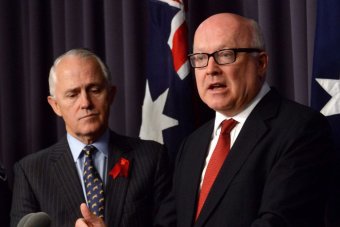
The Brandis touch: the kiss of death for freedom and trust.

brandis and turnbull data retention

 “Fundamental to our rights as citizens is the right to be free. The power to detain without warrant, without charge, without access to legal advice is normally reserved for dictators and tyrants. No free society unnecessarily cedes to its government powers of detention without review,” Australian Lawyers Alliance (ALA) in submission Parliamentary Joint Committee on Intelligence and Security about the Counter-Terrorism Legislation Amendment (Foreign Fighters) Bill.

What is it about Attorney General George Brandis that makes us uneasy? What is it about him that does not inspire trust? Confidence? Quite a lot when you think about it.

First he reassures too much. Part of the Brandis problem is that he’s always offering reassurances; placating us with the lie that he’s making us safer. Don’t you worry?  We know best. We know what’s best for you. Trust us, he says.

Trust? Not a chance, not when you look at what he is doing; what he has done. Alarm bells ring.

Next comes the rest of the Brandis bedside manner: his condescension; the supercilious way he talks down to ordinary mortals. Common folk are invariably mistaken, in his eyes, whatever their point of view, and often before he’s fully considered it. Don’t ruffle my feathers, don’t demean me with your specious arguments, I am Cock of the Walk.

An ugly arrogance lurks behind the Mr Magoo spectacles fuelled by an intelligence which suffers fools constantly and painfully. Beneath his avuncular demeanour, burns a profound conviction in his own righteousness. Above all, his certain belief in his own moral and intellectual rectitude creates deep misgivings in the rest of us. And it was quick off the blocks.

Our disquiet with the current Attorney General began early when the recently appointed AG was caught rorting expenses. For any politician, let alone an AG, this was disturbing. For Brandis it was also hypocritical. In Opposition, the same George Brandis had ferociously attacked Peter Slipper for visiting a winery and charging the taxi ride to the Commonwealth.

Brandis excoriated Slipper on the former speaker’s dishonesty. Yet he had a blind spot with any similar inspection of his own misconduct. It was perfectly reasonable to attend a friend’s wedding at the Commonwealth’s expense, he claimed. Even when discovered, two years later, Brandis repaid the $1,600 and maintained he had done nothing wrong.  As Julian Burnside writes colourfully:  haughty, supercilious, self-righteous George Brandis was at the trough with the best of them.

Of course it could be argued that Brandis was simply following his leader. Tony Abbott billed the Commonwealth for every fun-run and each pollie pedalling.  His Tamworth photo opportunity cost the rest of us in Team Australia about ten grand. We’ve invested a fair bit in him over the last few years.  Abbott has claimed $3 million from the Commonwealth. Brandis, in this light, is merely one junior member of corrupt, hard right-wing Liberal government, led by self-seeking hypocrites. But it’s no excuse. The Nuremburg defence of following orders or example founders on the rock of individual adult moral autonomy. You knew it was wrong and you did it, George. The buck stops with you.

Beyond this flaw, the Brandis problem is even greater than the morally blind leading the blind. The Attorney General is working to put the skids well and truly under our freedom and security. With the National Security Monitor out of the way, the path has been cleared to introduce sweeping changes without real public scrutiny. George is eagerly beavering away to push through laws that will profoundly alter our society with only perfunctory consultation and review.

The Abbott government is intent on increasing the state’s powers of surveillance. Vastly. There is a rush on to get its data retention bill passed before Christmas. Caesar’s omniscient mad black eye may well be ever upon all of us by the New Year, thanks in no small part to you, George.  The state will have carte blanche to spy on its citizens.

Nothing to worry about if you are good, says Brandis. Everything to worry about if you value your privacy, your civil rights and if you understand that in our information age, secure data is an oxymoron. ISPs will keep massive databases. Worry about the security of this data. Worry about authorised access. As Chris Berg says, your data will be only a subpoena away with the passing of the Telecommunications (Interception and Access) Amendment (Data Retention) Bill 2014.

Worrying in the extreme is Brandis’ Foreign Fighters Bill. Drafted ostensibly to curb overseas travel for would-be Jihadists, disturbingly, the law reverses the burden of proof. Also disturbingly, it reveals George’s role as a keen collaborator in the Abbott government’s fear campaign; a key player in the manufacture of paranoid anxiety for political ends. The Counter-Terrorism Legislation Amendment (Foreign Fighters) Bill 2014, due to be signed into law within days, will give law enforcers powers to query, arrest and charge people who travel to countries such as Syria, Iraq, or proscribed zones (so-called “declared areas”) therein, without a valid reason.

Yet the provisions embrace far more than foreign fighters and violent extremism. They amend 20 Acts including social security. The Australian Lawyers Alliance (ALA) warned in submission to the joint parliamentary committee that the new laws “threaten the independence of the judiciary, introduce retrospective warrants and more than triple the period an individual can be detained without others being notified.”

Brandis is least reassuring when he changes tack, as he has with regard to the proposed Department of Homeland Security. A month ago at the Press Club in Canberra he was opposed to any new super-Department, implying it wasn’t happening. Now it is likely to happen soon and Scott Morrison will be in charge. Perhaps Brandis himself has been surprised by this turn of events. Either way, it is an alarming indictment of an AG who asks to be trusted.

Technical matters are not Brandis’ forte. He was mocked for being unable to define metadata. Now his answer is that metadata will be defined in the legislation. All very well and good but we’d be a bit more at ease with an AG who could explain it; talk us through it as they say; a man as they say who was on top of his brief. Despite your talk and in some ways because of it, we firmly expect to end up like the US.

Data will be kept on everyone; the state will have access to everything. Your metadata waffle is a sideshow; a sop to those who like to be fobbed off with meaningless assurances dressed up with technical jargon. Yet, increasingly, Brandis, Abbott and other Team Australians slip up and reveal a glimpse of their true intentions. They are disquietingly far-reaching incursions into our freedoms, which are announced in a manner which inspires neither confidence nor trust.

In August, Tony Abbott admitted in a television interview that requiring internet service providers to retain data on their customers’ activity was not just about anti-terrorism and national security but could be used to fight “general crime”. More recently, AFP Commissioner Andrew Colvin also let the cat out of the bag.

“Absolutely, I mean any interface, any connection somebody has over the internet, we need to be able to identify the parties to that connection … So illegal downloads, piracy … cyber-crimes, cyber-security, all these matters and our ability to investigate them is absolutely pinned to our ability to retrieve and use metadata. “

There has been an attempt subsequently by key Abbott ministers to back away from this but no-one is convinced, let alone reassured.

Brandis’ chutzpah and disdain for others’ views is deeply worrying. He insults his audience’s intelligence with tired rhetorical devices to fob off questions. On Q&A, in response to a question regarding the harm done by the government’s fondness for the divisive Team Australia slogan and stance, he claimed that PM Abbott addresses the cabinet as ‘team’. This is somehow expected to convince us that the PM is an egalitarian leader who happily places his faith in democratic consensus. This was expected to satisfy the question of whether the term Team Australia is exclusive. Who are you kidding, George? Of course it is. And perhaps you need to be more alert to your leader’s use of irony. Exclusive, indeed, Team Australia has proved.

When in August some Islamic leaders refused to attend meetings with Tony Abbott in Sydney and Melbourne, Abbott described their boycott as “foolish”. There was, he elaborated, a “Team Australia” spirit among those who did join in. Muslim community members have not missed the point of the team analogy. Yet Brandis has told them to their faces they have got this wrong.

What Brandis had offered was token consultation. Leaders were permitted half an hour to read over draft legislation before being expected to comment. The proposed laws were to curb young Muslims from heading off overseas to fight with ISIS and other ‘foreign conflicts.’

Brandis’ avuncular manner patronises those who attempt to challenge, those who question. The subtext is: We know what’s best for you. Even if you don’t quite understand. We will take your freedom away. You have to give up some freedoms to be safe. If you have done nothing wrong you have nothing to worry about. A strong state means safer citizens. A strong state is good for business.

A month ago, Senator Brandis solemnly told the National Press Club that the Australian people should trust the Coalition, because Liberals are historically freedom loving:

“The side of politics which has in its DNA to keep governments small and to keep freedom large, can be better trusted to handle these matters without over-reaching than the side of politics which believes that expansion of the power of the state is the solution to every problem”.

Spare us the rhetoric Mr Brandis. No-one is fooled. Your government has done more than any other to curtail the freedoms of the Australian people. Trust is something you earn. Your words have to match your deeds. Your deeds entail a vast expansion of the powers of the state, in haste and often by stealth. Trust is not something you or your government will ever inspire. You don’t keep your promises to the Australian people. You seek to limit our freedom. You pretend that it is for our own good. You and your government will go down in history as cynical, dishonest and morally bankrupt; not servants of the people working for the common good; but a self-serving elite unworthy of respect or trust; our greatest betrayers.

Direct Action: all bets are off.

Greg hunt with flag looking mad

Pity poor Greg Hunt. Abbott’s Minister for the Environment, aka the work experience boy, may well be chuffed to have the PUP on board his DAP (Direct Action Policy) but there is precious little to make anyone else happy. Unless you count Hunt’s certain political oblivion as cause to throw a party. Some unkind souls might. Here at the Wronski institute we are more charitable. We feel for the man. But we feel for our country and our planet and our children’s children rather more.

Hunt is on a hiding to nothing. He’s the fall guy, the unwary lightweight apprentice hoop saddled up with the donkey. It is a dark horse. Direct Action, a dodgy nag out of Do Nothing and Deny You Need To, is a donkey out of IPA’s stable of mystery imports with shadowy connections rumoured to be worth squillions. The nag has no form whatsoever and is completely untested over the distance. The most likely result will be that the gelding will break poorly, pull up at the first hurdle and break down well before the end of the race. A few punters think it will run backwards given the jockey’s previous form on ETS.

In another bizarre twist in the tale, trackside touts report recent workouts in which jockey Hunt appeared to be attempting to ride while be facing the rear of his mount. He’s a brave boy. Turning mid race is extremely hazardous to say nothing of what it does to your chances of finishing the race.

Justice will be done and seen on TV starring men with hats several sizes too small. There’ll be a steward’s inquiry as to why the horse did not run on its merits. Metabolite of testosterone test results will be instanced. A strikingly smaller man out of the saddle, jockey Hunt will appear, completely buggered, on camera squeaking up in defence of his riding but the result will be a foregone conclusion. Finito. He’ll be sent packing. A disqualified person.

It won’t be easy. Hunt’s put everything on his riding a winner. It won’t be any small step down. Never short of a word, or shy of a wager, he’s wind-bagged to journalists that he’ s staking his reputation on DAP giving a good account of itself. True enough. In fact, in the event, he’ll be lucky to get a job riding track work. Or in the knackery.

Direct action is a dud. It has no body of evidence to support it and a Melbourne Cup field of experts who warn us it’s a fraud. It’s a handout to polluters, and a nag that failed in the past, when it pulled up lame and had to be put down when it ran for the Gillard stable.

The $5.5 billion Contracts for Closure fund under the Gillard Government’s Clean Energy Futures legislation failed to bring about any reduction in Victoria’s polluting brown coal fired power generation and was abandoned by the government.   Moreover, it is an expensive fraud. It is unlikely to meet the emissions reduction target, and it will cost billions of dollars. Indeed, experts predict an ever expanding cost as it fails to deliver.

A key part of the DAP involves burying carbon. ‘Dappers’ claim that soil carbon storage and $3 billion in funding for emissions reduction projects will achieve a 5 per cent reduction in emissions. It is a long shot. No scientific evidence exists to show it could reduce Australia’s carbon emissions at all, as the CSIRO’s review into soil carbon storage  concludes. CSIRO warns that despite its theoretical potential, storing carbon in agricultural soils is untried, un-researched and impossible to measure.

Even if it did reduce emissions, 5% by 2020 is far too low a target to do us any good. As the Climate Change Authority concluded in its Final Report in February, we need to aim much higher. 15% below 2000 levels should be our the minimum target.  We could get 5% by doing nothing, as the economic slowdown and the rising price of electricity and gas curbs output. Some sceptics suggest that the very modest 5% target is a cunning ploy, a figure that its authors know will be reached without doing anything and then used to justify the DAP.

The DAP has no teeth. They say that if you are a polluter and you put your hand up for the money, that’s it.  You don’t even have to prove you have cut emissions at the end of your five years. In a process Abbott and Hunt poetically describe as a ‘reverse auction’, (in reality polluters are chosen by the government), you won’t have any penalty if you don’t make your target. You can take the money and run. The taxpayer’s money. A look at the fine print suggests that this is not strictly true but two thirds of industries are exempt from any expectation to show results.

Not only is direct action on the nose in the real world; in the world of those who know and care about climate change, it has its open critics even within Liberal ranks.

In 2009, Malcolm Turnbull described the policy as bullshit:

…the fact is that Tony and the people who put him in his job do not want to do anything about climate change. They do not believe in human caused global warming. As Tony observed on one occasion “climate change is crap” or if you consider his mentor, Senator Minchin, the world is not warming, it’s cooling and the climate change issue is part of a vast left wing conspiracy to de-industrialise the world.

The Liberal Party is currently led by people whose conviction on climate change is that it is ‘crap’ and you don’t need to do anything about it. Any policy that is announced will simply be a con, an environmental fig leaf to cover a determination to do nothing.

Direct action was dreamed up by Alan Moran director of the Deregulation unit in  the Institute of Public Affairs as part of IPA’s standing brief to lobby for traditional industries and generally keeping things as they are. Direct action was invented by elements of the far-right and is backed financially by those with vested interests in maintaining the status quo. It is designed to buy time. No one really expects it work. It is and always was a ‘Clayton’s’ policy. And it was eagerly embraced by an expedient Tony Abbott as the policy you have when you are not having a climate change policy. Abbott doesn’t believe in it. He has thrown Hunt 3.2 billion and told him to go away and play with his model. There won’t be any more money. Get back to me when you can show it works.

Greg Hunt is a dead man walking with his DAP. His integrity has already been seriously compromised by his flip flop conversion from passionate ETS advocate in Howard’s government to the mouthpiece of direct action under Abbott. Now he is headed for ignominy and almost certain political oblivion. He has staked his reputation on proving a type of alchemy. And his cynical boss, Abbott, has been happy to send him on this fool’s errand.

Greg Hunt can look to his ambition to work out what went wrong.. For all other Australians, Direct Action will cost us dear in the billions we pay polluters and the damage it will permit to be caused to our environment. And if it seems cruel of Abbott to exploit the callow Hunt, what are we to make of a government that is prepared not only to shirk its obligations to the rest of the world but which is prepared to trade its children’s futures for its own selfish short term gain?

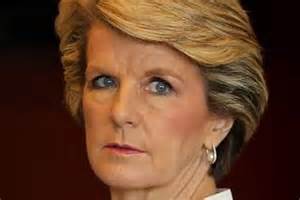
Julie Bishop for PM?

thAFGX3GCV

Mr Pyne: “I think she’s a great role model to everyone, not just women, by the way. I think she’s a great Foreign Minister but we have a fantastic Prime Minister, I want her to be Prime Minister for 10 years and after that people can worry about the next 10 years.

Interviewer: You want her to be Prime Minister for ten years?

Mr Pyne: Tony Abbott. I said we have a great Prime Minister and we want him to be Prime Minister for ten years. I said him.

His official transcript fixed the misspeak, but that minor slip did nothing to deflect attention from Julie Bishop’s growing stature within the Government.

Recent media speculation that Australian Foreign Affairs Minister, Julie Bishop could be our next Prime Minister needs to be beaten down with a cold spoon. Not a chance. Not yet. Not ever. There is little in Bishop’s achievements so far on the world stage and less in her achievements in other spheres that commend her as a potential Prime Minister. In terms of political power, she is a very doubtful starter. Her WA seat means that she is at a disadvantage because the power base of the LNP is located in Sydney and Melbourne. Typically NSW and Victorian MPs determine the leadership because the more populated states hold a higher number of seats in the parliament.

Yet, we should not be too alarmed or surprised at such reports. When it comes to predicting leadership challenges, elements of the Australian media have an insatiable appetite. It’s an absorbing ticket-selling spectacle, in its own right. Primitive, visceral, it can become an all-consuming orgiastic feeding-frenzy, such as occurs between praying mantis and mate. Or between politicians themselves as occurred when in 2013 Abbott’s attack dog Bishop tore into Prime Minister Julia Gillard on the pretext of uncovering the AWU slush fund affair. Make no mistake, it is a blood sport; part of its appeal is the thrill of the kill.

It’s not all morbid, some thoughtful souls see a curious life of its own created in leadership speculation.  Some claim the speculation to be an eager political player in its own right. Whatever the explanation, however, we have come to expect such things as part of who we are. If not the natural corollary to our national obsession with gambling, or our penchant for serial marriage, it fits our psyche. To say nothing of our fractured attention span. No doubt it is also feels healthy if not empowering: our tall poppy syndrome mixes with our mythic egalitarianism in our enjoyment of the ‘swallow the leader’ ritual. Other parts of our complex selves, even paradoxically the parts that venerate the strong leader may also be indulged. Above all there is  the sheer entertainment value of the whole circus with its inherent tendency towards self-parody. At times it resembles Abbot and Costello’s Who’s on First Base?

The lack of suitable leadership contenders does not put us off. We are a flexible, resourceful people. Instead of betting on two flies walking up a wall, other insects will do. So what if one turns out to be a sand groper? (Except of course for the matter of the sand groper’s handicap but we will discuss that later.) And in our media obsession, the calibre of the candidate becomes ever less relevant. Julie Bishop can talked up despite a patchy record. Despite being the wrong person for the job.

Why do we do it? For the media, speculation is easy. It doesn’t require too much research, it seems simple enough for most to follow and it makes for a handy moment in interviews when you have run out of other material. Ask the subject of speculation about the leader’s baton you think you discern in their knapsack.

It may also be that the current crop of contenders have so little going for them as politicians that the only thing real left to focus on is their ambition.  As with Abbott, ambition is Julie Bishop’s strongest suit. Since her days as Head Prefect at St Peter’s Girls in Adelaide, or her days in corporate law, she has been disciplined, diligent and highly successful in getting to the top. As a lawyer she was tough. Determined. Opinions vary as to how successful she was, but her career forged ahead. She seems to have been a tough boss to work for when she rose to lead the firm and not every other step of her ascent saw Bishop distinguish herself by an excess of humanity. Nor did she allow her too many compunctious visitations of nature impede her legal career at CSR.

Bishop’s critics, including Slater and Gordon founder Peter Gordon, allege that lawyers for CSR used their financial power to drag out the cases of dying men to avoid compensation. He told Australian Doctor magazine in 2007:

“We had to fight even for the right of dying cancer victims to get a speedy trial. I recall sitting in the WA Supreme Court in an interlocutory hearing for the test cases involving Wittenoom miners Mr. Peter Heys and Mr. Tim Barrow. CSR was represented by Ms. Julie Bishop (then Julie Gillon). (She) was rhetorically asking the court why workers should be entitled to jump court queues just because they were dying.”

Robert Vojakovic of WA-based Asbestos Diseases Society says Bishop “had a take-no-prisoners approach”.

NSW Labor MP Stephen Jones comments: “You can’t judge anyone by their clients, I suppose. But she had some pretty dodgy ones in my view.”

Bishop, naturally, angrily rejects the accusations, blaming the courts for controlling the pace of proceedings.

“We did everything we could to fight the case professionally – when I say fight it, to test the legal propositions, knowing that the other cases potentially rested on this,” she says.

“Did I stand there and say ‘no, I have a moral objection to working on this case’? Of course not.”

Of course not. Bishop is entering a version of the Nuremburg defence. Whatever its value in the legal field, the defence of just following orders, of having no individual moral autonomy, is in this instance more than unbecoming in an aspirant for politics’ top office. It is, surely, a prima facie disqualification.  Her record of success as a corporate lawyer is unimpeachable. Whether it prepares her to be a Prime Ministers is another question altogether.

Much has been made of Julie Bishop’s success as Foreign Affairs Minister. Some of this praise has been over generous. The record has been patchy. We need not dwell on her provocation of China by intemperate language early in her portfolio. Perhaps as Alexander Downer has said, she has grown into the job. Perhaps also her record of success is enhanced by spin rather than empirical evidence.

Interviewed in March on British radio she made less than compelling defences of Operation Sovereign Borders. Pressed on the treatment of detainees she said:

“… they’re not holiday camps… I have visited there and I am satisfied [that] people are treated appropriately.”

The asylum seeker who had his head broken when an attendant hit him with a piece of wood would no doubt completely agree that he was treated appropriately.

In the course of the interview and elsewhere Bishop has revealed a patchy grasp of her portfolio.

She asserted that the claims of asylum seekers ”are processed in third countries, and then we look for resettlement in other countries, including in Australia – and we’ve done this before and it worked”. It is not true.

Scott Morrison’s official message to boat arrivals is that they will never be resettled in Australia.

The only resettlement option for those on Manus Island whose refugee claims are recognised is resettlement in Papua New Guinea, even though this is a matter of conjecture in PNG. There is, of course, resettlement on Nauru, a ‘solution’ in serious trouble, it would seem from recent reports.

Bishop asserted, ”people are clearly having their applications for asylum processed there [on Manus and Nauru] and if they are found not to be genuine asylum seekers, they are returned [home]”.

The problem here is that no determinations on refugee status have been made – aside from one positive decision on Nauru – and the UN  refugee agency has serious doubts about the capacity of either country to make determinations and give adequate protection to those who have fled persecution.

Perhaps even more disturbing was Bishop’s attempt to defend Australia’s treatment of children:

“Their children go to school, they have community centres … the standard of accommodation and the standard of support they receive, in many instances, is better than that received by the people of Papua New Guinea.” This is not what has emerged at the Australian Human Rights commission’s hearings into the detention of children, Ms Bishop.

Despite being filmed talking to Russian President Vladimir Putin at the Asia-Europe economic summit in Italy  for example, and despite the publication of a claim that she met him for 25 minutes, there appears no formal outcome. The pair discussed MH17, the dangers posed by ISIL and the upcoming G20 summit in Brisbane, in a 25-minute meeting.

Despite having claimed success over having obtained a legal framework towards Abbott’s much-vaunted holy grail of an Iraqi government indemnity for our commandos in Iraq, they are still awaiting a green light. In the light of current political and military realities in Iraq as detailed recently for Fairfax by Paul McGeough, a signed indemnity looks ever more unlikely.

Is Julie Bishop’s gender also a handicap to high office? The short answer is yes. It is highly unlikely that the conservative, male-dominated hard-right power brokers in her own party would ever move to elevate her current status as token female in cabinet. The same doubts they expressed about Julia Gillard, unmarried and with no children would be voiced. It is further unlikely that her party would see her promotion as one which gave them any kind of electoral advantage, especially given the misogynistic treatment meted out to Julia Gillard from parts of the Australian community, whipped up by shock jocks and others in an appalling campaign of persecution.

In the end, however, it comes down to merit, especially job performance and relevant personal skills and qualities. Julie Bishop’s record as Minister for Foreign Affairs does not suggest anything like the level of performance required to merit the spin which is currently propelling her into the prime ministerial stakes. Her record of achievement in other spheres, moreover, in opposition and in corporate law would suggest that Australians be very cautious, indeed, before championing her as a candidate for PM or rushing to conclude that she has any real qualifications to lead us at the top.